OK, I know it sounds self-serving to begin talking about the price of something when we’re in the selling business. But how many times have you bought something because of the low price?
A new book by Ellen Ruppel Shell, called “Cheap: The High Cost of Discount Culture”, examines the price, value and cost of things – all sorts of things. According to the author, a contributing editor for The Atlantic, there is no such thing as cheap, because the cost is being paid for by somebody.
She uses the shrimp industry in Thailand to demonstrate her hypothesis: traditional shrimp farming operations in Thailand were converted into gigantic factories (with the help of international investors). Among the more serious problems created by gigantic shrimp farms is the degradation and loss of natural coastal resources, where vital fish breeding and nursery habitats are being lost to the shrimp farms. Chemicals were used to produce artificial conditions which made the factories productive. (Read more about modern industrial shrimp aquaculture here.) But the shrimp couldn’t flourish in these conditions (i.e., it was not, to use that word again, sustainable) so the shrimp got sick and their ponds became “black holes of pollution and toxic waste. What followed was ruinous debt, environmental degradation, horrifying human rights abuses and violence that left millions destitute”, writes Ruppel Shell.
For many manufacturers, cost cutting is paramount, and many companies compete only on price. Robert Lawrence, the Harvard economist, told Ruppel Shell that we’re not even building better mousetraps anymore – just cheaper ones, which makes innovation almost impossible.
In textiles, that translates to continued use of that cheapest of alternatives: polyester. It’s ubiquitous in the market, and there is no great rush to try to find good alternatives. Third party certification programs, the watch dogs of the industry, are not being promoted by stakeholders, and companies are slow (or reluctant) to certify their fabrics. Please note that there are many certified FIBER products on the market, largely because fiber crops come under many food certification programs since many of the fiber crops are also food (such as cotton and flax, both of which are grown for the seed and used in food products). But the manufacturing of the fabric is largely ignored, and low cost synthetic (often toxic) chemicals are still being used.
There has been lots of press in the U.S. recently about tainted Chinese products ranging from toxic toys to pet food and drywall,[1] but the focus is shifting to the role multinational companies play in demanding ever-lower prices for Chinese products. By demanding ever lower prices for goods, the Chinese suppliers are forced to reduce or ignore environmental safeguards in order to compete. “Prices in the U.S. are artificially low,” says Andy Xie, former chief economist for Morgan Stanley Asia, who now works independently. “You’re not paying the costs of pollution, and that is why China is an environmental catastrophe.” In 2007, the World Bank estimated that in China 760,000 people die every year from pollution – and in 2008, reports were that water pollution in China had gotten worse.[2]
In a chilling premonition to Ruppel Shell’s book, the Wall Street Journal ran an article in August 2007 (for which it’s author, Jane Spencer, won a Pulitzer) about the heavy environmental price that China has paid for the cheap textiles being produced there. (3)
In the textile industry, treating contaminated water costs upwards of about 13 cents a metric ton, so large factories can (and apparently, do) save hundreds of thousands of dollars a year by sending waste water directly to rivers – in violation of China’s water-pollution laws. Jane Spencer cited findings from an investigation into the Fuan Textile mill as an example. Fuan was caught dumping 22,000 tons of contaminated water a day (add that up: for one year that’s 5.3 million tons) into the local river, turning it dark red.
Large US companies who have Chinese textile suppliers (and that includes many household names such as Target, Liz Claiborne, Kohl’s, Calvin Klein, Wal Mart and Nike, among others) often turn a blind eye to what the Chinese are doing to be able to offer ever lower prices – so they can continue to offer the lowest cost products.
One of the easiest ways to cut costs is to slash labor costs. Although a job of any kind is a step up from the grinding rural poverty that many workers come from, these workers have no leverage to demand higher wages or more humane treatment. “We lecture our kids on social responsibility and then buy them toys assembled by destitute child workers on some far-flung foreign shore,” Ruppel Shell writes. “Somehow the Age of Cheap has raised cognitive dissonance to a societal norm.”
War on Want has an ongoing campaign for corporate accountability in the textile sector. They are trying to achieve “proper” regulation of multinational companies by exposing the true human cost of the goods sold so cheaply in stores in the UK. In their 2006 report, Fashion Victims, they present the result of interviews with workers in Bangladesh who make the clothes sold by bargain retailers in the UK such as Primark, Asda and Tesco.
In Fashion Victims, they ask, “how cheap is too cheap” and tell the story of workers who are paid a fraction of a living wage and who must work 80-100 hours per week in countries around the world where jobs are scarce. And sadly, since the 2006 Fashion Victims report, an updated report (click here) shows that conditions have actually gotten even worse.
If you want to help – before you buy any textile product, inquire about how/where it was made. The company selling the product should know the answer ! Support organizations that fight for the rights of workers, such the National Garment Workers’ Federation (NGWF) in Bangladesh and Colectiva de Mujeres Hondurenas (CODEMUH) in Honduras. Also see our post on child labor in the cotton fields, “Happy May Day”, published on May 1, 2009.
And support those companies that are having their goods certified by third parties like Oeko Tex or GOTS. It costs money to have the certification process completed, in addition to the water treatment they must put in place, or any other changes that must be made to be compliant. GOTS has many requirements in the social justice area: no forced or bonded labor, no child labor, fair wages, the ability of workers to do collective bargaining, mandated rest periods, and safe and hygenic working conditions are just some of the requirements under GOTS. Some companies which HAD been certified are choosing to save money by not paying the fees to have the certifications extended when their payments become due. And that puts us all back to square one.
“Bamboo” fabric has taken the world by storm – people love its luxurious softness, smooth hand and gentle drape, and they also seem to love its eco credentials (as touted by those selling the fabric).
It’s easy to tout bamboo (the plant) as eco friendly, because it is a wonderfully beneficial plant and just might be the world’s most sustainable resource: It’s the fastest growing grass and can grow up to a yard or more per day. Growing bamboo improves soil quality and helps rebuild eroded soil. The extensive root system of bamboo holds soil together, prevents soil erosion, and retains water in the watershed. It doesn’t require replanting after harvest because its vast root network continually sprouts new shoots, all the while pulling in sunlight and greenhouse gases while converting them to new growth. All this without the use of tractors or other machinery using petroleum, and without pesticides or fertilizers.
Bamboo (the plant) produces a huge biomass, both above and below ground. One study found bamboo produces 14 tons of wood per acre, as against 8 for loblolly pine[1]; planted in large groves, it can store four times the CO2 as a stand of trees of similar size, and it releases 35% more oxygen.[2] Currently there are no known genetically modified organism (GMO) variants of bamboo.
But though bamboo the plant can be terrifically sustainable and beneficial, bamboo the fabric can raise environmental and health concerns – but like many issues on the green front, the answer is not black and white. Some bamboo fiber can be green and some is not – and some green bamboo fiber can be woven conventionally and dyed with dyestuffs that contain lead, mercury, or other heavy metals, mutagenic chemicals that change our DNA or endocrine disruptors which affect our hormone balance. And the factory using these chemicals probably did not treat their effluent before returning it to our waterways.
The Federal Trade Commission has finally acted to restrict some of the more outrageous claims being made about textiles, bamboo fabric specifically: they have charged four sellers of clothing and other textile products with deceptive labeling and advertising. Their intention is to demonstrate that unsubstantiated green claims in the clothing and other textile related product categories will not be tolerated. And believe me, that’s a GREAT thing, because claims are being made for “green” textiles of every stripe – often stretching the “green” issue to the limit. But to categorically say bamboo fabric is NOT green is to overstep in the opposite direction. There is some naturally retted bamboo (processed like flax or hemp) on the market though it’s still hard to find. The process used to turn bamboo into a fiber which is used almost exclusively today, the viscose process, can also be eco friendly if the manufacturer makes the effort to capture emissions and treat effluent. We have to stop and take the time to evaluate claims.
Let’s give it a go.
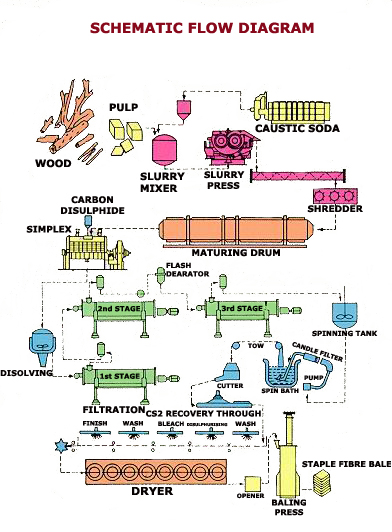
“Rayon” is the generic name for any man-made fiber made from cellulose – man in this case applies a chemical process to transform the cellulose. It’s usually used with cellulose found in very hard and woody plants, such as wood or bamboo, although it can also be made from algae or other types of cellulose. Cellulose is a carbohydrate and the chief component in the walls of plants. There are several chemical and manufacturing techniques to make rayon, but the most common method is the viscose process. In the viscose process, cellulose is treated with caustic soda (aka: sodium hydroxide) and carbon disulfide, converting it into a gold liquid about the color and consistency of honey, called viscose. Viscose is forced through fine holes, called a spinerette, directly into a chemical bath where it hardens into fine strands. When washed and bleached these strands become rayon yarn. Most rayon made today uses this viscose process, which dates to the early 1900s.
Viscose is known as a “regenerated cellulose” fiber – in other words, it is reconstituted from cellulose. Other regenerated cellulosic fibers include lyocell, Tencel®, modal and MicroModal – these are all made from wood. Although the viscose process of making rayon from wood or cotton has been around for a long time, it wasn’t until 2003 that a method was devised for using bamboo for this process.(3)
The reason the viscose process is thought to be detrimental to the environment is based on the process chemicals used. Though sodium hydroxide is routinely used in the processing of organic cotton, and is approved by the Global Organic Textile Standard (GOTS), carbon disulfide can cause nervous system damage with chronic exposure. And that “chemical bath” to harden the threads? Sulfuric acid. These chemicals do not remain as a residue on the fibers – the proof of this is that almost all of the viscose produced can be (and often is) Oeko Tex certified (which certifies that the finished fiber has been tested for any chemicals which may be harmful to a person’s health and contains no trace of these chemicals.)
The problem comes in disposing of these process chemicals: the sodium hydroxide (though not harmful to humans) is nevertheless harmful to the environment if dumped into our rivers as untreated effluent. Same with carbon disulfide and, certainly, sulfuric acid. Oeko Tex certifies only the final product, i.e.,the fibers or the fabric. They do not look at the production process, which can be devastating. The production could be done in a closed loop process, capturing and reclaiming all the chemicals used during manufacture, but this is seldom done.
And then of course there is the weaving of these viscose fibers into fabric – if done conventionally, the environmental burden is devastating (in terms of chemical and water use) and the fabric itself probably contains many chemicals known to be harmful to our health.
What is the FTC saying in their charge of deceptive advertising? The unsubstantiated green claims they take issue with are:
The claim that the products are manufactured using an environmentally friendly process.
As I explained above, the claims may or may not be true. Certainly the standard viscose production process is definitely NOT environmentally friendly, but some manufacturers use new closed loop systems, treat and/or recycle wastewater and capture emissions. Tencel® certainly advertises its environmentally friendly production processes, based on closed loop systems, and a new non-toxic solvent (amine oxide) which, they say, is 99.9% recycled. Tencel® brand takes great pains to differentiate itself from viscose (saying that it is different because it’s based on solvents, but I cannot find what they really mean by this as it seems to me they’re just using different chemicals.) In the lyocell/Tencel process, the wood pulp is dissolved in N-Methylmorpholine N-oxide, then pushed thru spinneets to form individual fibers. Although there is little by-product, the process uses a lot of energy and the solvent used is a by-product of gasoline production.
The claim that these products retain natural antimicrobial properties of the bamboo plant.
There has been little research done on viscose made from bamboo. However, many studies have been done by Lenzing Group, which produces Tencel®. One study sponsored by Lenzing found that “bacterial growth on textiles made from cellulosic fibers as compared to synthetic fibers showed lower bacterial growth”.[4] Of course, many claims assert that bamboo’s “natural antimicrobial properties” are retained by the viscose fibers. However, could it be possible that the exceptional water absorption ability of cellulosic fibers retards bacterial growth, as Tencel® claims?
The claim that they are biodegradable.
Ohio State University’s Consumer and Textile Sciences fact sheet on lyocell says it is “biodegradeable and recyclable”[5] and Tencel® also makes that claim – as seen in many advertisements about products made from this fiber. Is the bamboo viscose not as biodegradeable and/or recyclable as lyocell and Tencel®, both very similar fibers to bamboo viscose? What is the inherent difference that would preclude the degredation of one and not the other?
The FTC says that “bamboo is not a generic fiber”. Their reasoning is that the products are advertised as being made of “bamboo” when they should be saying the products are made of “rayon” or “rayon from bamboo”:
The differences between lyocell, Tencel, modal and viscose gets WAY technical; I think it’s sufficient here to note that they are all known by their fiber or brand names, rather than the cellulose source used in production. For example, rayon is derived from wood pulp – and the kind of wood used can vary from beech, pine, spruce and hemlock to Eucalyptus – it’s not known as “lyocell rayon from beech” or “Tencel rayon from beech trees” as the FTC is requiring for “rayon from bamboo”. MicroModal, another regenerated cellulosic fiber, is even classified as “cotton” for importation by U.S. Customs.(6)
I guess I’m glad they’ve finally drawn a line in the sand. Something is always better than nothing. But I’m disappointed that they’re focusing on the fiber and ignoring the processing, because the processing is both a huge environmental burden (if done conventionally) and potentially very harmful to us and our kids. So why stop with the fiber? The Global Organic Textile Standard (GOTS) addresses these issues. If manufacturers were forced (by the market or by federal regulations) to have third party certifications in place, we’d all be healthier and the ecosystem would have a better chance. Perhaps the FTC could spend some effort spreading the word about GOTS and what exactly a GOTS certified fabric is and why it’s better than a fabric (non certified) made with a GOTS certified – or organic – fiber.
[1]Raver, Ann, “A Cane the World Can Lean On”, New York Times, July 5, 2007
[2] Janssen, Jules A., Technical University Eindhoven, 2000
[3] US patent 7313906 by Xiangqi Zhou, Zheng Liu, Liming Liu and Hao Geng
Last week we talked about the importance of livestock management in the battle against climate change. It came as a real revelation to this city girl that large grazing animals are a vital and necessary part of the solution to climate change. Sheep can actually help to improve soils, which improves the soil’s ability to absorb water and maintain its original nutrient balance – and most importantly, by increasing the organic matter in the soil, it makes the soil a highly effective carbon bank.
So the management of the livestock can be beneficial – but it’s a long way from a sheep in the pasture to a wool fabric. So let’s look at the wool produced by these sheep and examine what “organic wool” means.
In order for wool to be certified organic in the U.S., it must be produced in accordance with federal standards for organic livestock production, which are:
Feed and forage used for the sheep from the last third of gestation must be certified organic.
Synthetic hormones and genetic engineering of the sheep is prohibited.
Use of synthetic pesticides on pastureland is prohibited and the sheep cannot be treated with parasiticides, which can be toxic to both the sheep and the people exposed to them.
Good cultural and management practices of livestock must be used.
A key point to remember about the USDA and OTA organic wool designations: the organic certification extends only to livestock – it doesn’t cover the further processing of the raw wool. Should that be a concern?
Wool as shorn from the sheep is known as greasy (or raw) wool. Before it is suitable for further processing it must be washed to remove dirt, water soluble contaminants (called suint), and woolgrease – and there are a lot of these contaminants. On average, each ton of greasy wool contains:
150 KG woolgrease (when refined this is known as lanolin)
40 KG suint
150 KG dirt
20 KG vegetable matter
640 KG wool fiber
This process of washing the wool is known as scouring. Scouring uses lots of water and energy :
water for washing: The traditional method of wool scouring uses large amounts of water to wash the wool – the wool is passed through a series of 4 – 8 wash tanks (bowls), each followed by a squeeze to remove excess water. Typical scouring plants can consume up to half a million litres of water per day.
pollution: The scouring water uses detergents and other chemicals in order to remove contaminants in the greasy wool, which creates the problem of disposing of the waste water without contaminating the environment. In unmodified plants, a single scouring line produces a pollution load equivalent to the pollution produced by 30,000 people.[1]
energy: to power the scouring line.
What about the chemicals used?
Detergents used in wool scouring include alkylphenol ethoxylates (APEOs) or fatty alcohol ethoxylates (more benign); sodium carbonate (soda ash), sodium chloride and sodium sulphate. APEOs are among those chemicals known as endocrine disruptors – they interfere with the body’s endocrine system They’re known to be very toxic for aquatic life – they cause feminization of male fish, for example. (Click here to see what happened to alligators in Florida’s Lake Apopka as a result of endocrine disruptors traced to effluents from a textile mill. ) More importantly they break down in the environment into other substances which are much more potent than the parent compound. They’re banned in Europe.
The surface of wool fibers are covered by small barbed scales. These are the reason that untreated wool itches when worn next to skin. So the next step is to remove the scales, which also shrinkproofs the wool. Shrinking/descaling is done using a chlorine pretreatment sometimes combined with a thin polymer coating. (Fleece is soaked in tertiary amyl or butyl hypochlorite in solution and heated to 104° for one hour. The wool absorbs 1.5% of the chlorine. [2] ) These treatments make wool fibers smooth and allow them to slide against each other without interlocking. This also makes the wool feel comfortable and not itchy.
Unfortunately, this process results in wastewater with unacceptably high levels of adsorbable organohalogens (AOX) – toxins created when chlorine reacts with available carbon-based compounds. Dioxins, a group of AOX, are one of the most toxic known substances. They can be deadly to humans at levels below 1 part per trillion. Because the wastewater from the wool chlorination process contains chemicals of environmental concern, it is not accepted by water treatment facilities in the United States. Therefore all chlorinated wool is processed in other countries, then imported.[3] (For more about chlorine, go to the nonprofit research group Environmental Working Groups report about chlorine, http://www.ewg.org/reports/considerthesource.) There are new chlorine free shrink/descaling processes coming on the market, but they’re still rare.
Finally, there is the weaving of the yarn into fabric – and all the environmental problems associated with conventional weaving and finishing. In addition to the environmental concerns associated with conventional weaving, dyeing, and finishing (see some of our earlier blog posts), wool is often treated for moth and beetle protection, using pyrethroids, chlorinated sulphonamide derivatives, biphenyl ether or urea derivatives, which cause neutrotoxic effects in humans.
In the last 10 years, the textile industry, along with animal ethics groups like People for the Ethical Treatment of Animals, have lobbied against the wool industry, taking a stand against unethical treatment of sheep. In 2004, U.S. retailer Abercrombie and Fitch became the first to sign on to an animal rights campaign boycott of Australian wool that stood firmly against the typical practices of mulesing (where folds of skin around the sheep’s anus are cut off with shears during the wool shearing) and live export of sheep to halal butchers when their wool production becomes minimal. Other companies such as H&M, Marks & Spencer, Nike, Gap, Timberland, and Adidas (among others) have since joined, sourcing wool from South Africa or South America (where mulesing is not done). The result of this outcry has led to the increased production of both organic and ethical wool, though it is still relatively minor when compared to the overall global wool production.
To complicate things a bit more, each country maintains their own standards for “organic wool” – Australia, for instance, has no equivalence or agreement with US organic standards. The International Wool Textile Organization (IWTO) has adopted a new organic wool standard (closely aligned with GOTS) which they hope will be accepted by its members. In addition, many companies use the term “eco wool”, which means the wool is sheared from free range roaming sheep that have not been subjected to toxic flea dipping, and the fleece was not treated with chemicals, dyes or bleaches – but this is wide open to interpretation and exploitation. According to the IWTO, “Eco wool” must meet the standards set by the EU Eco-label.
Wool is a fabulous fiber – in addition to its many other attributes, it smolders rather than burns, and tends to be self-extinguishing. (Read what The Commonwealth Scientific and Industrial Research Organisation (CISRO), Australia’s national science agency, has to say about the flame resistance of wool by clicking here: http://www.csiro.au/files/files/p9z9.pdf ) So if you can find organic wool – making sure, of course, that the term “organic” covers:
management of the livestock according to organic or holistic management principles
processing of the raw wool, using newer, more benign processes rather than harmful scouring and descaling chemicals; and wastewater treatment from scouring and processing
weaving according to Global Organic Textile Standards (GOTS). Read more about GOTS here.
…then go for it! Nothing is quite like it in terms of comfort, resilience, versatility and durability.
But first you have to find it. And that means you’ll have to ask lots of questions because there are lots of certifications to hide behind.
[1]The Cleanier Production Case Studies Directory EnviroNET Australia, Environment Protection Group, November 1998
[2] “Textiles: Shrink-proof wool”, Time, October 17, 1938
The more I learn about organic farming the more impressed I become with the dynamics of it all. As Fritz Capra has said, we live in an interconnected and self-organizing universe of changing patterns and flowing energy. Everything has an intrinsic pattern which in turn is part of a greater pattern – and all of it is in flux. That sure makes it hard to do an LCA, and it makes for very wobbly footing if somebody takes a stand and defends it against all comers.
For example, I have been under the impression (based on some published LCA’s) that the production of wool is very resource inefficient, largely based on the enormous need for water: it’s generally assumed that 170,000 litres of water is needed to produce 1 KG of wool (versus anywhere from 2000 to 5300 to produce the same amount of cotton). That’s because the livestock graze on land and depend on rainwater for their water – and some LCA’s base the water use on the lifetime of the sheep (reminding me to check the research parameters when referring to published LCA’s).
In addition, industrial agricultural livestock production often results in overgrazing. As we now see in the western United States, overgrazing in extreme cases causes the land to transform from its natural state of fertility to that of a desert. At the very least, it severely limits plant reproduction, which in turn limits the soil’s ability to absorb water and maintain its original nutrient balance, making overgrazing difficult to recover from. And then there’s methane: livestock are often vilified for producing more greenhouse gases than automobiles.
The exciting thing is that what is known as “holistic management” of the soil makes it possible to use animals to improve, rather than degrade, land. What’s consistently ignored in the research is the failure to distinguish between animals raised in confined feedlots and animals grazing on rangeland in a holistic system. Research on holistic land management is, in fact, showing that large grazing animals are a vital and necessary part of the solution to climate change and carbon sequestration. Read about holistic land management on the Holistic Managmeent Institute (HMI) website.
The reason holistic practices work, according to HMI, is that grazing animals and grassland co-evolved. According to the HMI website, hooves and manure accomplish what mechanical tilling and petrochemical fertilizers cannot: healthy, diverse grassland with abundant root systems and improved soil structures that makes highly effective use of existing rainfall. Domestic animals can be managed in ways that mimic nature, called “planned grazing”: rather than allowing animals to linger and eat from the same land repeatedly, animals are concentrated and moved according to a plan which allows the land long periods of rest and recovery. This planned grazing allows the animals to till packed soil with their hooves, distribute fertilizer and seed in their manure and urine, and move from one area to another before they can overgraze any one spot. In fact, the animals help maintain the soil, rather than destroying it, and increase the amount of organic matter in the soil, making it function as a highly effective carbon bank. Properly managed, grazing animals can help us control global climate change: soil carbon increased 1% within a 12 month period in a planned grazing project (a significant increase).
This carbon is essential to not only feeding soil life and pasture productivity, but it also affects water infiltration rates. On one trial site where planned grazing was implemented, within two years, the soil water infiltration rate increased eightfold in comparison to the conventional grazing treatment.
In addition, holistic management of grazing animals eliminates the need for the standard practice of burning crop and forage residues. That burning currently sends carbon directly into the atmosphere. If we convert just 4 million acres of land that’s operating under the traditional, conventional agriculture model to holistically managed land – so the residue is not burned – the carbon is captured rather than released. Look at the difference in erosion in the picture below: compare the severely eroded, conventionally managed riverbank on the left with the Holistically Managed bank on the right. All the shrubbery and grass means abundant root systems and healthy soil infrastructure underground – both of these sequester CO2.
According to Christine Jones, Founder, Australian Soil Carbon Accreditation, “The fabulous thing about sequestering carbon in grasslands is that you can keep on doing it forever – you can keep building soil on soil on soil… perennial grasses can outlive their owners; they’re longer-lived than a lot of trees, so the carbon sequestration is more permanent than it is in trees: the carbon’s not going to re-cycle back into the atmosphere if we maintain that soil management… and there’s no limit to how much soil you can build… for example, we would only have to improve the stored carbon percentage by one percent on the 415 million hectares (1,025,487,333 acres) of agricultural soil in Australia and we could sequester all of the planet’s legacy load of carbon. It’s quite a stunning figure.”
Data from a demonstration project in Washington State is confirming other worldwide research that grazing could be better for the land than growing certain crops in dryland farming regions – it reverses soil decline (erosion and desertification), restores soil health, and instead of losing carbon through tilling or systems requiring inputs (like wheat farming) planned grazing sequesters carbon; biomass to soak up carbon is increased, and the use of fossil fuel has been reduced by more than 90%. Wildlife habitat has improved. The Washington State project even sells carbon credits.
In April of this year, Catholic Relief Service, one of the country’s largest international humanitarian agencies, is launching a worldwide agricultural strategy that adopts a holistic, market oriented approach to help lift millions of people out of poverty. Read more about this here.
The debate over sustainable agriculture has gone beyond the health and environmental benefits that it could bring in place of conventional industrial agriculture. For one thing, conventional industrial agriculture is heavily dependent on oil, which is running out; and it is getting increasingly unproductive as the soil is eroded and depleted. Climate change will force us to adopt sustainable, low input agriculture to ameliorate the worst consequences of conventional agriculture, and to genuinely feed the world.
And climate change is upon us. I’m sitting in Seattle experiencing an “historic heat wave” while reading that the Hadley Center of the British Meteorological Organization has said the world’s temperature will increase by 8.8 degrees F rather than 5.8 degrees F this century.
The Inter-Governmental Panel on Climate Change (IPCC) has said we can expect a considerable increase in heat waves, storms, floods, and the spread of tropical diseases into temperate areas, impacting the health of humans, livestock and crops. It also predicts a rise in sea levels up to 35 inches this century, which will affect something like 30% of the world’s agricultural lands (by seawater intrusion into the soils underlying croplands and by temporary as well as permanent flooding). If the Hadley Center is right, the implications will be even more horrifying: Melting of the Antarctic, the Arctic, and especially the Greenland ice-shields is occurring far more rapidly than was predicted by the IPCC. This will reduce the salinity of the oceans, which in turn weakens (if not diverts) oceanic currents such as the Gulf Stream from their present course . And if that continues, it would eventually freeze up areas that at present have a temperate climate, such as Northern Europe.
According to the Institute of Science in Society, “It is becoming clear that climate change and its different manifestations (as mentioned above) will be the most important constraints on our ability to feed ourselves in the coming decades. We cannot afford to just sit and wait for things to get worse. Instead, we must do everything we can to transform our food production system to help combat global warming and, at the same time, to feed ourselves, in what will almost certainly be far less favorable conditions.”
But before we tackle the question of how best to feed ourselves during these “less favorable” times: how can organic agriculture help with global warming?
It’s generally assumed that various Greenhouse Gases (GHG) are responsible for
global warming and climate change. On a global scale, according to a study commissioned by IFOAM, agriculture has been responsible for approximately 15% of all GHG emissions:
25% of all CO2 emissions come from agriculture
60% of CH4 (methane) emissions come from agriculture
80% of N2O (nitrous oxide) emissions come from agriculture
About 60% of the CO2 emissions from human and animal activities is absorbed by the oceans and plants; the remaining 40% builds up in our atmosphere. So what to do about the 40% that’s building up in our atmosphere? Where can it be stored?
In looking at ways to “defuse” this CO2 build up, scientists began looking at carbon “sinks”. Carbon sinks are natural systems that suck up and store carbon dioxide from the atmosphere. The main natural carbon sinks are plants, the ocean and soil. Plants grab carbon dioxide from the atmosphere to use in photosynthesis; some of this carbon is transferred to soil as plants die and decompose. The oceans are a major carbon storage system for carbon dioxide. Marine animals also take up the gas for photosynthesis, while some carbon dioxide simply dissolves in the seawater.
Initially forests were thought to be the most efficient way to sequester (or absorb) this carbon. It was thought that escalating fossil fuel consumption could be balanced by vast forests breathing in all that CO2. But these sinks, critical in the effort to soak up some of our greenhouse gas emissions, may be maxing out, thanks to deforestation, and human-induced weather changes that are causing the oceanic carbon dioxide “sponge” to weaken.
New data is beginning to show that it may be that the soil itself makes more of a difference (in terms of carbon sequestration) than what’s growing on it. On a global scale, soils hold more than twice as much carbon as does vegetation (1.74 trillion tons for soil vs. 672 billion tons for vegetation) – and more than twice as much as is contained in our atmosphere.
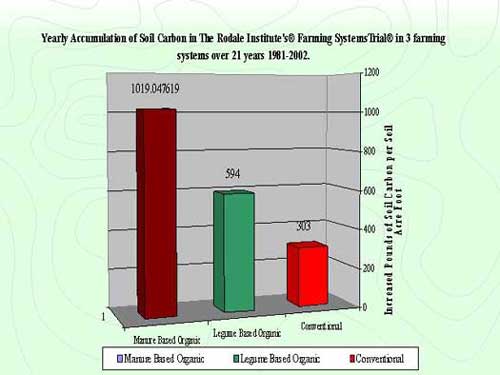
The Rodale Institute Farming Systems Trial (FST), launched in 1981, is a 12 acre side by side experiment comparing three agricultural management systems: one conventional, one legume-based organic and one manure-based organic. In 23 years of continuous recordkeeping, the FST’s two organic systems have shown an increase in soil carbon of 15 – 23%, with virtually no increase in non-organic systems.
This soil carbon data shows that improved global terrestrial stewardship–specifically including regenerative organic agricultural practices–can be the most effective currently available strategy for mitigating CO2 emissions. [2]
But although it is well established that organic farming methods sequester atmospheric carbon, researchers have yet to flesh out the precise mechanisms by which this takes place. One of the keys seems to be in the handling of organic matter – while conventional agriculture typically depletes organic matter, organic farming builds it thru the use of composed animal manures and cover crops. In the FST, soil carbon levels increased more in the manure-based organic system than in the legume-based organic system, presumably because of the incorporation of manures, but the study also showed that soil carbon depends on more than just total carbon additions to the system–cropping system diversity or carbon-to-nitrogen ratios of inputs may have an effect. “We believe that the differences in decay rates [of soil organic matter] have a lot to do with it,” says Hepperly, since “soluble nitrogen fertilizer accelerates decomposition” in the conventional system.
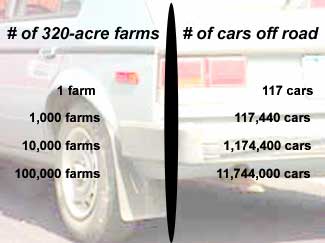
The people at Rodale put the carbon sequestration argument into an equivalency we can all understand: think of it in terms of the number of cars that would be taken off the road each year by farmers converting to organic production. Organic farms sequester as much as 3,670 pounds of carbon per acre-foot each year. A typical passenger car, according to the EPA, emits 10,000 pounds of carbon dioxide a year (traveling an average of 12,500 miles per year). Here’s how many cars farms can take off the road by transitioning to organic:
U.S. agriculture as currently practiced emits a total of 1.5 trillion pounds of CO2 annually into the atmosphere. Converting all U.S. cropland to organic would not only wipe out agriculture’s massive emission problem, but by eliminating energy-costly chemical fertilizers, it would actually give us a net increase in soil carbon of 734 billion pounds.
Organic agriculture is an undervalued and underestimated climate change tool that could be one of the most powerful strategies in the fight against global warming, according to Paul Hepperly, Rodale Institute Research Manager. In addition to emitting fewer GHGs while sequestering carbon, organic agriculture uses less energy for production. A study done by Dr. David Pimentel of Cornell University found that organic farming systems used just 63% of the energy required by conventional farming systems, largely because of the massive amounts of energy requirements needed to synthesize nitrogen fertilizers.
Taking it one step further beyond the energy inputs we’re looking at, which help to mitigate climate change, organic farming:
eliminates the use of synthetic fertilizers, pesticides and genetically modified organisms (GMOs) which is an improvement in human health and agrobiodiversity
conserves water (making the soil more friable so rainwater is absorbed better – lessening irrigation requirements and erosion)
ensures sustained biodiversity
and compared to forests, agricultural soils may be a more secure sink for atmospheric carbon, since they are not vulnerable to logging and wildfire.
Organic production has a strong social element and includes many Fair Trade and ethical production principles. As such it can be seen as more than a set of agricultural practices, but also as a tool for social change.[3] For example, one of the original goals of the organic movement was to create specialty products for small farmers who could receive a premium for their products and thus be able to compete with large commercial farms.
And actually, it seems that modern industrial agriculture is on the way out. The Food and Agriculture Organization of the United Nations (FAO) admitted in 1997 that wheat yields in both Mexico and the USA had shown no increase in 13 years – blamed on the fact that fertilizers are becoming less and less effective, as are pesticides. The farmers are losing the battle. Conventional agrochemical use (which includes many highly toxic substances) also has many immediate human impacts: documented cases of short term illnesses, increased medical costs and the build up of pesticides in human and animal food chains. The chemicals also contaminate the drinking and ground water. And industrial agriculture is far too vulnerable to shortages in the availability of fuel and to increases in the price of oil.
That’s a lot to think about when looking for your next T shirt, so before you plunk down your money for another really cool shirt, think about what you will be getting in exchange.
[1] I should point out that although “sinks” in vegetation and soils have a high
potential to mitigate increases of CO2 in the atmosphere, they are not
sufficient to compensate for heavy inputs from fossil fuel burning. The long-term solution to global warming is simple: reduce our use of fossil fuel, somehow, anyhow!
Yet the contribution from agriculture could buy time during which
alternatives to fossil fuel can take affect – especially if that agricultural system is organic.
Provocative title, isn’t it? But I didn’t say it, the statement comes from Jim Rogers, one of the world’s most successful investors and co-founder of the Quantum Fund (with George Soros) from which he retired in 1980. Since then he has been a college professor, world traveler, author, economic commentator and creator of the Rogers International Commodities Index. And now, Jim Rogers says he’s investing in agriculture.
Jim Rogers is looking at cotton as a commodity (and an investment strategy), based on the fact that almost everything has some dependence on energy prices, based on the embodied energy of the product. He bases his decision on the fact that so many textiles today are made from synthetics – which come from oil. Since the price of oil is going up (and will likely continue to go up) the price of synthetics is also going up. So textile makers are reverting to natural fibers. Cotton is the most popular natural fiber in the world, and the cotton – oil connection is both direct (through the use of synthetic fertilizers and pesticides), and indirect (land formerly used to grow cotton can be shifted to other production to feed ethanol demand). As Jim Rogers says, “I hadn’t thought of this cotton-oil connection before, and it’s drawing these connections before others do that makes a great investor.”
If we are going to “reduce our dependence on foreign oil” (as the government likes to put it), shouldn’t we be looking at agriculture? Dr. Albert Bartlett, Professor Emeritus in Nuclear Physics at Colorado University, Boulder, has said that the definition of “modern agriculture is the use of land to convert petroleum into food”.
I checked the web – and agriculture is really an energy hog. According to the website Food and Water Watch:
20% of the fossil fuel used in the US goes toward food production.
This inefficient system spends 10,551 quadrillion joules of energy each year – about the same as used by all of France.
The US EPA reported that US agriculture is responsible for the same amount of CO2 emissions per year as 141,000,000 cars. Emissions DOUBLE when electricity usage is included.
Kenneth Watt, on the very first Earth Day in 1970, said that our very existence is dependent on the massive import of energy into industrial agriculture from petroleum, natural gas and coal – and this massive energy use creates a “fossil fuel subsidy”: that means the use of petroleum has enabled fewer farmers to produce much more food on less land, so the population can grow.
Petroleum-based agriculture has reduced the proportion of the US population engaged in agriculture from about 50% about 75 years ago to less than 2% today. In other words, the average American farmer feeds lots of people, as well as having enough left over to ship abroad. Petroleum also lets Floridians eat salmon from Alaska, and Alaskans enjoy orange juice from Florida. Between 1950 and 1970, the last 11 million horses were taken out of American agriculture and replaced by tractors powered by crude oil. Since it takes very roughly four times the acreage to support one horse as a person, this means we have been able to add 44 million people to the American population [in those twenty years] for that one cause alone, because of a fossil fuel subsidy.
According to Kenneth Watt, “mankind is embarked on an absolutely immense gamble. We are letting the population build up and up and up, by increasing the carrying capacity of the Earth for people, using a crude-oil energy subsidy, on the assumption that there’s no inherent danger in this because when the need arises we’ll be able to get ultimate sources of energy.”
But what happens if we don’t have alternate sources of energy, when the oil crunch appears? As oil production declines, prices will rise – especially commodities – and most especially food.
So how can organic agriculture help us with this dire picture. You’ll be surprised! Check in next week.
Synthetic fibers are the most popular fibers in the world – it’s estimated that synthetics account for about 65% of world production versus 35% for natural fibers.[1] Most synthetic fibers (approximately 70%) are made from polyester, and the polyester most often used in textiles is polyethylene terephthalate (PET). Used in a fabric, it’s most often referred to as “polyester” or “poly”.
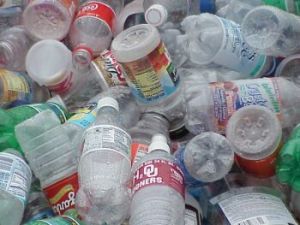
The majority of the world’s PET production – about 60% – is used to make fibers for textiles; about 30% is used to make bottles. It’s estimated that it takes about 104 million barrels of oil for PET production each year – that’s 70 million barrels just to produce the virgin polyester used in fabrics.[2] That means most polyester – 70 million barrels worth – is manufactured specifically to be made into fibers, NOT bottles, as many people think. Of the 30% of PET which is used to make bottles, only a tiny fraction is recycled into fibers. But the idea of using recycled bottles – “diverting waste from landfills” – and turning it into fibers has caught the public’s imagination.
The reason recycled polyester (often written rPET) is considered a green option in textiles today is twofold, and the argument goes like this:
energy needed to make the rPET is less than what was needed to make the virgin polyester in the first place, so we save energy.
And we’re keeping bottles and other plastics out of the landfills.
Let’s look at these arguments.
1) The energy needed to make the rPET is less than what is needed to make the virgin polyester, so we save energy:
It is true that recycling polyester uses less energy that what’s needed to produce virgin polyester. Various studies all agree that it takes from 33% to 53% less energy[3]. If we use the higher estimate, 53%, and take 53% of the total amount of energy needed to make virgin polyester (125 MJ per KG of ton fiber)[4], the amount of energy needed to produce recycled polyester in relation to other fibers is:
Embodied Energy used in production of various fibers:
energy use in MJ per KG of fiber:
hemp, organic
2
flax
10
hemp, conventional
12
cotton, organic, India
12
cotton, organic, USA
14
cotton,conventional
55
wool
63
rPET
66
Viscose
100
Polypropylene
115
Polyester
125
acrylic
175
Nylon
250
rPET is also cited as producing far fewer emissions to the air than does the production of virgin polyester: again estimates vary, but Libolon’s website introducing its new RePET yarn put the estimate at 54.6% fewer CO2 emissions. Apply that percentage to the data from the Stockholm Environment Institute[5], cited above:
KG of CO2 emissions per ton of spun fiber:
crop cultivation
fiber production
TOTAL
polyester USA
0
9.52
9.52
cotton, conventional, USA
4.2
1.7
5.89
rPET
5.19
hemp, conventional
1.9
2.15
4.1
cotton, organic, India
2
1.8
3.75
cotton, organic, USA
0.9
1.45
2.35
Despite the savings of both energy and emissions from the recycling of PET, the fact is that it is still more energy intensive to recycle PET into a fiber than to use organically produced natural fibers – sometimes quite a bit more energy.
2) We’re diverting bottles and other plastics from the landfills.
That’s undeniably true, because if you use bottles then they are diverted!
But the game gets a bit more complicated here because rPET is divided into “post consumer” PET and “post industrial” rPET: post consumer means it comes from bottles; post industrial might be the unused packaging in a manufacturing plant, or other byproducts of manufacturing. The “greenest” option has been touted to be the post consumer PET, and that has driven up demand for used bottles. Indeed, the demand for used bottles, from which recycled polyester fibre is made, is now outstripping supply in some areas and certain cynical suppliers are now buying NEW, unused bottles directly from bottle producing companies to make polyester textile fiber that can be called recycled.[6]
Using true post consumer waste means the bottles have to be cleaned (labels must be removed because labels often contain PVC) and sorted. That’s almost always done in a low labor rate country since only human labor can be used. Add to that the fact that the rate of bottle recycling is rather low – in the United States less than 6% of all waste plastic gets recycled [7]. The low recycling rate doesn’t mean we shouldn’t continue to try, but in the United States where it’s relatively easy to recycle a bottle and the population is relatively well educated in the intricacies of the various resin codes, doesn’t it make you wonder how successful we might be with recycling efforts in other parts of the world?
There are two types of recycling: mechanical and chemical:
Mechanical recycling is accomplished by melting the plastic and re-extruding it to make yarns. However, this can only be done few times before the molecular structure breaks down and makes the yarn suitable only for the landfill[8] where it may never biodegrade, may biodegrade very slowly, or may add harmful materials to the environment as it breaks down (such as antimony). William McDonough calls this “downcycling”.
Chemical recycling means breaking the polymer into its molecular parts and reforming the molecule into a yarn of equal strength and beauty as the original. The technology to separate out the different chemical building blocks (called depolymerization) so they can be reassembled (repolymerization) is very costly and almost nonexistent.
Most recycling is done mechanically (or as noted above, by actual people). Chemical recycling does create a new plastic which is of the same quality as the original, but the process is very expensive and is almost never done, although Teijin has a new program which recycles PET fibers into new PET fibers.
The real problem with making recycled PET a staple of the fiber industry is this: recycling, as most people think of it, is a myth. Most people believe that plastics can be infinitely recycled – creating new products of a value to equal the old bottles or other plastics which they dutifully put into recycling containers to be collected. The cold hard fact is that there is no such thing as recycling plastic, because it is not a closed loop. None of the soda and milk bottles which are collected from your curbside are used to make new soda or milk bottles, because each time the plastic is heated it degenerates, so the subsequent iteration of the polymer is degraded and can’t meet food quality standards for soda and milk bottles. The plastic must be used to make lower quality products. The cycle goes something like this:
virgin PET can be made into soda or milk bottles,
which are collected and recycled into resins
which are appropriate to make into toys, carpet, filler for pillows, CD cases, plastic lumber products, fibers or a million other products. But not new soda or milk bottles.
These second generation plastics can then be recycled a second time into park benches, carpet, speed bumps or other products with very low value.
The cycle is completed when the plastic is no longer stable enough to be used for any product, so it is sent to the landfill
where it is incinerated (sometimes for energy generation, which a good LCA will offset) –
or where it will hold space for many years or maybe become part of the Great Pacific Garbage Patch![9]
And there is another consideration in recycling PET: antimony, which is present in 80 – 85% of all virgin PET[10], is converted to antimony trioxide at high temperatures – such as are necessary during recycling, releasing this carcinogen from the polymer and making it available for intake into living systems.
Using recycled PET for fibers also creates some problems specific to the textile industry:
The base color of the recycled polyester chips vary from white to creamy yellow, making color consistency difficult to achieve, particularly for the pale shades. Some dyers find it hard to get a white, so they’re using chlorine-based bleaches to whiten the base.
Inconsistency of dye uptake makes it difficult to get good batch-to-batch color consistency and this can lead to high levels of re-dyeing, another very high energy process. Re-dyeing contributes to high levels of water, energy and chemical use.
Unsubstantiated reports claim that some recycled yarns take almost 30% more dye to achieve the same depth of shade as equivalent virgin polyesters.[11]
Another consideration is the introduction of PVC into the polymer from bottle labels and wrappers.
Many rPET fibers are used in forgiving constructions such as polar fleece, where the construction of the fabric hides slight yarn variations. For fabrics such as satins, there are concerns over streaks and stripes.
Once the fibers are woven into fabrics, most fabrics are rendered non-recyclable because:
the fabrics almost always have a chemical backing, lamination or other finish,
or they are blends of different synthetics (polyester and nylon, for example).
Either of these renders the fabric unsuitable for the mechanical method of recycling, which cannot separate out the various chemicals in order to produce the recycled yarn; the chemical method could – if we had the money and factories to do it.
One of the biggest obstacles to achieving McDonough’s Cradle-to-Cradle vision lies outside the designers’ ordinary scope of interest – in the recycling system itself. Although bottles, tins and newspapers are now routinely recycled, furniture and carpets still usually end up in landfill or incinerators, even if they have been designed to be recycled [12] because project managers don’t take the time to separate out the various components of a demolition job, nor is collection of these components an easy thing to access.
Currently, the vision that most marketers has led us to believe, that of a closed loop, or cycle, in which the yarns never lose their value and recycle indefinitely is simply that – just a vision. Few manufacturers, such as Designtex (with their line of EL fabrics designed to be used without backings) and Victor Innovatex (who has pioneered EcoIntelligent™ polyester made without antimony), have taken the time, effort and money needed to accelerate the adoption of sustainable practices in the industry so we can one day have synthetic fabrics that are not only recycled, but recyclable.
We just had a spectacularly beautiful July 4th weekend here in Seattle – temperatures were actually above 80, it was sunny and sparkling. It was just too much to post yet another bog about the dire state of our environment. So I was floundering around looking for some great new environmental news to share. I found some interesting stuff on LiveScience (Top 10 crazy environmental ideas) but Lucy Siegle’s list of 20 great ideas in the Observer had one that really got my heart pumping!
The idea in a nutshell: rather than boycott a business – procott instead!
“The problem is that businesses will do anything for money,” says 27-year-old US environmentalist Brent Schulkin. “But what if that’s also the solution?” This idea is not brand new – Diane MacEachern founded The Big Green Purse to empower consumers (especially women) to use their buying clout to protect the environment. But Schulkin’s plan has an added dimension – that of adding the value of organization.
His idea was to encourage profit-hungry companies to do good by promising to spend more money with them. But he wouldn’t be making all the purchases himself; he’d bring a mob.
That was the inspiration for Carrotmob, his loosely organized group of conscious consumers.
According to Schulkin, there’s an old saying that there are two ways to make a donkey walk forward: Either offer a delicious carrot out in front of it, or hit its behind with a stick. Think of businesses as the donkeys. Traditional consumer activism uses a lot of sticks, such as protests, lawsuits, boycotts, and so on. Schulkin’s idea is to use the carrot instead. Schulkin believes that we can get businesses to make big positive changes by offering them profits in return. It’s a positive model where there are no enemies and everyone wins.
To put his idea into practice, Schulkin visited 23 liquor stores in his Mission District neighborhood, and asked each one how much money they’d be willing to set aside for energy efficiency improvements from the profits of Carrotmob’s spending. The bidding started at 10%, and increased slightly until K&D Market offered the winning bid of 23%.
Next experts came in to inspect K&D and to offer suggestions for energy improvements. Using the internet, Schulkin puclicized the event and nervously waited to see if any shoppers would show up.
They did.
With a bouncer at the door to ensure a safe number of people inside the little market, the line stretched to the end of the block. Store staff continuously restocked the shelves with liquor, cereal, organic peanut butter, tuna fish and other canned food. At the end of the day there were two overflowing barrels of donations for the San Francisco Food Bank and market receipts totaling $9,276, several thousands of dollars more than usual.
Schulkin’s idea is that we buy products anyway, so why not from a company that is doing good? Ultimately he wants to create carrotmobs so big that they can negotiate with some of the globe’s biggest corporations.
Although most of the current focus on lightening our carbon footprint revolves around transportation and heating issues, the modest little fabric all around you turns out to be from an industry with a gigantic carbon footprint. The textile industry, according to the U.S. Energy Information Administration, is the 5th largest contributor to CO2 emissions in the United States, after primary metals, nonmetallic mineral products, petroleum and chemicals.[1]
The textile industry is huge, and it is a huge producer of greenhouse gasses. Today’s textile industry is one of the largest sources of greenhouse gasses (GHG’s) on Earth, due to its huge size.[2] In 2008, annual global textile production was estimated at 60 billion kilograms (KG) of fabric. The estimated energy and water needed to produce that amount of fabric boggles the mind:
1,074 billion kWh of electricity or 132 million metric tons of coal and
Fabrics are the elephant in the room. They’re all around us but no one is thinking about them. We simply overlook fabrics, maybe because they are almost always used as a component in a final product that seems rather innocuous: sheets, blankets, sofas, curtains, and of course clothing. Textiles, including clothing, accounted for about one ton of the 19.8 tons of total CO2 emissions produced by each person in the U.S. in 2006. [4] By contrast, a person in Haiti produced a total of only 0.21 tons of total carbon emissions in 2006.[5]
Your textile choices do make a difference, so it’s vitally important to look beyond thread counts, color and abrasion results.
How do you evaluate the carbon footprint in any fabric? Look at the “embodied energy’ in the fabric – that is, all of the energy used at each step of the process needed to create that fabric. To estimate the embodied energy in any fabric it’s necessary to add the energy required in two separate fabric production steps:
(1) Find out what the fabric is made from, because the type of fiber tells you a lot about the energy needed to make the fibers used in the yarn. The carbon footprint of various fibers varies a lot, so start with the energy required to produce the fiber.
(2) Next, add the energy used to weave those yarns into fabric. Once any material becomes a “yarn” or “filament”, the amount of energy and conversion process to weave that yarn into a textile is pretty consistent, whether the yarn is wool, cotton, nylon or polyester.[6]
Let’s look at #1 first: the energy needed to make the fibers and create the yarn. For ease of comparison we’ll divide the fiber types into “natural” (from plants, animals and less commonly, minerals) and “synthetic” (man made).
For natural fibers you must look at field preparation, planting and field operations (mechanized irrigation, weed control, pest control and fertilizers (manure vs. synthetic chemicals)), harvesting and yields. Synthetic fertilizer use is a major component of the high cost of conventional agriculture: making just one ton of nitrogen fertilizer emits nearly 7 tons of CO2 equivalent greenhouse gases.
For synthetics, a crucial fact is that the fibers are made from fossil fuels. Very high amounts of energy are used in extracting the oil from the ground as well as in the production of the polymers.
A study done by the Stockholm Environment Institute on behalf of the BioRegional Development Group concludes that the energy used (and therefore the CO2 emitted) to create 1 ton of spun fiber is much higher for synthetics than for hemp or cotton:
KG of CO2 emissions per ton of spun fiber:
crop cultivation
fiber production
TOTAL
polyester USA
0.00
9.52
9.52
cotton, conventional, USA
4.20
1.70
5.89
hemp, conventional
1.90
2.15
4.10
cotton, organic, India
2.00
1.80
3.75
cotton, organic, USA
0.90
1.45
2.35
The table above only gives results for polyester; other synthetics have more of an impact: acrylic is 30% more energy intensive in its production than polyester [7] and nylon is even higher than that.
Not only is the quantity of GHG emissions of concern regarding synthetics, so too are the kinds of gasses produced during production of synthetic fibers. Nylon, for example, creates emissions of N2O, which is 300 times more damaging than CO2 [8] and which, because of its long life (120 years) can reach the upper atmosphere and deplete the layer of stratospheric ozone, which is an important filter of UV radiation. In fact, during the 1990s, N2O emissions from a single nylon plant in the UK were thought to have a global warming impact equivalent to more than 3% of the UK’s entire CO2 emissions.[9] A study done for the New Zealand Merino Wool Association shows how much less total energy is required for the production of natural fibers than synthetics:
Embodied Energy used in production of various fibers:
Natural fibers, in addition to having a smaller carbon footprint in the production of the spun fiber, have many additional benefits:
being able to be degraded by micro-organisms and composted (improving soil structure); in this way the fixed CO2 in the fiber will be released and the cycle closed. Synthetics do not decompose: in landfills they release heavy metals and other additives into soil and groundwater. Recycling requires costly separation, while incineration produces pollutants – in the case of high density polyethylene, 3 tons of CO2 emissions are produced for ever 1 ton of material burnt.[10] Left in the environment, synthetic fibers contribute, for example, to the estimated 640,000 tons of abandoned fishing nets in the world’s oceans.
sequestering carbon. Sequestering carbon is the process through which CO2 from the atmosphere is absorbed by plants through photosynthesis and stored as carbon in biomass (leaves, stems, branches, roots, etc.) and soils. Jute, for example, absorbs 2.4 tons of carbon per ton of dry fiber.[11]
Substituting organic fibers for conventionally grown fibers is not just a little better – but lots better in all respects: uses less energy for production, emits fewer greenhouse gases and supports organic farming (which has myriad environmental, social and health benefits). A study published by Innovations Agronomiques (2009) found that 43% less GHG are emitted per unit area under organic agriculture than under conventional agriculture.[12] A study done by Dr. David Pimentel of Cornell University found that organic farming systems used just 63% of the energy required by conventional farming systems, largely because of the massive amounts of energy requirements needed to synthesize nitrogen fertilizers. Further it was found in controlled long term trials that organic farming adds between 100-400kg of carbon per hectare to the soil each year, compared to non-organic farming. When this stored carbon is included in the carbon footprint, it reduces the total GHG even further.[13] The key lies in the handling of organic matter (OM): because soil organic matter is primarily carbon, increases in soil OM levels will be directly correlated with carbon sequestration. While conventional farming typically depletes soil OM, organic farming builds it through the use of composted animal manures and cover crops.
Taking it one step further beyond the energy inputs we’re looking at, which help to mitigate climate change, organic farming helps to ensure other environmental and social goals:
eliminates the use of synthetic fertilizers, pesticides and genetically modified organisims (GMOs) which is an improvement in human health and agrobiodiversity
conserves water (making the soil more friable so rainwater is absorbed better – lessening irrigation requirements and erosion)
ensures sustained biodiversity
and compared to forests, agricultural soils may be a more secure sink for atmospheric carbon, since they are not vulnerable to logging and wildfire.
Organic agriculture is an undervalued and underestimated climate change tool that could be one of the most powerful strategies in the fight against global warming, according to Paul Hepperly, Rodale Institute Research Manager. The Rodale Institute Farming Systems Trial (FST) soil carbon data (which covers 30 years) provides convincing evidence that improved global terrestrial stewardship–specifically including regenerative organic agricultural practices–can be the most effective currently available strategy for mitigating CO2 emissions.
At the fiber level it is clear that synthetics have a much bigger footprint than does any natural fiber, including wool or conventionally produced cotton. So in terms of the carbon footprint at the fiber level, any natural fiber beats any synthetic – at this point in time. Best of all is an organic natural fiber.
And next let’s look at #2, the energy needed to weave those yarns into fabric.
There is no dramatic difference in the amount of energy needed to weave fibers into fabric depending on fiber type..[14] The processing is generally the same whether the fiber is nylon, cotton, hemp, wool or polyester: thermal energy required per meter of cloth is 4,500-5,500 Kcal and electrical energy required per meter of cloth is 0.45-0.55 kwh. [15] This translates into huge quantities of fossil fuels – both to create energy directly needed to power the mills, produce heat and steam, and power air conditioners, as well as indirectly to create the many chemicals used in production. In addition, the textile industry has one of the lowest efficiencies in energy utilization because it is largely antiquated.
But there is an additional dimension to consider during processing: environmental pollution. Conventional textile processing is highly polluting:
Up to 2000 chemicals are used in textile processing, many of them known to be harmful to human (and animal) health. Some of these chemicals evaporate, some are dissolved in treatment water which is discharged to our environment, and some are residual in the fabric, to be brought into our homes (where, with use, tiny bits abrade and you ingest or otherwise breathe them in). A whole list of the most commonly used chemicals in fabric production are linked to human health problems that vary from annoying to profound.
The application of these chemicals uses copious amounts of water. In fact, the textile industry is the #1 industrial polluter of fresh water on the planet.[16] These wastewaters are discharged (largely untreated) into our groundwater with a high pH and temperature as well as chemical load.
Concerns in the United States continue to mount about the safety of textiles and apparel products used by U.S. consumers. Philadelphia University has formed a new Institute for Textile and Apparel Product Safety, where they are busy analyzing clothing and textiles for a variety of toxins. Currently, there are few regulatory standards for clothing and textiles in the United States. Many European countries, as well as Japan and Australia, have much stricter restrictions on the use of chemicals in textiles and apparel than does the United States, and these world regulations will certainly impact world production.
There is a bright spot in all of this: an alternative to conventional textile processing does exist. The new Global Organic Textile Standard (GOTS) is a tool for an international common understanding of environmentally friendly production systems and social accountability in the textile sector; it covers the production, processing, manufacturing, packaging, labeling, exportation, importation and distribution of all natural fibers; that means, specifically, for example: use of certified organic fibers, prohibition of all GMOs and their derivatives; and prohibition of a long list of synthetic chemicals (for example: formaldehyde and aromatic solvents are prohibited; dyestuffs must meet strict requirements (such as threshold limits for heavy metals, no AZO colorants or aromatic amines) and PVC cannot be used for packaging).
A fabric which is produced to the GOTS standards is more than just the fabric:
It’s a promise to keep our air and water pure and our soils renewed; it’s a fabric which will not cause harm to you or your descendants. Even though a synthetic fiber cannot be certified to GOTS, the synthetic mill could adopt the same production standards and apply them. So for step #2, the weaving of the fiber into a fabric, the best choice is to buy a GOTS certified fabric or to apply as nearly as possible the GOTS parameters.
At this point in time, given the technology we have now, an organic fiber fabric, processed to GOTS standards, is (without a doubt) the safest, most responsible choice possible in terms of both stewardship of the earth, preserving health and limiting toxicity load to humans and animals, and reducing carbon footprint – and emphasizing rudimentary social justice issues such as no child labor.
And that would be the end of our argument, if it were not for this sad fact: there are no natural fiber fabrics made in the United States which are certified to the Global Organic Textile Standard (GOTS). The industry has, we feel, been flat footed in applying these new GOTS standards. With the specter of the collapse of the U.S. auto industry looming large, it seems that the U.S. textile industry would do well to heed what seems to be the global tide of public opinion that better production methods, certified by third parties, are the way to market fabrics in the 21st Century.
[1] Source: Energy Information Administration, Form EIA:848, “2002 Manufacturing Energy Consumption Survey,” Form EIA-810, “Monthly Refinery Report” (for 2002) and Documentatioin for Emissions of Greenhouse Gases in the United States 2003 (May 2005). http://www.eia.doe.gov/emeu/aer/txt/ptb1204.html
[3] Rupp, Jurg, “Ecology and Economy in Textile Finishing”, Textile World, Nov/Dec 2008
[4] Rose, Coral, “CO2 Comes Out of the Closet”, GreenBiz.com, September 24, 2007
[5] U.S. Energy Information Administration, “International Energy Annual 2006”, posted Dec 8, 2008.
[6] Many discussions of energy used to produce fabrics or final products made from fabrics (such as clothing) take the “use” phase of the article into consideration when evaluating the carbon footprint. The argument goes that laundering the blouse (or whatever) adds considerably to the final energy tally for natural fibers, while synthetics don’t need as much water to wash nor as many launderings. We do not take this component into consideration because
it applies only to clothing; even sheets aren’t washed as often as clothing while upholstery is seldom cleaned.
is biodegradeable detergent used?
Is the washing machine used a new low water machine? Is the water treated by a municipal facility?
Synthetics begin to smell if not treated with antimicrobials, raising the energy score.
Indeed, it’s important to evaluate the sponsors of any published studies, because the studies done which evaluate the energy used to manufacture fabrics are often sponsored by organizations which might have an interest in the outcome. Additionally, the data varies quite a bit so we have adopted the values which seem to be agreed upon by most studies.
[12] Aubert, C. et al., (2009) Organic farming and climate change: major conclusions of the Clermont-Ferrand seminar (2008) [Agriculture biologique et changement climatique : principales conclusions du colloque de Clermont-Ferrand (2008)]. Carrefours de l’Innovation Agronomique 4. Online at <http://www.inra.fr/ciag/revue_innovations_agronomiques/volume_4_janvier_2009>
[13] International Trade Centre UNCTAD/WTO and Research Institute of Organic Agriculture (FiBL); Organic Farming and Climate Change; Geneva: ITC, 2007.
[14] 24th session of the FAO Committee on Commodity Problems IGG on Hard Fibers of the United Nations





 What you see on the right is the result of managed animal impact. Source:

 SOURCE:
  OEcotextiles