OEcotextiles

Indulgent yet responsible fabrics


Since the 1960s, the use of synthetic fibers has increased dramatically,  causing the natural fiber industry to lose much of its market share. In December 2006, the United Nations General Assembly declared 2009 the International Year of Natural Fibres (IYNF); a year-long initiative focused on raising global awareness about natural fibers with specific focus on increasing market demand to help ensure the long-term sustainability for farmers who rely heavily on their production.

International Forum for Cotton Promotion

Since I have recently been ranting about the plastics industry I thought it was time to turn to natural fibers, which have a history of being considered the highest quality fibers, valued for their comfort, soft hand and versatility.  They also carry a certain cachet:  cashmere, silk taffeta and 100% pure Sea Island cotton convey different images than does 100% rayon,  pure polyester or even Ultrasuede, don’t they?  And natural fibers, being a bit of an artisan product, are highly prized especially in light of campaigns by various trade associations to brand its fiber:    “the fabric of our lives” from Cotton, Inc. and merino wool with the pure wool label are two examples. 

Preferences for natural fibers seem to be correlated with income; in one study, people with higher incomes preferred natural fibers by a greater percentage than did those in lower income brackets.   Cotton Incorporated funded a study that demonstrated that  66% of all women with household incomes over $75,000 prefer natural fibers to synthetic.

What are the reasons, according to the United Nations, that make natural fibers so important?  As  the UN website, Discover Natural Fibers says:

  1. Natural fibers are a healthy choice.
    1. Natural fiber textiles absorb perspiration and release it into the air, a process called “wicking” that creates natural ventilation. Because of their more compact molecular structure, synthetic fibers cannot capture air and “breathe” in the same way. That is why a cotton T-shirt is so comfortable to wear on a hot summer’s day, and why polyester and acrylic garments feel hot and clammy under the same conditions. (It also explains why sweat-suits used for weight reduction are made from 100% synthetic material.) The bends, or crimp, in wool fibers trap pockets of air which act as insulators against both cold and heat – Bedouins wear thin wool to keep them cool. Since wool can absorb liquids up to 35% of its own weight, woollen blankets efficiently absorb and disperse the cup of water lost through perspiration during sleep, leaving sheets dry and guaranteeing a much sounder slumber than synthetic blankets.
    2. The “breathability” of natural fiber textiles makes their wearers less prone to skin rashes, itching and allergies often caused by synthetics. Garments, sheets and pillowcases of organic cotton or silk are the best choice for children with sensitive skins or allergies, while hemp fabric has both a high rate of moisture dispersion and natural anti-bacterial properties.   Studies by Poland’s Institute of Natural Fibers have shown that 100% knitted linen is the most hygienic textile for bed sheets – in clinical tests, bedridden aged or ill patients did not develop bedsores. The institute is developing underwear knitted from flax which, it says, is significantly more hygienic than nylon and polyester. Chinese scientists also recommend hemp fiber for household textiles, saying it has a high capacity for absorption of toxic gases.
  2. Natural fibers are a responsible choice.
    1. Natural fibers production, processing and export are vital to the economies of many developing countries and the livelihoods of millions of small-scale farmers and low-wage workers. Today, many of those economies and livelihoods are under threat: the global financial crisis has reduced demand for natural fibers as processors, manufacturers and consumers suspend purchasing decisions or look to cheaper synthetic alternatives.
    2. Almost all natural fibers are produced by agriculture, and the major part is harvested in the developing world.
      1. For example, more than 60% of the world’s cotton is grown in China, India and Pakistan. In Asia, cotton is cultivated mainly by small farmers and its sale provides the primary source of income of some 100 million rural households.
      2. In India and Bangladesh, an estimated 4 million marginal farmers earn their living – and support 20 million dependents – from the cultivation of jute, used in sacks, carpets, rugs and curtains. Competition from synthetic fibers has eroded demand for jute over recent decades and, in the wake of recession, reduced orders from Europe and the Middle East could cut jute exports by 20% in 2009.
      3. Silk is another important industry in Asia. Raising silkworms generates income for some 700 000 farm households in India, while silk processing provide jobs for 20 000 weaving families in Thailand and about 1 million textile workers in China. Orders of Indian silk goods from Europe and the USA are reported to have declined by almost 50% in 2008-09.
      4. Each year, developing countries produce around 500 000 tonnes of coconut fiber – or coir – mainly for export to developed countries for use in rope, nets, brushes, doormats, mattresses and insulation panels. In Sri Lanka, the single largest supplier of brown coir fiber to the world market, coir goods account for 6% of agricultural exports, while 500 000 people are employed in small-scale coir factories in southern India.
      5. Across the globe in Tanzania, government and private industry have been working to revive once-booming demand for sisal fiber, extracted from the sisal agave and used in twine, paper, bricks and reinforced plastic panels in automobiles. Sisal cultivation and processing in Tanzania directly employs 120 000 people and the sisal industry benefits an estimated 2.1 million people. However, the global slowdown has cut demand for sisal, forced a 30% cut in prices, and led to mounting job losses.
  3. Natural fibers are a sustainable choice.
    1. Natural fibers will play a key role in the emerging “green” economy based on energy efficiency, the use of renewable feed stocks in bio-based polymer products, industrial processes that reduce carbon emissions and recyclable materials that minimize waste.  Natural fibers are a renewable resource, par excellence – they have been renewed by nature and human ingenuity for millennia. They are also carbon neutral: they absorb the same amount of carbon dioxide they produce. During processing, they generate mainly organic wastes and leave residues that can be used to generate electricity or make ecological housing material. And, at the end of their life cycle, they are 100% biodegradable.
    2. An FAO study estimated that production of one ton of jute fiber requires just 10% of the energy used for the production of one ton of synthetic fibers (since jute is cultivated mainly by small-scale farmers in traditional farming systems, the main energy input is human labor, not fossil fuels).
    3. Processing of some natural fibers can lead to high levels of water pollutants, but they consist mostly of biodegradable compounds, in contrast to the persistent chemicals, including heavy metals, released in the effluent from synthetic fiber processing. More recent studies have shown that producing one ton of polypropylene – widely used in packaging, containers and cordage – emits into the atmosphere more than 3 ton of carbon dioxide, the main greenhouse gas responsible for global warming. In contrast, jute absorbs as much as 2.4 tonnes of carbon per tonne of dry fiber.
    4. The environmental benefits of natural fiber products accrue well beyond the production phase. For example, fibers such as hemp, flax and sisal are being used increasingly as reinforcing in place of glass fibers in thermoplastic panels in automobiles. Since the fibers are lighter in weight, they reduce fuel consumption and with it carbon dioxide emissions and air pollution.
    5. But where natural fibers really excel is in the disposal stage of their life cycle. Since they absorb water, natural fibers decay through the action of fungi and bacteria. Natural fiber products can be composted to improve soil structure, or incinerated with no emission of pollutants and release of no more carbon than the fibers absorbed during their lifetimes. Synthetics present society with a range of disposal problems. In land fills they release heavy metals and other additives into soil and groundwater. Recycling requires costly separation, while incineration produces pollutants and, in the case of high-density polyethylene, 3 tonnes of carbon dioxide emissions for every tonne of material burnt. Left in the environment, synthetic fibers contribute, for example, to the estimated 640 000 tonnes of abandoned fishing nets and gear in the world’s oceans.
  4. Natural fibers are a high-tech choice.
    1. Natural fibers have intrinsic properties – mechanical strength, low weight and low cost – that have made them particularly attractive to the automobile industry.
      1. In Europe, car makers are using mats made from abaca, flax and hemp in press-molded      thermoplastic panels for door liners, parcel shelves, seat backs, engine shields and headrests.
        1. For consumers, natural fiber composites in automobiles provide better thermal and acoustic insulation than fiberglass, and reduce irritation of the skin and respiratory system. The low density of plant fibers also reduces vehicle weight, which cuts fuel consumption.
        2. For car manufacturers, the moulding process consumes less energy than that of fibreglass and produces less wear and tear on machinery, cutting production costs by up to 30%. The use of natural fibres by Europe’s car industry is projected to reach 100 000 tonnes by 2010. German companies lead the way. Daimler-Chrysler has developed a flax-reinforced polyester composite, and in 2005 produced an award-winning spare wheel well cover that incorporated abaca yarn from the Philippines. Vehicles in some BMW series contain up to 24 kg of flax and sisal.  Released in July 2008, the Lotus Eco Elise (pictured above) features body panels made with hemp, along with sisal carpets and seats upholstered with hemp fabric. Japan’s carmakers, too, are “going green”. In Indonesia, Toyota manufactures door trims made from kenaf and polypropylene, and Mazda is using a bioplastic made with kenaf for car interiors.

    1. Worldwide, the construction industry is moving to natural fibres for a range of products, including light structural walls, insulation materials, floor and wall coverings, and roofing. Among recent innovations are cement blocks reinforced with sisal fibre, now being manufactured in Tanzania and Brazil. In India, a growing shortage of timber for the construction industry has spurred development of composite board made from jute veneer and coir ply – studies show that coir’s high lignin content makes it both stronger and more resistant to rotting than teak. In Europe, hemp hurd and fibres are being used in cement and to make particle boards half the weight of wood-based boards. Geotextiles are another promising new outlet for natural fibre producers. Originally developed in the Netherlands for the construction of dykes, geotextile nets made from hard natural fibres strengthen earthworks and encourage the growth of plants and trees, which provide further reinforcement. Unlike plastic textiles used for the same purpose, natural fibre nets – particularly those made from coir – decay over time as the earthworks stabilize.
  1. Natural fibers are a fashionable choice.

    John Patrick Organic Fall/Winter 2010

    1. Natural fibers are at the heart of a fashion movement that goes by various names: sustainable, green, uncycled, ethical, eco-, even eco-environmental. It focuses fashion on concern for the environment, the well-being of fiber producers and consumers, and the conditions of workers in the textile industry. Young designers now offer “100% carbon neutral” collections that strive for sustainability at every stage of their garments’ life cycle – from production, processing and packaging to transportation, retailing and ultimate disposal. Preferred raw materials include age-old fibres such as flax and hemp, which can be grown without agrochemicals and produce garments that are durable, recyclable and biodegradable. Fashion collections also feature organic wool, produced by sheep that have not been exposed to pesticide dips, and “cruelty-free” wild silk, which is harvested – unlike most silk – after the moths have left their cocoons.
    2. The Global Organic Textile Standard (GOTS)   sets strict standards on chemicals permitted in processing, on waste water treatment, packaging material and technical quality parameters, on factory working conditions and on residue testing.
    3. Sustainable fashion intersects with the “fair trade” movement, which offers producers in developing countries higher prices for their natural fibres and promotes social and environmental standards in fibre processing. Fair trade fashion pioneers are working with organic cotton producers’ cooperatives in Mali, hand-weavers groups in Bangladesh and Nepal, and alpaca producers in Peru. A major UK chain store launched in 2007 a fair trade range of clothing that uses cotton “ethically sourced” from farmers in the Gujarat region of India. It has since sold almost 5 million garments and doubled sales in the first six months of 2008.
    4. Another dimension of sustainable fashion is concern for the working conditions of employees in textile and garment factories, which are often associated with long working hours, exposure to hazardous chemicals used in bleaching and dyeing, and the scourge of child labor. The recently approved (November 2008) Global Organic Textile Standard, widely accepted by manufacturers, retailers and brand dealers, includes a series of “minimum social criteria” for textile processing, including a prohibition on the use of child labor, workers’ freedom of association and right to collective bargaining, safe and hygienic working conditions, and “living wages”.

For the next few weeks I’ll talk about various fiber types, starting with my favorite, hemp.
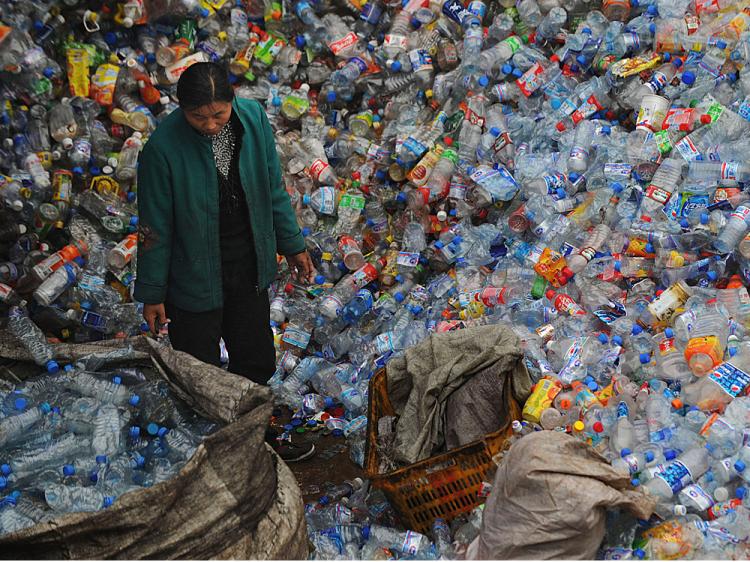
I’ve been ranting about plastics for the past three weeks, and you might be wondering why, especially since we’re in the fabric business.

Well, the chance is that most of the fabrics you buy are either 100% synthetic (polyester, acrylic, nylon, etc.) or they’re blended with natural fibers – such as the very popular cotton/polyester blends.  Synthetic fabrics account for the lion’s share of the global textile market, and most of the rest of the market is scooped up by cotton.  Most synthetic fabrics are made of polyester, or polyethelene terephthalate (PET)  – the same stuff used as containers for soda and water.  Of the total virgin PET produced globally,   60%  is used to make fibers, while 30% goes into bottle production.

As I explained in a previous blog,  the textile industry has adopted recycled polyester as the fiber of choice to promote its green agenda.  As one company puts it, “It’s one of the most earth-friendly fabric ingredients in the world.”  Another company says of its recycled polyester fabrics that “after years of enjoyable use, these fabrics are recyclable.”

What I want to do is expose these statements (and others like them) for what they are:  self-serving attempts to convince the public that a choice of a recycled polyester fabric is actually a good eco choice – when the reality is that this is another case of expediency and greed over any authentic attempts to find a sustainable solution.  My biggest complaint with the industry’s position is that there is no attempt made to address the question of water treatment or of chemical use during dyeing and processing of the fibers.

So let’s look at the reasons why the textile industry wants us to think that recycled polyester fabric is a “green” choice:

  • It saves energy – the industry itself says using recycled polyester saves between 30 – 50% of the energy needed to produce virgin polyester.
    • Yes, but:    even if we give them the benefit of the doubt and assume energy savings of 50%, the embodied energy needed to produce that recycled polyester yarn is STILL higher than the embodied energy needed to produce any natural fiber – and is  about 6 times higher than using organic fibers.
    • And you overlook the emissions!  Recycling a 16 oz. PET bottle generates toxic emissions of nickel, ethyl oxide and benzene; it creates more than 100 times the toxic emissions of an equivalent size glass bottle.
    • And let’s not forget the chemical components of the feedstock: Among the  chemicals used in the production of PET are antimony oxide, a suspected carcinogen,  lead oxide and lead chromate. Lead is extremely toxic and is listed as a hazardous waste. PET may also include cadmium compounds which are a suspected human carcinogen and have been found to cause birth defects in laboratory animals. It is also listed as a hazardous waste and can cause extreme reactions in workers that inhale as little as 1/1000 of an ounce during production. Ethylene Oxide is another carcinogen used in the production of PET.  The components of acrylic and PVC are even more scary.
    • And finally, what about the byproducts of the recycling process – the wastewater and sludge?  Often polyester proponents will tell you that the production of polyester fiber uses very little water – and that’s true.  But those fibers, as yarns, are subjected to the same process treatments to weave them into fabric as their natural fiber cousins.  So the chemical cocktail created by the weaving mill’s wastewater and sludge is just as potent whether we’re talking about cotton or recycled polyester.
  • It diverts bottles from the landfill.
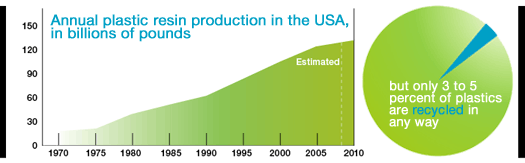
    • I’ve spent weeks writing about why this is misleading  – because there can be no doubt that if a bottle is turned into fiber then it is diverted from the landfill. (Please see our blog posts on this subject – you can read them here and here.)  The reality is that recycling seems to only encourage more plastic use – the veneer of environmentalism encourages more plastic use, and business as usual:  plastic use has increased by a factor of 30 since the 1960s, while recycling has only increased by a factor of 2.
  • It implies that the fabric you buy can be recycled.
    • Almost guaranteed it won’t happen – beside the fact that there is no collection infrastructure, and most things are not designed for disassembly,  the blended yarns, coupled with backings of a different polymer, means that most fabrics couldn’t be recycled even if they were disassembled and collected.
    • You can make fibers from bottles, but you can’t make bottles from fibers.  Or other fabrics.  (To understand why, see our blog post Plastics Part 1, or  Issues with using recycled polyester) So this recycled PET fabric (IF it is 100% polyester and IF it is un-backed with a different polymer and IF somebody separated the fabric from the piece of furniture it came in on)  is destined for maybe one more use (as a park bench, speed bump or plastic lumber) before it eventually ends up in the landfill – where those process chemicals discussed above slowly leach into our groundwater.

What the textile industry does not tell us is that polyester – even recycled polyester – is extremely cheap.  The fabric you buy may not be cheap, but you’ve heard of margins, right?  Polyester is ubiquitous in the market and there is no great rush to find good alternatives. Third party certification programs, the watch dogs of the industry, are not being promoted by stakeholders, and companies are slow (or reluctant) to certify their fabrics.  Please note that there are many certified FIBER products on the market, largely because fiber crops come under many food certification programs since these fiber crops are also food (such as cotton and flax, both of which are grown for the seed and used in food products for both animals and humans).  The manufacturing of the fabric is largely ignored, so low cost synthetic (often toxic) chemicals are still being used and water and sludge is still being released untreated into our environment.

And there are also issues with using recycled polyester, specific to the textile industry, which increases energy and chemical use:

  • The base color of the recyled chips varies from white to creamy yellow.  This makes it difficult to get consistent dyelots, especially for pale shades.
  • In order to get a consistently white base, some dyers use chlorine-based bleaches.
  • Dye uptake can be inconsistent, so the dyer would need to re-dye the batch.  There are high levels of redyeing, leading to increased energy use.
  • PVC is often used in PET labels and wrappers and adhesives.  If the wrappers and labels from the bottles used in the post consumer chips had not been properly removed and washed, PVC may be introduced into the polymer.
  • Some fabrics are forgiving in terms of appearance and lend themselves to variability in yarns,  such as fleece and carpets; fine gauge plain fabrics are much more difficult to achieve.

Not all fabrics made of recycled polyester is made from bottles.  Most of it is made from industrial scrap, which is called “post industrial” polyester – if it were made from bottles it would be called “post consumer” polyester.  There is no difference, chemically, from post consumer or post industrial polyester.  Polyester is polyester.  Once it’s all melted together there is no way to tell what percentage is made from what source.

So when you buy a fabric that claims it’s made of 100% post consumer polyester – how do you know that the fibers are 100% post consumer?  Indeed, how do you know the fibers are even recycled?   Unless you have access to the supply chain, there is no way to tell what constitutes the polymer.  There is no system of traceability for polyesters as there is for organically labeled products.  Even the Global Recycling Standard just certifies that the polymers are recycled material rather than virgin – but not whether post consumer or post industrial.

In summary, the textile industry wants us to use more synthetic fabrics because they’re cheap and easily available.  I’m not categorically against the use of synthetics.   For one thing, natural fibers cannot by themselves meet total textile demand.   They have many attributes which make them preferable for certain situations – one that comes immediately to mind is healthcare, where the launderability of the fabric is very important.  But nobody is pointing out that even if synthetics are preferable in healthcare, the way those fabrics were produced can vary from toxic to benign:  dyestuffs and finishes can be used which have been tested to avoid chemicals which give us cancer, birth defects or change our genetic profile, and water treatment can prevent those same chemicals from entering our groundwater.

But there is no effort being made by the industry to find new alternatives  – certainly there are research institutions looking into the problem but very little industry supported research.  And we need alternatives, because even if it does take less energy to recycle  polyester than to create new polyester and even if recycling reduces the amount of oil needed to fill synthetic demand, less bad  ≠  good.

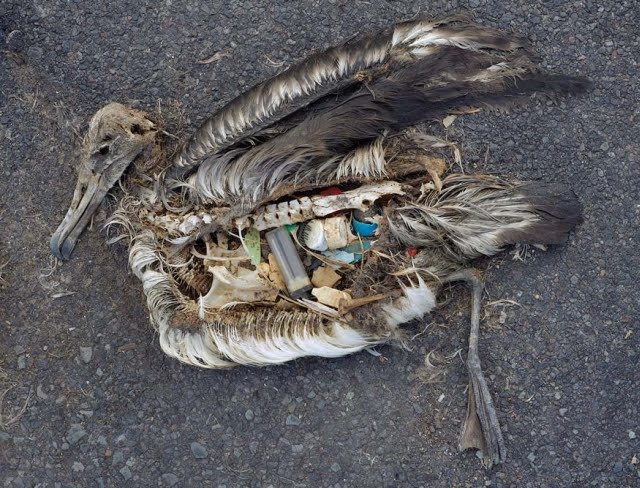
I was going to go on to other subjects, but just saw in the Seattle Times that the whale that washed up on a West Seattle beach last month was discovered to have 3.2 lbs. of garbage in its belly – including 20 plastic bags and 37 other  kinds of plastic (read entire article here.)

If you’ve been reading my posts for the past two weeks (On 5.5.10 and 4.28.10), it has hopefully dawned on you that we have a dilemma with regard to plastic:   Recycling presents problems, yet not recycling hardly seems an option.  Whether you see plastic as a boon or a bane, plastic is the fastest-growing portion of our waste stream and now makes up the second-largest category by volume (next to paper) of trash going into our landfills, according to a draft report prepared for the California Integrated Waste Management Board called the “Plastics White Paper.”

Eco Nature Care did a post on plastic recycling, and highlighted many of the reasons recycling isn’t catching on in this country.  I’ve copied the post below (and you can read it here):

Plastics make up 17.8 % by volume  of what’s thrown into California landfills. While consumers are increasingly snapping those Evian bottles off the shelves, they toss the empties into the trash bin more often than the recycling bin. The recycling rate for plastic bottles is only 16 percent — miserably low compared to glass and aluminum — even though consumers can redeem their used plastic bottles for the same CRV (California Refund Value) rate as other containers.

California cities and counties have an incentive to recycle as much material as possible. A 1989 law requires that municipalities reduce the trash they send to landfills by 50%  or face hefty fines.

Diversion, then, becomes the magic word. But from the point of view of recyclers, accepting some types of plastic is more trouble than it’s worth. For example, plastics coded 3 through 7 — cottage cheese, tofu, salsa and yogurt containers — are particularly difficult to recycle profitably. So why take these additional containers at all, especially when their volume is low? According to Mark Loughmiller, executive director of the Arcata Community Recycling Center, the answer is public pressure.

“I fought it. There are no domestic markets for it. At a point you get tired of being harangued by people coming in trying to quote unquote “do the right thing.’”  They don’t want to throw anything away, he said, and that’s all well and good. But a more appropriate position might be, “I shouldn’t buy it in the first place,” he suggested.

The plastics trail

The plastics collected at the Arcata sites are baled and stored for about a month until they fill a 12-ton truckload, Loughmiller said. The truck typically contains 5 tons of milk bottles (the number 2s), 7 tons of soda and water bottles (the number 1s), and about three-quarters of a ton of the so-called “mixed plastics,” the 3s through 7s, which are baled together.

They then make their way to Ming’s Recycling in Sacramento (which also takes all of the plastics from Humboldt Sanitation in McKinleyville). Kenny Luong, president of Ming’s, said his center has 40 or 50 suppliers in California and another 30 to 40 elsewhere in the United States and Canada. Almost all of the plastics that come into Ming’s are sold to brokers in Hong Kong, who pay to transport it via container ship from the Port of Oakland to China. The transport is cheap because China exports far more to the United States than we do to them; the ships traveling back to China have plenty of room.

The mixed plastics don’t make Luong very much money, he said, which explains why the cities of Arcata and Eureka get nothing for their mixed plastic bales. (A ton of milk jugs, by contrast, pays about $200; a ton of soda bottles, $160.)

“It’s enough to cover the transport to the harbor, that’s pretty much it,” Luong said of the mixed plastics. He would prefer not to take those at all. But a change to state law in 2000 expanded the list of beverages included in the California Redemption Value program. And if the bottle has a “CRV” on it — even if it’s a number 3 or 4 plastic — a certified recycling center must accept it and pay the refund to the consumer.

“It’s really a pain in the butt,” Luong said. “There aren’t a whole lot, but we are required to purchase them by law. It prompted us to find a market for it.”

That market, it turns out, consists of recyclers in Shanghai and Guangdong province. Luong said he has never seen the China facilities and knows little about them. “Once it’s loaded on the ship, it’s out of my hands.”

Recycling in Guangdong

One of his brokers has visited some of the locations in China where plastics from Humboldt end up. Doug Spitzer is the owner of Monarch Enterprises of Santa Cruz, which is affiliated with the gargantuan paper company Boise Cascade. He sells plastics to Chinese recyclers and ran a plastic film-recycling factory himself outside of Guangdong in the early 1990s.

“Most of our material goes through Hong Kong into that closest province [to Hong Kong], which is Guangdong,” Spitzer said. One factory will typically limit itself to one type of plastic, and one village might have most of its residents involved in that type of recycling, he said.

“Within this one town outside of Guangzhou [in Guangdong province], when I was there, my partners were telling me there were at least 3,000 plastic film processors there, and they’re right next door to each other. It’s a small village; they all process it.” The facilities range from a mom-and-pop operation that takes one container-load per month to very large, comparatively modern factories.

One Spitzer saw when he visited four years ago involved soda bottles: The workers would break open the bales, women would sort the bottles by color, a “guy with a machete” cut the tops off, two other men scraped labels off, then the bottles were ground into pellets and melted down. 

It was not the kind of place that would be approved by the U.S. Occupational Safety and Health Administration, Spitzer said.

“OSHA would go nuts. The place is noisy, it’s crowded, it’s just amazing. Not that they’re killing people off. They’re safe, and all the time we were running the factory there were no major accidents,” he said. “Do people engage in unsafe practices to try to make a living? Yeah, all over the world.”

He said his current business provides a valuable service. “What I’m doing is I’m supplying a raw material that can go to a Third World country.”

There are some facilities in the United States that recycle soda bottles and milk jugs “if the material is clean enough,” said Luong of Ming’s Recycling. But the market for recycled plastic makes it difficult, if not impossible, for recyclers to make any money. The reasons are many. Since plastic is made from petroleum, virgin plastic makers have a large supply of raw material available to them. When manufacturers can buy virgin plastic pellets or flakes for about the same amount of money as recycled plastic, there is little incentive to use recycled (the italics are mine!).

There are also limits to the products that can be made from recycled plastic. The U.S. Food and Drug Administration does not allow food containers to be made into new food containers because they can’t be heated at temperatures high enough to sterilize them. (The FDA has said it will allow a layer of recycled plastic sandwiched between layers of virgin plastic in soda bottles.)

A numbers game

Plastic recyclers must also face the issue of contamination. Recycling the number 1 (PET) plastics — the soda bottles — could work economically were it not for the number 3s that enter the mix, said Peter Anderson, a recycling consultant in Madison, Wis., who has worked with state and federal agencies, including the U.S. Environmental Protection Agency and the state of California. Number 3 plastics are polyvinyl chloride, or PVC for short.

“PVC presents enormous problems because it looks just like PET physically,” Anderson said. “A single bottle of PVC will contaminate the entire [10,000-bottle] load” aesthetically, causing the new PET bottles made with the material to be yellowed or, with more contamination, to have black streaks, he said. There are X-ray scanning machines that can detect the PVC intruders, but those are too expensive for many recyclers.

“You can’t make plastics recycling work with PVC in the mix,” Anderson said. So, he argued, taking the 3 through 7 plastics makes no economic sense. “Who the hell knows what China’s doing with them? I don’t think anyone can make a case without a smirk on their face that they’re recycling 3 through 7s.”

He called the idea of recycling all plastics “a serious mistake.”

Some recyclers take the 3 through 7 plastics because, they reason, they’ll get more of the “good stuff” — the soda bottles and milk bottles — if they advertise that they accept a wider range of recyclables. Eel River Disposal in Fortuna, for example, accepts numbers 1, 2 and 3, which they send to Smurfit Recycling in Oakland.

Eel River owner Harry Hardin said he doesn’t collect enough of the number 3s to make a separate bale with it, so he bales it with the number 2s. “I even put some 4s in there,” he said.

Asked about the PVC contamination problem, Hardin said, “It depends what market you send it into. Smurfit’s — I’m not quite sure what they do with theirs. But they will allow some number 3 and 2 together.”

Not so, said Don Kurtz, plant manager for Smurfit in Oakland. “If we identify that there are 3s in there, we reject the bale,” he said. Eel River was recently told to come and get one of their bales that was turned away for that very reason. “We really don’t want number 3s. It really doesn’t make sense for us to mess with it.” (Unlike Ming’s, Smurfit is not legally bound to take any particular recyclables because the company is classified as a “processor,” not a recycling facility.)

Another Humboldt County recycler sells his material to a middleman in a different part of the state. The man, who did not want to be identified, said he does not collect enough 3 through 7 numbered plastics to bale them separately, so he mixes them with the bales for the numbers 1 and 2. “Don’t advertise that,” he said. “It’s garbage plastic, but a lot of people like to recycle it.” His company then sells it to a broker who sends it overseas.

“If they’re putting it in with the PET [number 1s], I guarantee they’re getting thrown out,” said the broker, Patty Moore of the Sonoma-based Moore Recycling Associates.

Destination landfill

All in all, plastic recycling appears to fall far short of its promise. Even if recycled under the best of conditions, a plastic bottle or margarine tub will probably have only one additional life. Since it can’t be made into another food container, your Snapple bottle will become a “durable good,” such as carpet or fiberfill for a jacket. Your milk bottle will become a plastic toy or the outer casing on a cell phone. Those things, in turn, will eventually be thrown away.

“With plastics recycling, we’re just extending the life of a material. We’re not creating a perpetual loop for that material,” like we do with glass and aluminum recycling, said Loughmiller, the Arcata recycling director.

“I think people really need to have a reality check on plastics,” said Puckett of the Basel Action Network. “The mantra has been, `divert from the landfill.’ What we’ve been saying is, divert to what? Dump it on the Chinese? Plastics recycling needs to be looked at with a jaundiced eye,” he said. “It’s not what it’s touted to be.”

If you’ve ever looked on the bottom of your plastic juice bottle,  detergent bottle or tofu tub, you’ve seen the little triangle of arrows with a number inside. That symbol — contrary to popular belief — does not indicate that a container is recyclable.

Back in 1988, “the trade groups managed to get into law the resin [type of plastic] identification,” said Mark Loughmiller, executive director of the Arcata Community Recycling Center. The numbers indicate which category of plastic the container is made from.

“The triangled arrows imply recyclability,” Loughmiller said. “The plastic industry denied it was trying to mislead the public and cause confusion.” But that’s what happened, he said. People regularly come to his center and demand to know why their plastic lawn chair with a number on the bottom can’t be recycled.

And why can’t it? Because, even in one category, such as plastics labeled with a number 2 (high density polyethylene or HDPE), there are many variations. Milk jugs and yogurt containers, for example, may both be made with HDPE, but because the recycling process requires melting of the old containers, and they melt at different temperatures, they may be incompatible.

In Plastics, Part 1 (last week’s post; click here to read it) I tried to give a summary of why plastics are not such a good thing.  The Plastic Pollution coalition has a list of basic concepts about plastic.  Click here to read the expanded version:

  • Plastic is forever
  • Plastic is poisoning our food chain
  • Plastic affects human health
  • Recycling is not a sustainable solution

Yet there seems to be no end to our demand for plastics.   In one year alone, from 1995 – 96, plastic packaging increased by 1,000,000,000 lbs.  And despite recycling efforts, for every 1 ton increase in plastic recycling, there was a 14 ton increase in new plastic production.

I tried to explain some of the roadblocks to plastic recycling efforts.   We have all heard that recycling is good for the environment,  and it’s hard to argue with the intuitively correct reasoning that if we recycle we reduce our dependence on foreign oil, we conserve energy and emissions and we keep bottles out of the landfills.

And what about the lighter weight of plastic bottles?  Surely there are benefits in shipping lighter weight bottles  – giving plastic bottles a lower overall carbon footprint?  Well, here’s the thing:  there are environmental trade offs, just like in life.  Even if we accept that plastics are more carbon efficient than alternative materials (glass) in transportation, we’re still talking about vast amounts of carbon emissions.  Plastics use releases at least 100 million tons of CO2 – some say as much as 500 million tons – into the atmosphere each year.  That’s the equivalent of the annual emissions from 10 – 45% of all U.S. drivers.  Plastic manufacturing also contributes 14% of the national total of toxic (i.e., other than CO2) releases to our atmosphere; producing a 16 oz PET bottle generates more than 100 times the amount of toxic emissions than does making the same size in glass.  But the critical point is that it’s definitely cheaper to ship liquids in plastic rather than in glass.  And it’s also cheaper for manufacturers to use virgin plastic than a recycled plastic.

These rather alarming CO2 numbers could be much lower, we understand, if only Americans recycled more than the paltry 7% of plastic which is recycled today.  We could cut our usage of virgin material by one third – and that means an annual savings of 30 to 150 million tons of CO2.

So why aren’t Americans recycling more?  Although our plastic consumption has grown by a factor of 30 since the 1960s, recycling has grown by a factor of just two.  Is this just because we don’t take the time to separate recyclable plastics from general waste, or because we don’t take the time to throw the bottle into the proper recycling bin?  What about companies that use the plastic – they are not clamoring to spend more to use recycled plastic (again that bugaboo “cost”) so they continue to demand virgin plastic.

When Rhode Island enacted comprehensive recycling legislation in 1986, including bans on plastic bottles – the plastic industry responded by introducing their resin codes, in part (some say) to deflect attention from the virgin polyester production and encourage an environmental spin on the plastics.  The plastics industry’s  “chasing arrows” symbol surrounding a number (those resin codes) were “deliberately misleading” according to Daniel Knapp, director of Berkeley’s Urban Ore.  “The plastics industry has wrought intentional confusion with that symbol”, said Bill Sheehan, director of GrassRoots Recycling Network.  Unlike glass and aluminum, plastic has no system for recycling – no infrastructure to sell it, no markets to buy it, no facilities to make it.  “In short, the arrows led nowhere.”(1)

According to many, these codes just gave plastic an environmental patina, which the industry was quick to use.  “Several states have postponed or backed off from restrictive packaging legislation as a result of the voluntary coding system” – this gleeful statement from a 1988 newsletter of the Council on Plastics and Packaging in the Environment.

The industry’s critics say that it won’t do anything to support recycling.  Mel Weiss, an independent plastics broker, sees the industry focused on PR and not at all interested in recycling.  He says:  “the American Plastics Council (APC), a trade group representing virgin-resin producers, won’t do anything to support recycling. If they had a choice between selling one pound of virgin and 22 tons of recycled, they’d sell the virgin. All they’re doing is masking what they’re doing with an expensive ad campaign.”

Here’s the irony:  it was the veneer of recyclability – cultivated by the plastics industry – that led to this explosion of plastic use.

The plastics industry, spearheaded by the American Plastics Council (APC), has sponsored campaigns to convince the public that recycling is easy, economical and a big success.  They are a “responsible choice in a more environmentally conscious world”, according to the APC.  Between November 1992 and July 1993, the APC spent $18 million in a national advertising campaign to “Take Another Look at Plastics.” (Environmental Defense Fund, October 21, 1997, “Something to hide: The sorry state of plastics recycling.”)  Examples of how plastics “leave a lighter footprint on the planet” include the argument that plastic grocery bags are lighter and create less waste by volume than paper sacks, the industry said. And the fact that plastics are so lightweight and durable enables manufacturers to use less energy and generate less waste in production processes, plastic promoters said.

In addition to the American Plastics Council, the American Chemical Council (ACC) also spends millions to defend the chemicals produced by their members to make plastics. – including lobbying against any bills that would add a few cents to each bag or bottle to encourage returns and recycling efforts.    According to Lisa Kaas Boyle, Board Member of Heal the Bay, the ACC has hired the same advisors who defended the tobacco industry to formulate a strategy to promote and defend the petrochemical industry.  That strategy is based on preventing legislation to curtail single use plastics  (SUPs – i.e., soda bottles etc.) and to generate positive press on the promotion of recycling as the solution to plastic pollution.  This approach makes the industry look environmental while continuing with business as usual.

Because most manufacturers don’t take back their products, there’s often little opportunity to sell collected plastic. It is true that the West Coast  is blessed with domestic and overseas markets that have made recycling of #1 and #2 plastics – soda bottles and milk jugs – somewhat easier. But even here, metals and paper are the real money-makers.

“Plastics is the least profitable part of the business,” said Kevin McCarthy, regional recycling manager at Waste Management Inc.,  “and it may not even be fair to say that it is profitable at all.”

Like McCarthy’s operation, many recyclers will collect plastic only to meet contractual requirements from government agencies. The impetus to collect certain types of plastic comes from residents. But these plastics often have no market for reuse. Recyclers call it “junk plastic,”  – stuff that gets collected only “because residents wanted it collected because they watched the commercials on TV extolling the recyclability of plastic,” said one recycling official who insisted on anonymity.

In Europe, plastic recycling rates hover around 16.5%, largely because there are strict regulations from Europe’s “End of Life Directive”, in which manufacturers must take more responsibility for the processing of waste from their products.  In the U.S., efforts come largely from voluntary programs within companies, such as Wal Mart’s campaign to reduce the size of packages and increase their use of recycled materials.   The  U.S. government is highly unlikely to enact recycling legislation.  We in Seattle  voted last summer on a citizen sponsored plastic bag tax (we called it a fee)  of $0.20 per disposable bag coupled with a ban on Styrofoam.  The American Chemistry Council spent more than $1.4 million to defeat the bill – and they succeeded.

One aspect of recycling which is little known to consumers is the fact that almost all of the plastics we recycle, regardless of type, end up in China, where worker safety standards are virtually nonexistent and materials are sorted and processed under dirty, primitive conditions. The economics surrounding plastic recycling — unlike those for glass and aluminum — make it a dubious venture for U.S. companies.

(1)  Dan Rademacher, “Manufacturing a Myth: The plastics recycling ploy”, Terrain Magazine, Winter 1999

Plastics – part 1

O Ecotextiles (and Two Sisters Ecotextiles)

Philosopher George Carlin once said,   “Man is only here to give the planet something it didn’t have:   Plastic.”

And man has done well:  plastic is ubiquitous in our world today and the numbers are growing.   We produce 20 times more plastic today than we did 50 years ago.

The production and use of plastics has a range of environmental impacts. Plastics production requires significant quantities of resources:  it uses land and water, but the primary resource is fossil fuels, both as a raw material and to deliver energy for the manufacturing process. It is estimated that 8% of the world’s annual oil production is used as either feedstock or energy for production of plastics.

Plastics production also involves the use of potentially harmful chemicals, which include cadmium, lead, PVC, and other pollutants which are added as stabilizers, plasticizers or colorants. Many of these have not undergone environmental risk assessment and their impact on human health and the environment is currently uncertain.  Finally, plastics manufacture  produces waste and emissions. In the U.S., fourteen percent of airborne toxic emissions come from plastics production.  The average plastics plant can discharge as much as 500 gallons of  wastewater per minute – water contaminated with process chemicals.  (The overall environmental impact varies according to the type of plastic and the production method employed.)

Every second, 200 plastic bottles made of virgin, non-renewable resources are land-filled – and every hour another 2.5 million bottles are thrown away.  And though I can’t get a definitive answer about whether the plastics decompose (because although they don’t biodegrade they do photodegrade – when exposed to UV radiation, over time they break down into smaller and smaller bits, leaching their chemical components), most sources, if they do accept that plastic can degrade, admit that nobody knows how long it really takes because most plastics have only been around for 50 years or so  –  but estimates range into the thousands of years.   (To read how scientists make estimates for plastic decomposition rates, click here. )

How do we cope with this plastic onslaught?

Recycling is the most widely recognized concept in solid waste management – and the environmental benefits of recycling plastic are touted elsewhere.  I’ll just give you the highlights here:

  • It reduces the amount of garbage we send to landfills:  Although plastic accounts for only 8% of the waste by weight, they occupy about 20% of the volume in a landfill due to their low bulk density.
  • It conserves energy:  recycling 1 pound of PET conserves 12,000 BTUs of heat energy; and the production of recycled PET uses 1/3 less energy than is needed to produce virgin PET.
  • It reduces greenhouse gas emissions.
  • It helps conserve natural resources.

But it should be remembered that some items are much better candidates for recycling than others.  Aluminum recycling, for example, uses 95% less energy than producing aluminum from bauxite ore, and aluminum cans can be recycled into new aluminum cans.  There is no limit to the amount of times an aluminum container can be recycled. The PET bottle, which is used for everything from water to wine,  was patented in 1973 – that’s only 27 years ago!  Prior to that most bottles were of glass.  Glass, like aluminum,  is infinitely recyclable.  As late as 1947, virtually 100% of all beverage bottles were returnable; and states with bottle deposit laws have 35 – 40% less litter by volume.  I found this image while looking for Earth Day anniversary images, and think it’s a great example of how corporations will slant anything to their purposes.  (Please note that the company in question is Coca Cola – I’ll have a lot to say about Coke’s recycling efforts in 2010 in upcoming blog posts):

There are different costs and benefits for other recyclable items: plastic, paper, electronics, motor oil… They each have their own individual problems.

With reference to the textile industry, 60% of all the virgin polyethelene terephthalate (PET) produced globally is used to make fibers, while only 30% goes into bottle production.  As I explained in a previous blog,  the textile industry has adopted recycled polyester as the fiber of choice to promote its green agenda.   What I want to do is expose this choice for what it is: a self-serving attempt to convince the public that a choice of a recycled polyester fabric is actually a good eco choice – when the reality is that this is another case of expediency and greed over any authentic attempts to find a sustainable solution.  My biggest complaint with the industry’s position is that there is no attempt made to address the question of water treatment or of chemical use during dyeing and processing of the fibers.

So to begin, let’s look at what plastic recycling means, since there are many misconceptions about recycling plastic – especially plastic bottles from which (some) recycled polyester yarns are made.

In 1970, at the time of the first Earth Day, Gary Anderson won a contest sponsored by Container Corporation of America to present a design which symbolizes the recycling process.  His winning design  was a three-chasing-arrows Mobius loop, with the arrows twisting and turning among themselves.   Because of the symbol’s simplicity and clarity it became widely used worldwide and is a symbol now recognized  by almost everyone.  Today almost all plastic containers have the “chasing arrows” symbol.  We’re bombarded with that symbol – any manufacturer worth his salt slaps it on their products.

But the symbol itself is meaningless.  This symbol is not a government mandated code, and does not imply any particular type or amount of recycled content.  Many people think that the “chasing arrows” symbol means the plastic can be recycled – and that too is untrue.

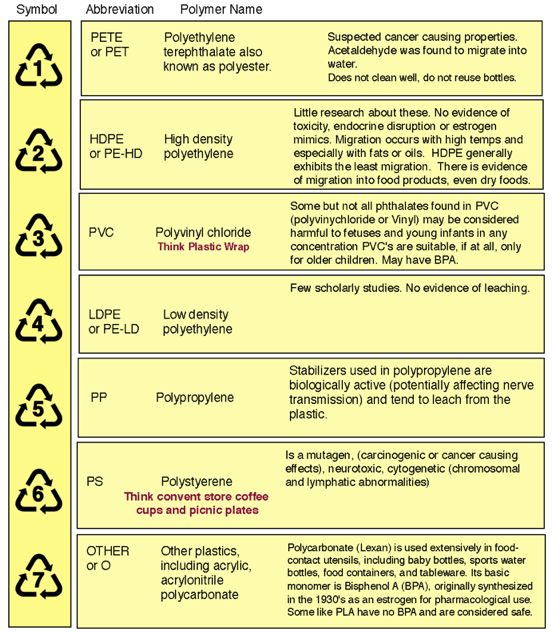
The only useful information in the “chasing arrows” symbol is the number inside the arrows, which indicates the general class of resin used to make the container. There are thousands of types of plastic used for consumer packaging today. In 1988, the Society of the Plastics Industry devised a numbering system  to aid in sorting plastics for recycling, because in order to be recycled,  each plastic container must be separated by type before it can be used again to make a new product. Of the seven types, only two kinds, polyethelene terephthalate (PET), known as #1, and High Density Polyethelyne (HDPE) – or #2 –  are typically collected and reprocessed.   Some of these resins are not yet recyclable at all (such as #6 or 7), or they’re recyclable only rarely.

In addition, a resin code might indeed indicate #1 (PET) for example, but depending on the use (yogurt cup vs. soda bottle) it will contain different dyes, plasticizers, UV inhibitors, softeners, or other chemicals.
This mix of additives changes the properties of the plastic, so not all #1 resins can be melted together – further complicating the process.  Here’s a list of the seven resin codes and some of the concerns associated with each:

Consumers see the symbol and  – thinking it means the plastic can be recycled – drop bottles into recycling bins, feeling they’ve “done their part” and that the used bottle is now part of the infinite loop, becoming a new and valued product.  But does the bottle actually get “recycled”, returning to a high value product, staying out of the garbage dump?

Well, uh, . . .  not really.  Collecting plastic containers in a recycling bin fosters the belief that, like aluminum and glass, the recovered material is converted into new containers.  In fact, none of the recovered plastic containers are being made into containers again, but rather into new secondary products, like textiles, parking lot bumpers, or plastic lumber – all unrecyclable products.  “Recycled’ in this case merely means “collected.”

A bottle can become a fabric, but a fabric can’t become a bottle – or even another fabric, but we’ll get to that later.  There are far too few exceptions to this rule.

Plastic has what’s called a “heat history”: each time it gets recycled the polymer chains break down, weakening the plastic and making it less suitable for high end use.  PET degrades after about 5 melt cycles.  This phenomenon, known in the industry as “cascading” or “downcycling,” has a troubling consequence.    It means that all plastic – including the tiny proportion that finds its way into another bottle – “will eventually end up in the landfill,” said Jerry Powell, editor of Plastics Recycling Update.

The technology exists to recycle most kinds of plastic, but a lack of infrastructure prevents all but the most widespread kinds of plastic from being recycled.  Collection is expensive because plastic bottles are light yet bulky, making it hard to efficiently gather significant amounts of matching plastic.  For recycling to work, communities must be able to cost effectively collect and sort plastic, and businesses must be willing to accept the material for processing. So no matter whether a particular plastic is in a form which allows it to be melted and reused, something is only recyclable if there is a company out there who is willing to use it to make a new product. If there is no one who will accept the material and make a new product out of it, then it is not recyclable.

Only a few kinds of plastic have the supply and market conditions that make recycling feasible. With plastics in particular, how the plastic particles are put together (molded or extruded) changes their chemical make up and make them non recyclable in certain applications. Some bottles make it to a recycler, who must scramble to find a buyer.  The recycler  often ends up selling the bottles at a loss to an entrepreneur who makes carpeting or traffic strips – anything but new bottles.

Recycling reduces the ecological impact of plastic, but it remains more complicated, more expensive and less effective than other parts of the recycling industry. No matter how many chasing arrows are printed on plastic products, it doesn’t change the fact that plastic is largely a throwaway material.

Next week:   what is the plastic industry doing to create a stronger recycling market for its product?

Happy 40th, Earth Day!

O Ecotextiles (and Two Sisters Ecotextiles)

I remember the spring of 1970 vividly, but not  because of the first Earth Day.  I remember that  Richard Nixon was president,  Simon & Garfunkle’s  “Bridge over Troubled Waters” was playing on the radio and the Flip Wilson Show was on TV.   The academy award for best movie went to “Patton”.  (Actually I had to look that up.)  I was in college  –  and it was spring, for heaven’s sake!

I remember thinking that these Earth Day folks should get a grip:  political turmoil had sent the country reeling and students across the country were up in arms about the draft, civil rights and other issues.   Protests against the escalation in Vietnam had reached a fevered pitch–demonstrations had reached hundreds of college campuses. Violence peaked during an antiwar protest at Ohio’s Kent State University in May 1970, when National Guard troops gunned down four student protesters.

But many people had been paying attention to some of the more obvious signs of our careless treatment of our environment:   Pollution from cars and industry had led to several fatal smog events, including a 1965 episode that killed 80 New Yorkers. Scientists told us that Lake Erie was dying and that the other Great Lakes were threatened by pollution from the steel plants, oil refineries, paper mills, and city sewage plants which for the previous one hundred years had befouled the world’s largest fresh water system.  In January 1969, a massive oil spill near Santa Barbara blackened 30 miles of California’s coastline.   For eleven days, 200,000 gallons of crude oil spilled into the channel from a disabled oil rig. In the aftermath, 3600 birds were dead along with ten seals and dolphins and countless fish and marine invertebrates.  Then in June, 1969,  Cleveland’s Cuyahoga River, a dump for steel mills and other industries, had burst into flames – one of many “river fires” caused by oil and chemical pollution.   (This was not the first time the Cuyahoga had caught fire.)  Time magazine reported on the event:

Some River! Chocolate-brown, oily, bubbling with subsurface gases, it oozes rather than flows. “Anyone who falls into the Cuyahoga does not drown,”  Cleveland’s citizens joke grimly,  “he decays”. . . The Federal Water Pollution Control Administration dryly notes: “The lower Cuyahoga has no visible signs of life, not even low forms such as leeches and sludge worms that usually thrive on wastes.” It is also — literally — a fire hazard.

Five months before Earth Day, on Sunday, November 30, 1969, The New York Times carried a lengthy article by Gladwin Hill reporting on the astonishing proliferation of environmental events:

“Rising concern about the environmental crisis is sweeping the nation’s campuses with an intensity that may be on its way to eclipsing student discontent over the war in Vietnam…a national day of observance of environmental problems…is being planned for next spring…when a nationwide environmental ‘teach-in’…coordinated from the office of Senator Gaylord Nelson is planned….”

On April 22, 1970, some 20 million people across the country rallied to protest the state of the planet.  This first Earth Day was, as American Heritage Magazine said, “one of the most remarkable happenings in the history of democracy.”  Earth Day was a spontaneous response  at the grassroots level  which spurred Congress to create America’s core environmental protection laws, and continues to be a day of celebration and activism worldwide.

Much has been achieved.  Because of Earth Day,  Congress passed basic legislation designed to preserve our environment, including the foundation of the Environmental Protection Agency.   Efforts to clean up air, land, and water have yielded all of us inestimable benefits and will continue to do so.   But 40 years later there is still much to be done.  Why is it that – even though many agree that ignoring the needs of our ecosystem puts us in mortal peril – we continue to bicker like school kids about who is responsible rather than putting our great minds to solving this  problem facing mankind?   I think David Suzuki expressed it very well:   “We’re in a giant car heading toward a brick wall and everyone’s arguing over where they’re going to sit.”

Curtis White, writing an article entitled “The Idols of Environmentalism” in the March/April 2007 issue of Orion magazine, presents a thought provoking explanation of why we seem to be in this predicament.  I found his article to be inspired and inspiring, and I’ve copied it here:

ENVIRONMENTAL DESTRUCTION proceeds apace in spite of all the warnings, the good science, the 501(c)3 organizations with their memberships in the millions, the poll results, and the martyrs perched high in the branches of sequoias or shot dead in the Amazon. This is so not because of a power, a strength out there that we must resist. It is because we are weak and fearful. Only a weak and fearful society could invest so much desperate energy in protecting activities that are the equivalent of suicide.

For instance, trading carbon emission credits and creating markets in greenhouse gases as a means of controlling global warming is not a way of saying we’re so confident in the strength of the free market system that we can even trust it to fix the problems it creates. No, it’s a way of saying that we are so frightened by the prospect of stepping outside of the market system on which we depend for our national wealth, our jobs, and our sense of normalcy that we will let the logic of that system try to correct its own excesses even when we know we’re just kidding ourselves. This delusional strategy is embedded in the Kyoto agreement, which is little more than a complex scheme to create a giant international market in pollution. Even Kyoto, of which we speak longingly—“Oh, if only we would join it!”—is not an answer to our problem but a capitulation to it, so concerned is it to protect what it calls “economic growth and development.” Kyoto is just a form of whistling past the graveyard. And it is not just international corporations who do this whistling; we all have our own little stake in the world capitalism has made and so we all do the whistling.

The problem for even the best-intentioned environmental activism is that it imagines that it can confront a problem external to itself. Confront the bulldozers. Confront the chainsaws. Confront Monsanto. Fight the power. What the environmental movement is not very good at is acknowledging that something in the very fabric of our daily life is deeply anti-nature as well as anti-human. It inhabits not just bad-guy CEOs at Monsanto and Weyerhaeuser but nearly every working American, environmentalists included.

It is true that there are CEO-types, few in number, who are indifferent to everything except money, who are cruel and greedy, and so the North Atlantic gets stripped of cod and any number of other species taken incidentally in what is the factory trawler’s wet version of a scorched-earth policy. Or some junk bond maven buys up a section of old-growth redwoods and “harvests” it without hesitation when his fund is in sudden need of “liquidity.” Nevertheless, all that we perceive to be the destructiveness of corporate culture in relation to nature is not the consequence of its power, or its capacity for dominating nature (“taming,” as it was once put, as if what we were dealing with was the lion act at the circus). Believing in powerful corporate evildoers as the primary source of our problems forces us to think in cartoons.

Besides, corporations are really powerless to be anything other than what they are. I suspect that, far from being perverse merchants of greed hellbent on destruction, these corporate entities are as bewildered as we are. Capitalism—especially in its corporate incarnation—has a logos, a way of reasoning. Capitalism is in the position of the notorious scorpion who persuades the fox to ferry him across a river, arguing that he won’t sting the fox because it wouldn’t be in his interest to do so, since he’d drown along with the fox. But when in spite of this logic he stings the fox anyway, all he can offer in explanation is “I did it because it is in my nature.” In the same way, it’s not as if businessmen perversely seek to destroy their own world. They have vacation homes in the Rockies or New England and enjoy walks in the forest, too. They simply have other priorities which are to them a duty.

THE IDEA THAT WE HAVE powerful corporate villains to thank for the sorry state of the natural world is what Francis Bacon called an “idol of the tribe.” According to Bacon, an idol is a truth based on insufficient evidence but maintained by constant affirmation within the tribe of believers. In spite of this insufficiency, idols do not fall easily or often. Tribes are capable of exerting will based on principles, but they are capable only with the greatest difficulty of willing the destruction of their own principles. It’s as if they feel that it is better to stagger from frustration to frustration than to return honestly to the question, does what we believe actually make sense? The idea of fallen idols always suggests tragic disillusionment, but this is in fact a good thing. If they don’t fall, there is no hope for discovering the real problems and the best and truest response to them. All environmentalists understand that the global crisis we are experiencing requires urgent action, but not everyone understands that if our activism is driven by idols we can exhaust ourselves with effort while having very little effect on the crisis. Most frighteningly, it is even possible that our efforts can sustain the crisis. The question the environmental tribe must ask is, do our mistaken assumptions actually cause us to conspire against our own interests?

The belief that corporate power is the unique source of our problems is not the only idol we are subject to. There is an idol even in the language we use to account for our problems. Our primary dependence on the scientific language of “environment,” “ecology,” “diversity,” “habitat,” and “ecosystem” is a way of acknowledging the superiority of the very kind of rationality that serves not only the Sierra Club but corporate capitalism as well. For instance:

“You can pump this many tons of greenhouse gases into the atmosphere without disturbing the major climatic systems.”

“This much contiguous habitat is necessary to sustain a population allowing for a survivable gene pool for this species.”

“We’ll keep a list, a running tally of endangered species (as we’ll call these animals), and we’ll monitor their numbers, and when that number hits a specified threshold we’ll say they are ‘healthy,’ or we’ll say they are ‘extinct.’ All this is to be done by bureaucratic fiat.”

I am not speaking here of all the notorious problems associated with proving scientifically the significance of environmental destruction. My concern is with the wisdom of using as our primary weapon the rhetoric and logic of the very entities we suspect of causing our problems in the first place. Perhaps we support legalistic responses to problems, with all their technoscientific descriptors, out of a sense that this is the best we can do for the moment. But the danger is always that eventually we come to believe this language and its mindset ourselves. This mindset is generally called “quantitative reasoning,” and it is second nature to Anglo-Americans. Corporate execs are perfectly comfortable with it, and corporate philanthropists give their dough to environmental organizations that speak it. Unfortunately, it also has the consequence of turning environmentalists into quislings, collaborators, and virtuous practitioners of a cost-benefit logic figured in songbirds.

It is because we have accepted this rationalist logos as the only legitimate means of debate that we are willing to think that what we need is a balance between the requirements of human economies and the “needs” of the natural world. It’s as if we were negotiating a trade agreement with the animals and trees unlucky enough to have to share space with us. What do you need? we ask them. What are your minimum requirements? We need to know the minimum because we’re not likely to leave you more than that. We’re going to consume any “excess.” And then it occurs to us to add, unless of course you taste good. There is always room for an animal that tastes good.

We use our most basic vocabulary, words like “ecosystem,” with a complete innocence, as if we couldn’t imagine that there might be something perilous in it. What if such language were actually the announcement of the defeat of what we claim to want? That’s the worm at the heart of the rose of the “ecologist.” It is something that environmentalism has never come to terms with because the very advocates for environmental health are most comfortable with the logic of science, never mind what else that logic may be doing for the military and industry. Would people and foundations be as willing to send contributions to The Nature Conservancy or the Sierra Club if the leading logic of the organization were not “ecosystems” but “respect for life” or “reverence for creation”? Such notions are, for many of us, compromised by associations with the Catholic Church and evangelicalism, and they don’t loosen the purse strings of philanthropy. “Let’s keep a nice, clean scientific edge between us and religion,” we protest. In the end, environmental science criticizes not only corporate destructiveness but (as it has always done) more spiritual notions of nature as well.

Environmentalism seems to conclude that the best thing it can do for nature is make a case for it, as if it were always making a summative argument before a jury with the backing of the best science. Good children of the Enlightenment, we keep expecting Reason to prevail (and in a perverse and destructive way, it does prevail). It is the language of “system” (nature as a kind of complicated machine) that allows most of us to feel comfortable with working for or giving money to environmental organizations. We even seem to think that the natural system should work in consort with our economic system. Why, we argue, that rainforest might contain the cure for cancer. By which we also mean that it could provide profitable products for the pharmaceutical industry and local economies. (God help the doomed indigenous culture once the West decides that it has an economy that needs assistance.) Al Gore’s An Inconvenient Truth may have distressing things to say about global warming, but subconsciously it is an extended apology for scientific rationality, the free market, and our utterly corrupted democracy. Gore doesn’t have to defend these things directly; he merely has to pretend that nothing else exists. Even the awe of Immanuel Kant’s famous “starry skies above” is lost to modern environmentalism, so obsessed is it with what data, graphs, and a good PowerPoint presentation can show.

In short, there would be nothing inappropriate or undesirable were we to understand our relation to nature in spiritual terms or poetic terms or, with Emerson and Thoreau, in good old American transcendental terms, but there is no broadly shared language in which to do this. So we are forced to resort to what is in fact a lower common denominator: the languages of science and bureaucracy. These languages have broad legitimacy in our culture, a legitimacy they possess largely because of the thoroughness with which they discredited Christian religious discourse in the eighteenth and nineteenth centuries. But many babies went out with the bath water of Christian dogma and superstition. One of those was morality. Even now, science can’t say why we ought not to harm the environment except to say that we shouldn’t be self-destructive. Another of these lost spiritual children was our very relation as human beings to the mystery of Being as such. As the philosopher G. W. Leibniz famously wondered, “Why is there something rather than nothing?” For St. Thomas Aquinas, this was the fundamental religious question. In the place of a relation to the world that was founded on this mystery, we have a relation that is objective and data driven. We no longer have a forest; we have “board feet.” We no longer have a landscape, a world that is our own; we have “valuable natural resources.” Even avowed Christians have been slow to recall this spiritualized relationship to the world. For example, only recently have American evangelicals begun thinking of the environment in terms of what they call “creation care.” We don’t have to be born again to agree with evangelicals that one of the most powerful arguments missing from the environmentalist’s case is reverence for what simply is. One of the heroes of Goethe’s Faust was a character called Care (Sorge), who showed to Faust the unscrupulousness of his actions and led him to salvation. Environmentalism has made a Faustian pact with quantitative reasoning; science has given it power but it cannot provide deliverance. If environmentalism truly wishes, as it claims, to want to “save” something—the planet, a species, itself—it needs to rediscover a common language of Care.

THE LESSONS OF OUR IDOLS come to this: you cannot defeat something that you imagine to be an external threat to you when it is in fact internal to you, when its life is your life. And even if it were external to you, you cannot defeat an enemy by thinking in the terms it chooses, and by doing only those things that not only don’t harm it but with which it is perfectly comfortable. The truth is, our idols are actually a great convenience to us. It is convenient that we can imagine a power beyond us because that means we don’t have to spend much time examining our own lives. And it is very convenient that we can hand the hard work of resistance over to scientists, our designated national problem solvers.

We cannot march forth, confront, and definitively defeat the Monsantos of the world, especially not with science (which, it should go without saying, Monsanto has plenty of). We can, however, look at ourselves and see all of the ways that we conspire against what we imagine to be our own most urgent interests. Perhaps the most powerful way in which we conspire against ourselves is the simple fact that we have jobs. We are willingly part of a world designed for the convenience of what Shakespeare called “the visible God”: money. When I say we have jobs, I mean that we find in them our home, our sense of being grounded in the world, grounded in a vast social and economic order. It is a spectacularly complex, even breathtaking, order, and it has two enormous and related problems. First, it seems to be largely responsible for the destruction of the natural world. Second, it has the strong tendency to reduce the human beings inhabiting it to two functions, working and consuming. It tends to hollow us out. It creates a hole in our sense of ourselves and of this country, and it leaves us with few alternatives but to try to fill that hole with money and the things money buys. We are not free to dismiss money because we fear that we’d disappear, we’d be nothing at all without it. Money is, in the words of Buddhist writer David Loy, “the flight from emptiness that makes life empty.”

Needless to say, many people with environmental sympathies will easily agree with what I’ve just said and imagine that in fact they do what they can to resist work and consumption, to resist the world as arranged for the convenience of money. But here again I suspect we are kidding ourselves. Rather than taking the risk of challenging the roles money and work play in all of our lives by actually taking the responsibility for reordering our lives, the most prominent strategy of environmentalists seems to be to “give back” to nature through the bequests, the annuities, the Working Assets credit cards and long distance telephone schemes, and the socially responsible mutual funds advertised in Sierra and proliferating across the environmental movement. Such giving may make us feel better, but it will never be enough. Face it, we all have a bit of the robber baron turned philanthropist in us. We’re willing to be generous in order to “save the world” but not before we’ve insured our own survival in the reigning system. It’s not even clear that this philanthropy is a pure expression of generosity since the bequest and annuity programs are carefully measured to provide attractive tax benefits and appealing rates of return.

Even when we are trying to aid the environment, we are not willing as individuals to leave the system that we know in our heart of hearts is the cause of our problems. We are even further from knowing how to take the collective risk of leaving this system entirely and ordering our societies differently. We are not ready. Not yet, at least.

Our finite pool of worry

O Ecotextiles (and Two Sisters Ecotextiles)

Earth Day is coming up and I am having a hard time with climate change.  It’s such a big, complicated issue.  Climate change, according to Columbia University’s Center for Research on Environmental Decisions (CRED),  is  inherently abstract, scientifically complex, and globally diffused in causes and consequences.  People have a hard time grasping the concept, let alone taking action.  What can one person do to have an impact on such an overriding problem?

Turns out I’m not the only one who thinks that way.

Research shows that most Americans are  aware of climate change and even rank it as a concern,  but they don’t perceive it on a par with, say, the economic downturn or health care reform.   According to CRED,  most Americans do not currently associate climate change with disastrous impacts, such as drought, extreme weather events, and coastal flooding. And although most people can recite at least a few things they could do to help mitigate global climate change (like replacing light bulbs or carrying  reuseable grocery bags) – most are not doing them.

I’m ashamed to say,  I’m in that category.  I forget my grocery bags.  I use the car when I should really walk.  I  wash dishes by hand rather than using the dishwasher.  (What’s that?  Did you know that a running faucet can waste 2.5 gallons of water every minute!  So if I do the dishes by hand and it takes me 15 minutes, I’ve just wasted 37.5 gallons of water.  It’s better for me to run the dishwasher  – which uses only 11 gallons of water per use – even if it isn’t full. But I’m an old dog and habits die hard.)    It’s not easy, is it?  Don’t you just feel like throwing up your hands?

I’m faced with decisions every day in our fabric collection that could have far reaching effects – for example, a supplier wants to know if it’s o.k. to use the mill which has antiquated water treatment because that mill is closer (thereby reducing the energy needed for transport) and, not least, they’re cheaper!  There it is again –   Cost.  The bottom line in most decisions.  And if we decide to go with the sub optimal water treatment,  we might gain a cost advantage (so YOU might buy the fabric) but what will it mean in terms of the health of our children and the kind of world we leave them?

Each day I do more research into the effects that synthetic chemicals are having on us and our environment.  It chills me and I really believe that we’re causing ourselves harm.  We’re playing Russian roulette with the chemical mix we allow in our systems – thinking that since we’re not sick now it’s really nothing we have to worry about.   I absolutely believe that long term effects of our love affair with synthetic chemicals will be profound and that we must do something to stem the tide.  I proselytize to expectant mothers (I can’t help myself) about using organic fabrics and mattresses for their infants and themselves – because much of the research shows exposure in utero is when the most harm can be done.  But research also shows that future consequences are discounted, so people think they’ll just put off thinking of this until they have more time.

I guess what I’m getting at is the fact that we still behave in destructive ways – we don’t buy organic foods because it costs more (and it’s not gonna kill us – tomorrow, anyway),  we forget our reuseable grocery bags and we don’t take the time to replace light bulbs.  It’s like losing weight or exercising – we know it’s good for us, but we still don’t do it.

A report entitled The Psychology of Climate Change Communication, released  by CRED, looks at how people process information and decide to take action …  or not.  It seems people can deal with only so much bad news at a time before they tune out.   Social scientists call this the “finite pool of worry”.   And for really big threats like climate change, people are likely to alleviate their worries by taking only one action, even if it’s in their best interest to take more than one action.

For Americans, recycling has become the catchall green measure, the one action that anybody can do and feel that they’re doing something.  As with every action, there are costs and benefits.  The recycling of some products, such as computers and other electronics, creates a more severe strain on the environment that do other types of products, such as newsprint.  Again, even this topic is so fraught with subtleties and variety that dissecting it is hard.

I’d like to focus on plastics because the textile industry has concentrated sustainability efforts on recycled polyesters – many fabric collections claim green credentials because certain of their fabrics are made of recycled, rather than virgin, polyester.  And we all smile and pat ourselves on the back because we’re doing something – and hey, it doesn’t even cost any more.

Polyester is just one of the many plastics that are in use today;  plastic recycling – bottles, packaging, bags – has been adopted  as the mascot of our green efforts – as one school program says, it “teaches children social responsibility and reinforces learning to respect and take care of the environment”.   But what does plastic recycling really accomplish?

Stay tuned.

Organic cotton fraud?

O Ecotextiles (and Two Sisters Ecotextiles)

A recent report in The Financial Times of Germany alleged  that a ‘gigantic fraud’ was taking place in the sale of cotton garments marked as organic by leading European retailers like H&M, C&A and Tchibo, because they actually contained genetically modified (GM)  cotton.   GM cotton (often called Bt cotton in India) is prohibited in organic cotton.  The source of fabrics, it said, was India.
Interestingly, the paper quoted Sanjay Dave, director of Apeda (Indian Agricultural and Processed Food Products Export Development Authority), as saying that the fraud was on a large-scale and that two European certifying agencies had been fined for lax processes.  Lothar Kruse, director of the laboratory which ran the tests, was quoted as saying that around 30% of  organic cotton samples from India  were found to be contaminated with GM cotton.   There were charges and countercharges by all involved – and Indian organic cotton has become suspect.  How did this happen?

In August, 2009, the Indian Ministry of Textiles took several initiatives to strengthen their textiles industry  —  among them was a commitment to “safeguard and promote” organic cotton.  Organic cotton had become an important crop in India:  according to the Organic Exchange, India accounted for about 65% of all the organic cotton produced worldwide in 2008-09, making India the No.1 producer of organic cotton in the world. And since the global market for organic cotton is growing by as much as 150 per cent per year (based on 2008-09 figures) its make sense for India to support organic cotton where it is already a market leader in a product for which an assured market exists and is growing.

And yet at the same time, the Indian government (through the Department of Biotechnology of the Ministry of Science and Technology) is supporting and promoting genetically modified cotton.  India allowed the commercial cultivation of genetically modified (GM) cotton in 2002, and by 2006, GM cotton accounted for 42% of the total Indian cotton crop. This makes India the country with the largest area of GM cotton in the world, surpassing China.  According to Reuters,  Indian farmers will grow genetically modified cotton on 90 % of the area under cotton cultivation by 2012.  See our blog posts on GMO crops:  Reasons for concern regarding GMOs and GMO Cotton.

Organic cotton  and genetically engineered cotton are mutually self-excluding commodities –  organic cotton prohibits the inclusion of any genetically engineered cotton.  So the Indian government is bumbling in two contradictory directions at the same time.  There have been warnings from opponents of genetically engineered crops that if GM cotton were to contaminate traces of organic cotton, the consignments of organic cotton would lose the certification that gets them a premium price advantage and be rejected by markets interested in buying organic cotton.  Organizations such as Gene Watch (UK) and Greenpeace have warned that it is impossible to keep agricultural produce like cotton or rice or strawberries apart once they are ready for the market.  These organizations also maintain a register of instances where genetically engineered crops have contaminated conventional or organic crops. The contamination cases run into hundreds across the world, often with grave economic consequences. Not so long ago, consignments of US rice exported to several countries had to be recalled because traces of GM rice was found in rice that was declared as conventional, non GM rice. The cost of recall was prohibitive but the greater damage was done to America’s future rice exports. Once countries returned the contaminated US rice, other rice exporting nations like Thailand entered the newly available markets in Europe, Japan and South Korea and established themselves there.

And the warnings by Gene Watch and Greenpeace have just come true in the form of the scandal which broke in January, 2010 based on  the report in the German edition of Financial Times

This casts a cloud over all exports of organic products from India, of which cotton is the leading item.

But in all this uproar, who is losing the most?  Once again it’s the small farmer in India.   The African proverb that when two elephants fight, it’s the grass that suffers, is certainly true in this case.

A bit of history:  The Indian government, in a desperate bid to promote the uptake of GM seeds, banned traditional seed varieties from many government seed banks in 2002  and allowed Monsanto to sell their new seed creations.  In return for this access, India was granted International Monetary Fund loans.

Because the family livelihood of Indian farmers depends entirely on good decisions being made, they often seek advice or take a lead from someone she/he thinks knows best. The average farmer is illiterate and ignorant of the implications of planting a GM crop, but lives in the hope that money borrowed to produce a cash crop will be more than repaid after a good harvest.   Monsanto began advertising the new GM seed heavily;  it was pervasive, with utterly misleading claims,  emanating from  celebrities, government officials, journalists, agricultural and corporate scientists, larger landowners and seed dealers who had either jumped on the media bandwagon or had vested interests in GM cotton sales. Bollywood personalities such as Nana Patekar attributed almost miraculous powers to the product on TV. Punjab Chief Minister Amrinder Singh  personally endorsed the Bollgard brand (one of Monsanto’s GM seed varieties sold in India). Local opinion leaders such as larger landowners received seed and pesticide discounted or free, and ‘poor farmers’ who extolled the virtues of GM cotton locally  turned out not to be farmers at all.

In the past, if a crop failed, the farmer could use his seed from prior years to replant his crop.  But with GM seeds they could not do this, because the seeds contain “terminator technology” meaning that the crops do not produce viable seeds of their own.  So farmers must buy seeds each year – at punitive prices:  GM seed costs about $15 for 4 ounces of seed, compared to $15 for 4,000 ounces of traditional seeds.

Farmers are also desperate to avoid the spiraling cost of pesticides, and were taken in by GM cotton advertising and Monsanto’s extravagant claims. For example, at the point of sale, when farmers are vulnerable, seed dealers  hyped up the yield of a hypothetical farmer’s GM cotton (based on Monsanto claims that yields are 30 – 40% higher than conventional hybrid seed) because the seed dealers profit is four times greater per drum than for non GM seed.  In addition,  Monsanto claims pesticide use will be 70% less because their Bollgard variety is supposed to  kill 90% of bollworms.

This perfect storm led to widespread adoption of GM seeds by Indian farmers.  But the promises made by Monsanto have proven to be false over time: GM cotton required double the amount of water that non GM varieties required (proving to be a matter of life and death for many),  many crops have been devastated by bollworms and there have been widespread crop failures.  (read  more here ).   Farmers, beguiled by  promises, incurred debts that they could not repay.  Thousands of farmers, according to the Mail Online in November, 2008, “are committing suicide”.  The crisis, branded the ‘GM Genocide’ by campaigners, was highlighted recently when Prince Charles claimed that the issue of GM had become a ‘global moral question’ – and condemned ‘the truly appalling and tragic rate of small farmer suicides in India, stemming… from the failure of many GM crop varieties’.
Read more here and here.

Many organizations have been trying to convert Indian farmers to organic practices –  “desperate times call for organic measures”.  The fact that farmers don’t have to spend money on pesticides and fertilizers coupled with the premium of 15 – 20% over conventional cotton that organic cotton commands in the marketplace has helped convince many farmers that organic agriculture is worth a try.   Yet now  organic cotton from India has been reported to be contaminated with GM cotton, leading many to cry fraud.

This was not unforeseen:  drift or contamination of GM with non-GM crops has long been a concern, especially now that 65-75% of total cotton production is made up of  GM cotton.  According to P.  Gouri, adviser on organic products to Apeda,   “measures to prevent contamination through strict implementation of a 50-meter refuge (buffer zones around farms growing GM cotton to prevent the pollens from contaminating neighboring farms) are absolutely essential.  If GM farming practices are regulated strictly, we can keep contamination at manageable-levels, specially if farmers use non-cotton as a buffer.”  Yet,   there have been  many violations of biosafety regulations; in addition there are no standards for the permissible amount of contamination in organic cotton.    Nobody is addressing the problem of gene transfer to conventional plants; and a general disregard of separation distances between the GM and non-GM crop makes contamination a fait acompli . Similarly, there is a general lack of enforcement of 20 percent non-GM refugia, designed to slow the evolution of pest resistance. The several generations of bollworm that live annually on a crop can lead to 60 percent resistance in a single year.

According to the Human Genome Project, the act of genetically modifying something like organic cotton has its own ripple effect from the potential environmental impacts of unintended transfer of trans genes through cross-pollination and unknown effects on other organisms (e.g., soil microbes), to the loss of flora and fauna biodiversity.  With no regulation of GM cotton, GM produce is entering our food and feed chain as cottonseed oil and cake.  (Did you know that we eat more of the cotton crop than we wear?)  Genetically engineered cotton has all kinds of stuff we’ve never eaten before: viral promoters, antibiotic-resistant genes, special bacteria.  Organic food producers are very concerned. This problem will continue to grow as fourteen new GM varieties of India’s staple crops were approved for field trials that began in 2005.


Currently, India and her customers rely on third party certifying agencies, such as Control Union, to substantiate organic claims.  Certification is being done as per GOTS, or Global Organic Textile Standards, but India is formulating its own standards. The biggest innovation is TraceNet, a web-based traceability system that has been introduced in the country, to trace and track all organic certifications for exports to ensure purity.   Inspectors employed by certification agencies will use GPS devices for capturing data so that wrong certifications are eliminated.

Fingers crossed.


Issues with using recycled polyester

O Ecotextiles (and Two Sisters Ecotextiles)

It looks like the plastic bottle is here to stay, despite publicity about bisphenol A  and other chemicals that may leach into liquids inside the bottle.   Plastic bottles (which had been used for some kind of consumer product) are the feedstock for what is known as “post consumer recycled polyester”.  Recycled polyester, also called rPET, is now accepted as a “sustainable” product in the textile market.   In textiles, most of what passes for “sustainable” claims by manufacturers have some sort of recycled polyester in the mix, because it’s a message that can be easily understood by consumers – and polyester is much cheaper than natural fibers.

The recycled market today has lots of unused capacity – as well as great potential for growth, because the recycling rates in many high consumption areas (like Europe and the USA) are low but growing.   In Europe, collection rates for bottles rose to 46% of all PET bottles on the market, while in the US the rate is 27%.   Factories are investing in technology and increasing their capacity – so the demand is huge.  According to Ecotextile News, beggars in China will literally stand watching people drink so that they can ask for the empty bottle.

As the size of the recycled polyester market grows, we think the integrity of the sustainability claims for polyesters will become increasingly important.  There has not been the same level of traceability for polyesters as there is for organically labelled products.  According to Ecotextile News, this is due (at least in part) to lack of import legislation for recycled goods.

When you buy a fabric that claims it’s made of 100% post consumer polyester – how do you know that the fibers are 100% post consumer?  Is there a certification which assures us that the fibers really are what the manufacturer says they are?  And it’s widely touted that recycling polyester uses just 30 – 50% the energy needed to make virgin polyester – but is that true in every case?  And what about water use – it’s widely thought that water use needed to recycle polyester is low, but who’s looking to see that this is true?

Recycled post consumer polyester is made from bottles – which have been collected, sorted by hand, and then melted down and formed into chips (sometimes called flakes).  These chips or flakes are then sent to the yarn spinning mills, where they’re melted down and (if not used at 100% rates) mixed with virgin polyester.   A fabric made of “recycled polyester” has a designated percentage of those chips in the polymer.  The technology has gotten so sophisticated that it’s now difficult to verify if something is really recycled.

First, let’s look at how the recycled polyester is used in textiles, beyond the issue of whether the recycled PET yarns actually ARE spun from recycled feedstock,  because there are several issues with using recycled PET which are unique to the textile industry:

  • The base color of the recyled chips varies from white to creamy yellow.  This makes it difficult to get consistent dyelots, especially for pale shades.
  • In order to get a consistently white base, some dyers use chlorine-based bleaches.
  • Dye uptake can be inconsistent, so the dyer would need to re-dye the batch.  There are high levels of redyeing, leading to increased energy use.
  • PVC is often used in PET labels and wrappers and adhesives.  If the wrappers and labels from the bottles used in the post consumer chips had not been properly removed and washed, PVC may be introduced into the polymer.
  • Some fabrics are forgiving in terms of appearance and lend themselves to variability in yarns,  such as fleece and carpets; fine gauge plain fabrics are much more difficult to achieve.

And of course, the chemicals used to dye the polymers as well as the processing methods used during weaving of the fabric may – or may not – be optimized to be environmentally benign.  Water used during weaving of the fabric may – or may not –  be treated.  And the workers may – or may not – be paid a fair wage.

One solution, suggested by Ecotextile News, is to create a tracking system that follows the raw material through to the final product.  This would be very labor intensive and would require a lot of monitoring (all of which adds to the cost of production – and don’t forget, recycled polyester now is fashion’s darling because it’s so cheap!).  There are also private standards which have begun to pop up, in an effort to differentiate their brands.  One fiber supplier which has gone the private standard route is Unifi.   Repreve is the name of Unifi’s recycled polyester – the company produces recycled polyester yarns, and (at least for the filament yarns) they have Scientific Certification Systems certify that Repreve yarns are made with 100% recycled content.  Unifi’s  “fiberprint” technology audits orders across the supply chain  to verify that if Repreve is in a product it’s present in the right amounts.  But there are still  many unanswered questions (because they’re  considered “proprietary information” by Unifi)  so the process is not transparent.

But now there is a new, third party certification which is addressing these issues.  The Global Recycle Standard, issued by Control Union, is intended to establish independently verified claims as to the amount of recycled content in a yarn.  In addition to the certification of the recycled content, this new standard holds the weaver to similar standards as found in the Global Organic Textile Standard:

  • companies must keep full records of the use of chemicals, energy, water consumption and waste water treatment including the disposal of sludge
  • all wastewater must be treated for pH, temperature, COD and BOD before disposal;
  • there is an extensive section related to worker’s health and safety.

In the end, polyester – whether recycled or virgin – is plastic.

I came across the work of a photographer living in Seattle, Chris Jordan, who published photographs of albatross chicks which he made in September, 2009, on Midway Atoll, a tiny stretch of sand and coral near the middle of the North Pacific.   As he says, “The nesting babies are fed bellies-full of plastic by their parents, who soar out over the vast polluted ocean collecting what looks to them like food to bring back to their young. On this diet of human trash, every year tens of thousands of albatross chicks die on Midway from starvation, toxicity, and choking.

To document this phenomenon as faithfully as possible, not a single piece of plastic in any of these photographs was moved, placed, manipulated, arranged, or altered in any way. These images depict the actual stomach contents of baby birds in one of the world’s most remote marine sanctuaries, more than 2000 miles from the nearest continent.”  See more at Chris Jordan’s website here.

To make thing worse, these tiny pieces of plastic are extremely powerful chemical accumulators for organic persistent pollutants present in ambient sea water such as DDE’s and PCB’s. The whole food chain,  from invertebrates to fish, turtles and mammals … are eating plastic and /or other animals who have plastic in them.

If you’re shocked by this picture, remember that this was brought to our attention years ago by National Geographic Magazine and in reports by scientists from many organizations.  One of the things they warned us of is the Great Pacific Garbage Patch, which has doubled in size while we have done nothing.  I am shocked that we have done nothing while the cascading effects of our disposable society continue to accumulate.

Cotton and China

O Ecotextiles (and Two Sisters Ecotextiles)

Chris Wood – an independent journalist living on Vancouver Island, Canada,  wrote an article in Miller-McCune about China’s cotton problem.   Most of the information here is taken from his article.  You can read the complete article here.

Clients often ask us where our fabrics and/or fibers come from because, they tell us,  they don’t want to buy something if it was made in China because they don’t want to support China’s horrible environmental reputation.

Well, first we’d like to say that China is a big place, and to say anything pertains to all of China is really stretching it.  And our experience has been quite the opposite – our contacts in China are among the most caring and environmentally sensitive, and now there’s evidence that the Chinese government is making efforts to support sustainability in this area also.  China’s Development Research Center (DRC) Deputy Director Long Guoqiang has said that  “sustainable trade means economic, social and environmental sustainabilities. In the past, China [judged] the former two more important than the latter one. In recent years the environmental target has become more and more important. We think the three targets are equally important to China at this stage.”

China,  cotton, and the United States  is a complicated threesome.  Not only does China provide the U.S.  more than $30 billion worth of textiles and clothing, China is the #1 foreign customer for American-grown cotton. And to further complicate this relationship, cotton is one of the world’s major agricultural commodities:  if we take into consideration all stages of  the cotton life cycle, cotton is the economic support for one-sixth of humanity.  It’s also implicated in a wide array of environmental issues, from falling aquifer levels in regions growing irrigated cotton to fertilizer runoff that nourishes fish-killing algae blooms in lakes and oceans and to pesticide contamination of groundwater.

In China, it costs money to treat textile effluent just as it does in other parts of the world.  It’s not costless.   The search for lower prices – an effort to stay profitable –  has led to cost cutting.   The Miller McCune story published the claim that almost one third of the dye effluent in China is discharged without any attempt to treat it – in some areas, the water is dangerously toxic to the touch.   This is one of the major factors in the unavailability of clean drinking water for large sections of Chinese society.  One official in China said that in 2006, the cumulative cost of environmental damage and pollution-related health care was effectively offsetting the country 10% annual economic growth.

And the Chinese government is not blind to this environmental degredation, nor to the scale of the pollution drag on the Chinese economy.  So the State Council directed its research arm, the Development Research Center (DRC), to seek advice on bringing the trade vital to China’s prosperity into balance with its ecological resources.  The DRC, in turn, commissioned a Canadian research center to oversee an international network of experts, to look into these problems and to help them envision a sustainable trade strategy.  The Chinese government was looking for pragmatic solutions.

But what it all boils down to is that despite China’s authoritarian government (which some say can get things done quickly once they’ve identified the path),  despite its efforts to bring the industries which are the engine for its prosperity into ecological balance, and despite the government’s efforts to identify the textile industry’s full-spectrum impact, cradle to grave, the bald truth is this:   textile products and clothing in particular are horribly undervalued.   The prices consumers are prepared to pay – or more accurately, the prices the high volume brands are willing to pay for product inputs – encourage producers to do simply what they can afford, rather than what is right.   The global cotton-textile value chain is “buyer driven”, dominated by a relatively small number of increasingly global participants.  In the U.S. market just two large discount chains – Wal-Mart and Kmart – account for 1/4 of all the clothing sold.  I wince every time I see Old Navy’s advertisements with their unbelieveably low prices for clothing – because I know what those prices mean to me in the long run.   “[I]f the true environmental costs can be included in the price of products and services,” the researchers argued, “the pricing system can give market signals that ensure the efficient allocation of environmental resource use.”

Taxes on such things as wastewater discharge, on cotton clothing to fund recycling, and tax incentives to motivate adoption of wastewater recycling have all be suggested.  But there is only so much the government can do.  Local authorities can’t afford for local businesses to close down –  and so we have a problem the the world can’t afford to ignore.

Another significant impediment, according to Chris Wood’s article,  to greater sustainability for China’s cotton trade lies in the difference between  “cotton production in the nominally communist state and its production in supposedly capitalist America. While U.S. production is dominated by heavily mechanized, industrial-scale farms, and China’s cotton is overwhelmingly grown on much smaller parcels tended by hand, it’s the large American cotton farms that are arguably the more socialized. China’s millions of small cotton farmers are highly exposed to the vagaries of the market; the United States subsidizes its growers by amounts that in some years exceed the harvested value of their crops. Such subsidies in the U.S. and countries in Europe and elsewhere (including China itself) depress the price of globally traded cotton, leaving small producers with little profit to invest in better growing techniques.”

But turn the American subsidies on it’s head, and look at the situation from another angle:  American taxpayers’ willingness to pick up much of the cost of its water- and chemical-intensive cotton crop keeps the price of U.S. cotton  irresistibly low to Chinese buyer, encouraging more of the same.  And American taxpayers will pay the piper when the water runs dry and the health concerns blossom into realities.