OEcotextiles

Indulgent yet responsible fabrics

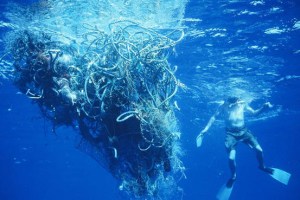
plastic trap The mass of  debris in the photo is, apparently, a tiny part of what the Wall Street Journal reports is afloat in the Pacific.   Nobody really knows how big it is:   “Some say it is about the size of Quebec, or 600,000 square miles — also described as twice the size of Texas. Others say this expanse of junk swept together by currents is the size of the U.S. — 3.8 million square miles. Or, it could be twice that size.”

Called The Great Pacific Garbage Patch, it’s a mass of floating plastic.  Nobody seems to be able to agree on the size, or even whether the plastic is dangerous or serving a function.   Plastics can harm ocean birds and mammals who eat it, because they carry toxins, can pierce internal organs and can trick animals into thinking they are full. But hard numbers are tough to come by. “It’s so hard to say a bird died due to plastic in its stomach,” says Holly Bamford, director of the National Oceanic and Atmospheric Administration’s marine-debris program. “We have seen birds mature and live out their whole life, and necropsies show plastic in their stomach.”  On the other hand, David Karl, an oceanographer at the University of Hawaii, says that the plastics have a high concentration of microorganisims clinging to them which are producing oxygen.

Polyester, or PET, is  a major component of this trash because PET is the major component of beverage containers (like bottled water).  But most PET (60% of global production) is used to make fibers and textiles.  In addition to the fact that this polyester remains in our oceans and landfills for around 1,000 years, it’s a very expensive way to spend our energy resources:

Polyester production, running at around 50 million tons  per year, consumes about 104 million barrels of oil for production (and that doesn’t include the energy needed for transportation).

We have called for research into substitutes for polyester fabrics and still insist that we  (a people which have sent men to the moon, after all) should be able to find a substitute for our plastic obsession.  Recycled polyester seems to have been crowned the Queen of Green by decorative fabrics distributors because it is claimed that by recycling the polyester we can have a lighter footprint.  I’ve outlined our arguments against that in other posts, not least of which is the fact that there are no workable takeback programs in place.

The argument in favor of recycling is that if consumers have an “easy” way to recycle their plastic, and are educated and reminded on the need to do so, most will, resulting in a cleaner environment.   However, Americans recycle only about 20% of their plastic bottles – and this in a nation where it’s relatively easy to throw a used bottle into a recycling container.   What percentage of fabrics do you think will be torn off sofas or delivered to a recycling facility?  How many project managers will tear out banquettes and order the separation of the fabric from the wooden frame?

Add to those arguments the fact that there has been a history of corporations collecting plastics and sending them overseas to be processed, such as the famous case of Pepsi Cola exporting tons of PET bottles to India in the 1990s.  This case amounts to an indictment of much of what passes for recycling in the United States and elsewhere – putting the plastic waste out of sight, out of mind.  The plastics industry is exporting their waste to less industrialized countries, avoiding domestic regulations, avoiding community opposition to waste handling facilities, paying their workers pennies a day, and maintaining a “green” image at home.  People in developed countries can lower their ecological guilt by depending on environmental injustice in Asia.  This is not recycling; this is, at best, a type of reprocessing that delays the eventual dumping of the plastic.  And at worst it encourages consumers to buy more plastic because their environmental concerns are lessened by the promise that the goods are being recycled.
carbon_footprint

If you’ve been following along you’ll know we haven’t even reached the point where we begin weaving – everything up till now dealt only with producing the raw materials (the fiber) and spinning into yarn!

So, the yarns are at the mill.  And that’s the kicker: we’ve been talking about how much energy it takes to produce the various fibers – and it varies dramatically – but there is no dramatic difference in the amount of energy needed to weave fibers into fabric depending on fiber type.[1] The processing is generally the same whether the fiber is nylon, cotton, hemp, wool or polyester:

  • thermal energy required per meter of cloth is 4,500-5,500 Kcal and
  • electrical energy required per meter of cloth is 0.45-0.55 kwh. [2]

This translates into huge quantities of fossil fuels  –  both to create energy directly needed to power the mills, produce heat and steam, and power air conditioners, as well as indirectly to create the many chemicals used in production.  In addition, the textile industry has one of the lowest efficiencies in energy utilization because it is largely antiquated.

So let’s go with the energy used to produce one KG of fabric (which is 92 MJ per KG as the New Zeland Merino Wool LCA study found).   Keeping  the energy needed for production as a  constant the synthetic fabrics still top the list:

Embodied Energy in production of various fibers + processing:
energy use in MJ per KG of fiber: energy use in MJ per KG of fabric TOTAL energy use in MJ per KG of fabric to produce fiber + weave into cloth
flax 10 92 102
Cotton, convt’l. 55 92 147
wool 63 92 155
Viscose 100 92 192
Polypropylene 115 92 207
Polyester 125 92 217
acrylic 175 92 267
Nylon 250 92 342


That means that it takes 3,886 MJ of energy to produce 25 yards of nylon fabric, which is  about enough to cover one average sofa.  That compares to 1,158 MJ if the fiber you used was flax (linen).  To put that into perspective, 1 gallon of gasoline equals 131 MJ of energy; driving a Lamborghini from New York to Washington D.C. uses approximately 2266 MJ of energy.(4)

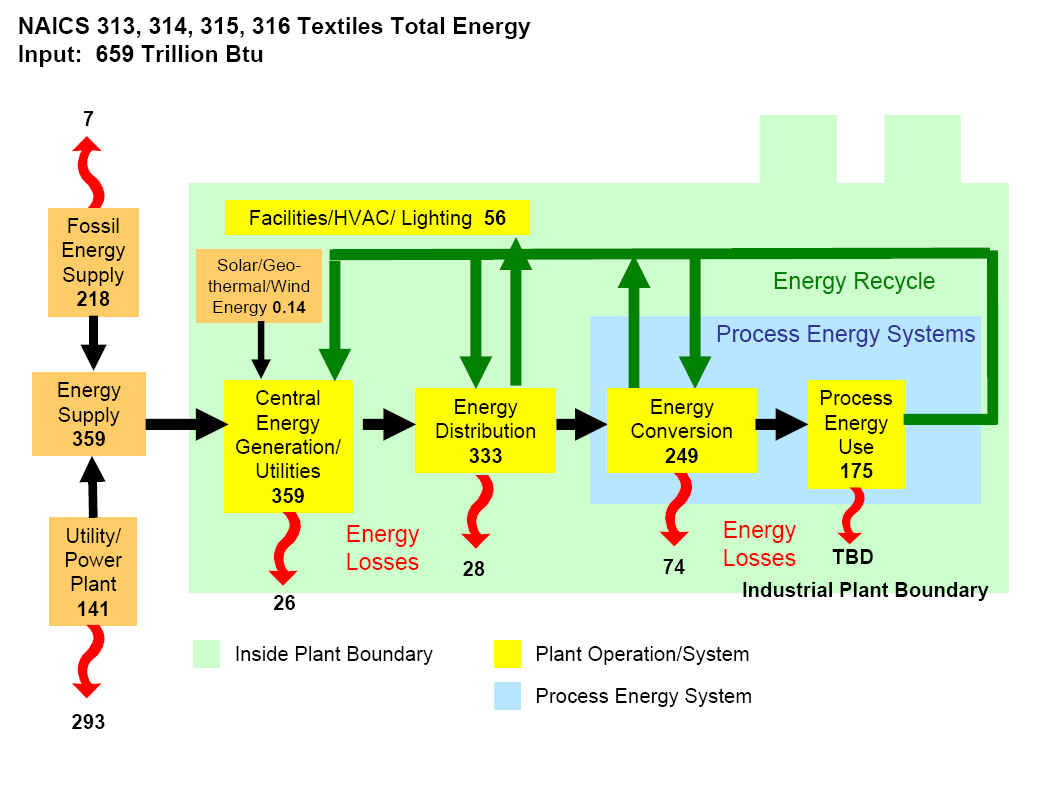
Textile_total_energy_input

In addition to the energy requirements for textile production,  there is an additional dimension to consider during processing:  environmental pollution.  Conventional textile processing is highly polluting:

  • Up to 2000 chemicals are used in textile processing, many of them known to be harmful to human (and animal) health.   Some of these chemicals evaporate, some are dissolved in treatment water which is discharged to our environment, and some are residual in the fabric, to be brought into our homes (where, with use, tiny bits abrade and you ingest or otherwise breathe them in).  A whole list of the most commonly used chemicals in fabric production are linked to human health problems that vary from annoying to profound.  And new research is linking many diseases and disorders to exposure to chemicals.  Through the new science of environmental health science, we are learning that exposure to toxic chemicals (at levels once thought to have been safe) is increasing the  chronic disease burden for millions of us.  For more information about this disturbing concept,  check out the National Institute of Environmental Health Sciences, part of the National Institutes of Health.
  • The application of these chemicals uses lots  of water. In fact, the textile industry is the #1 industrial polluter of fresh water on the planet.[3] These wastewaters are discharged (largely untreated) into our groundwater with a high pH and temperature as well as chemical load.  I wrote about a documentary which catalogues the ravages brought on by water pollution and how it impacts those downstream, called (interestingly enough), DOWNSTREAM.

We are all downstream.


[1] 24thsession of the FAO Committee on Commodity Problems IGG on Hard Fibers of the United Nations

[2] “Improving profits with energy-efficiency enhancements”, December 2008,  Journal for Asia on Textile and Apparel,  http://textile.2456.com/eng/epub/n_details.asp?epubiid=4&id=3296

[3] Cooper, Peter, “Clearer Communication,” Ecotextile News, May 2007.

(4)  from Annika Carlsson-Kanyama and Mireille Faist, 2001, Stockholm University Dept of Systems Ecology, htp://organic.kysu.edu/EnergySmartFood(2009).pdf

Embodied Energy in production of various fibers + processing:
beach image energy use in MJ per KG of fiber: energy use in MJ per KG of fabric TOTAL energy use in MJ per KG of fabric to produce fiber + weave into cloth
flax 10 92 102
Cotton, convt’l. 55 92 147
wool 63 92 155
Viscose 100 92 192
Polypropylene 115 92 207
Polyester 125 92 217
acrylic 175 92 267
Nylon 250 92 342

I’m so glad you asked!

From the previous post I hope I made it clear that natural fibers (whether organic or conventionally produced) have a lighter footprint than do synthetics – both in terms of emissions of greenhouse gasses and in terms of energy needed to manufacture the fibers.  And natural fibers have the added benefits of being able to be degraded by microorganisims and composted,  and  also of sequestering carbon.  According to the United Nations, they’re also a responsible choice, because by buying natural fibers you’re supporting the economies of many developing countries and supporting the livelihoods of many low-wage and subsistence workers.  The United Nations has declared 2009 the Year of Natural Fibers and they have a great website if you’re looking for more information:  http://www.naturalfibres2009.org/en/index.html

Substituting ORGANIC fibers for conventionally grown natural fibers is not just a little better but lots better in all respects:  uses less energy for production, emits fewer greenhouse gases, and supports organic farming (which has myriad environmental, social and health benefits).  A study published by Innovations Agronomiques  (http://www.inra.fr/ciag/revue_innovations_agronomiques/volume_4_janvier_2009) found that fully 43% less greenhouse gasses are emitted per unit under organic agriculture than under conventional agriculture.  A study done by Dr. David Pimentel of Cornell University found that organic farming systems used just 63% of the energy required by conventional farming systems, largely because of the massive amounts of energy requirements needed to synthesize nitrogen fertilizers.  Further, it was found in controlled long term trials that organic farming adds between 100-400KG of carbon per hectare to the soil each year, compared to non-organic farming.  When this stored carbon is included in the carbon footprint calculation, it reduces total greenhouse gasses even further. The key lies in the handling of organic matter (OM): because soil organic matter is primarily carbon, increases in soil OM levels will be directly correlated with carbon sequestration. While conventional farming typically depletes soil OM, organic farming builds it through the use of composted animal manures and cover crops.

Slide1

Taking it one step further beyond the energy inputs we’re looking at, which help to mitigate climate change, organic farming helps to ensure other environmental and social goals:

  • eliminates the use of synthetic fertilizers, pesticides and genetically modified organisims (GMOs) which is not only an improvement in human health and agrobiodiversity but also for the associated off farm biotic communities
  • conserves water (making the soil more friable so rainwater is absorbed better – lessening irrigation requirements and erosion)
  • ensures sustained biodiversity
  • and compared to forests, agricultural soils may be a more secure sink for atmospheric carbon, since they are not vulnerable to logging and wildfire.

Agriculture is an undervalued and underestimated climate change tool that could be one of the most powerful strategies in the fight against global warming, according to Paul Hepperly, Rodale Institute Research Manager. The Rodale Institute Farming Systems Trial (FST) soil carbon data (which covers 30 years)  shows conclusively that improved global terrestrial stewardship–specifically including regenerative organic agricultural practices–can be the most effective currently available strategy for mitigating CO2 emissions. (http://www.rodaleinstitute.org/files/Rodale_Research_Paper-07_30_08.pdf

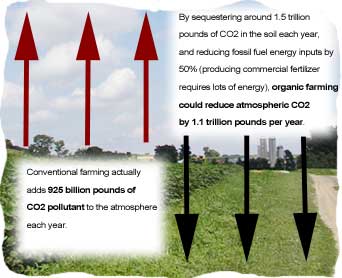
So just how much CO2 can organic farming take out of the air each year?  According to data from the Rodale Institute Farming Systems Trial (FST) :

  • If only 10,000 medium sized farms in the US converted to organic production, they would store so much carbon in the soil it would be equivalent to taking 1,174,400 cars off the road.
  • If we converted the U.S.’s 160 million acres of corn and soybeans to organic, we could sequester enough carbon to satisfy 73% of the Koyoto targets for CO2 reduction in the U.S.
  • Converting U.S. agriculture to organic would actually  wipe out the 1.5 trillion pounds of CO2 emitted annually and give us a net increase in soil carbon of 734 billion pounds.

carbon sequestratioon image 1

Paul Hepperly says that organic farming is a no brainer:  “Organic farming is not a technological fix, not an untried experiment that could have its own unforeseen consequences.” Instead, it may well be one of the most powerful tools we have in our fight against global warming that brings with it a wealth of other environmental benefits.

carbon footprints…

O Ecotextiles (and Two Sisters Ecotextiles)

Please be aware that our suggestions are just starting points for you to consider when looking at a fabric, because actually calculating a carbon footprint is very complex and time consuming.  Peter Tydemers, who is an ecological economist at Dalhousie University in Nova Scotia, has warned that many of the energy calculators we see should be taken with a pinch of salt – because every detail of where and how something is produced can change and therefore affect the outcome. For example, simply changing an animals feed can have an influence on its CO2 footprint. “It’s all very fluid”, he says, “There’s a tremendous hunger for these sorts of numbers and this has created the assumption that any existing figures are robust. They’re not.” We suggest that you examine carefully any studies to see the variables and the assumptions  made.  Something else to determine is who funded the study!  I was really perplexed to see a web site which had “data” on the energy used to create various fibers; the conclusions being drawn were just a bit outside the limits of any studies I had seen earlier.  But when I saw the industry group that funded the study it all became clear.

That being said, to begin to evaluate the carbon footprint of any fabric the first thing you have to do is  figure out what the fabric is made of  – the fiber.    The fiber tells you a lot about the energy needed to make the yarns, and then the fabric.  The energy needed to produce different fibers varies a lot.

To make it easy to compare the fibers, I”ll divide them into two types: “natural” (from plants, animals and – less commonly – minerals), and “synthetic” (man made)

For synthetics, it’s important to remember that most synthetic fibers  started as fossil fuel, an inherently non renewable resource.  Very high amounts of energy are needed to both extract the oil from the ground as well as to produce the polymers (as it is done under high temperatures).

For natural fibers you must look at field preparation, planting and field operations (mechanized irrigation, weed control, pest control and fertilizers (manure vs. synthetic chemicals)), harvesting and yields.  Synthetic fertilizer use is a major component of the high cost of conventional agriculture:  making just one ton of nitrogen fertilizer emits nearly 7 tons of CO2 equivalent greenhouse gases.

A study done by the Stockholm Environment Institute on behalf of the BioRegional Development Group  concludes that the energy used (and therefore the CO2 emitted) to create 1 ton of spun fiber is much higher for synthetics than for hemp or cotton:

KG of CO2 emissions per ton of spun fiber:

crop cultivation

fiber production

TOTAL

polyester USA

0.00

9.52

9.52

cotton, conventional, USA

4.20

1.70

5.89

hemp, conventional

1.90

2.15

4.10

cotton, organic, India

2.00

1.80

3.75

cotton, organic, USA

0.90

1.45

2.35

The table above only gives results for polyester; other synthetics have more of an impact:  acrylic is 30% more energy intensive in its production than polyester and nylon is even higher than that.

Not only is the quantity of GHG emissions of concern regarding synthetics, so too are the kinds of gasses produced during production of synthetic fibers.  Nylon, for example, creates emissions of Nitrous Oxide,  N2O, which is 300 times more damaging than CO2.[1] In fact, during the 1990s, N2O emissions from a single nylon plant in the UK were thought to have a global warming impact equivalent to more than 3% of the UK’s entire CO2 emissions.[2] A study done for the New Zealand Merino Wool Association shows how much more total energy is required for the production of  synthetics than any natural fibers:

Energy used in production of various fibers:

energy use in MJ perKG of fiber:
flax fibre (MAT)

10

cotton

55

wool

63

Viscose

100

Polypropylene

115

Polyester

125

acrylic

175

Nylon

250

SOURCE:  “LCA: New Zealand Merino Wool Total Energy Use”, Barber and Pellow,      http://www.tech.plym.ac.uk/sme/mats324/mats324A9%20NFETE.htm

Natural fibers, in addition to having a smaller carbon footprint in the production of the spun fiber, have the benefit of

  1. being able to be degraded by micro-organisms and composted; in this way the fixed CO2 in the fiber will be released and the cycle closed.  Synthetics do not decompose.
  2. sequestering carbon.  Sequestering carbon is the process through which CO2 from the atmosphere is absorbed by plants through photosynthesis and stored as carbon in biomass (leaves, stems, branches, roots, etc.) and soils.

As I said, looking at the production of the fiber is just the first part of the equation.  It is clear that, in terms of energy use and CO2 emissions, synthetics are  significantly higher in both cases than any natural fiber.  How the fibers are grown or managed also makes a huge contribution to energy use, and as you might have suspected, organic methods improve these results even more and widen the gap between synthetic and natural fibers.  That’s next week’s topic.


[1] “Tesco carbon footprint study confirms organic farming is energy efficient, but excludes key climate benefit of organic farming, soil carbon”, Prism Webcast News, April 30, 2008, http://prismwebcastnews.com/2008/04/30/tesco-carbon-footprint-study-confirms-organic-farming%E2%80%99s-energy-efficiency-but-excludes-key-climate-benefit-of-organic-farming-%E2%80%93-soil-carbon/

(2) Fletcher, Kate, Sustainable Fashion and Textiles,  Earthscan, 2008,  Page 13

We’re starting a series of blogs on the carbon footprint of textiles.    Because it’s such a complex subject we’re breaking it into smaller portions, beginning with looking at the textile industry as a whole.   In other words, why the fuss over textiles?

Fabrics, believe it or not, have a large carbon footprint.  In other words, it takes a lot of energy to produce fabrics.  According to the U.S. Energy Information Administration, the U.S. textile industry is the 5th largest contributor to CO2 emissioins in the United States (after primary metals, nonmetallic mineral products, petroleum and chemicals).  In the developing world, where the textile industry represents a larger percentage of GDP and mills are often antiquated, the CO2 emissions are greater.

In fact, today’s textile industry is one of the biggest sources of greenhouse gasses on Earth, due to the huge size and scope of the industry as well as the many processes and products that go into the making of textiles and finished textile products. (See Vivek Dev, “Carbon Footprint of Textiles”, April 3, 2009, http://www.domain-b.com/environment/20090403_carbon_footprint.html)

Based on estimated annual global textile production of 60 billion kilogrms (KG) 0f fabric, the estimated energy and water needed to produce that 60 billion KG of fabrics boggles the mind:  1,074 billion KWh of electricity (or 132 million metric tons of coal) and between 6 – 9 trillion liters of water.

Fabrics have been the elephant in the room for too long.  Do we overlook them because they are almost always used as a part of a finished product, such as sheets, blankets, sofas, curtains, and of course clothing?  It’s estimated that clothing and textiles account for about one ton of the 19.8 tons of total CO2 emissions produced by each person in the U.S. in 2006 (see Jurg Rupp, “Ecology and Economy in Textile Finishing”, Textile World, Nov/Dec 2008).

In the U.K., the Carbon Trust, working with Continental Clothing, has developed the world’s first carbon label for clothing (http://www.environmentalleader.com/2009/03/27/uk-launches-first-carbon-footprint-label-for-retail-clothing/)  The new label will provide the carbon footprint of the garment, from raw materials and  manufacture to use and disposal.

carbon footprint label

carbon footprint label

The first point we want you to keep in mind is that the industry is huge, and because of its size it’s impacts are profound.  There is more to think about when buying a fabric than thread counts or abrasion ratings.

Just found this and had to share…

O Ecotextiles (and Two Sisters Ecotextiles)

I just found the web site for Green Air (www.greenairradio.com) which bills itself as  “a nationally syndicated news radio feature and multi-platform interactive hub for Green and environmentally significant news, stories and entertainment. It is comprised of a broad network of media professionals including producers, journalists, broadcasters, writers, photographers and filmmakers worldwide. Green Air creates, publishes, and distributes traditional and new media content with a contemporary and humanistic voice.”

While scrolling through the GreenAir search, I found the segment titled Toxic Textiles ( http://greenairradio.com/?p=1612 ) Please take the time to watch it!    It was an eye opener even for me, who prides herself on knowing the facts about textile manufacturing, but when I actually see those farmers spraying the pesticides – how it’s done in a developing country – and when I see the dyehouse workers wringing dyed fabrics by hand, it’s a different ballgame.  Not to mention the two women profiled who have health problems brought on by exposure to these fabrics.


Lots of people are concerned about the transportation costs of shipping fabric from China to the US, because they think the shipping contributes to an enormous carbon footprint of, say,  cotton fabric. The thinking goes that the homegrown variety (which doesn’t have the transportation burden) is far preferable because you save so much by not having to ship such long distances.

Well…A wise guy once said that green is not black and white.

An article which appeared in the New Yorker magazine by Michael Specter entitled  “Big Foot” describes how  easy it is to confuse morality and science.  It turns out that the carbon accounting thing is extraordinarily complex and often counterintuitive.
Mr. Specter quotes Adrian Williams, an agricultural researcher in the Natural Resources Department of Cranfield University in England:   “The idea that a product travels a certain distance and is therefore worse than one you raised nearby—well, it’s just idiotic,” he said. “It doesn’t take into consideration the land use, the type of transportation, the weather, or even the season. ”  He cites as an example the environmental burden imposed by importing apples from New Zealand to England.  New Zealand apples can have a smaller carbon footprint than those raised 50 miles outside London because in New Zealand they have more sunshine than in the UK, so the yield is higher and energy needed to grow the crop is correspondingly lower.  Also electricity in New Zealand is mostly generated by renewable resources, none of which emits large amounts of CO2.

Turns out that that applies to natural fibers and fabrics also.

We found two reliable LCA studies – one done by Patagonia (for finished products) and another by the the Stockholm Environment Institute (entitled “Ecological Footprint and Water Analysis of Cotton, Hemp and Polyester”) , which  both  found that transportation costs account for only about 1% of the total energy used.  Resources used to produce the fibers require by far the greatest amount of energy.   Patagonia’s Director of Sustainability, Jill Dumain, is quoted in the WSJ  “Six Products, Six Carbon Footprints”, as saying that “there’s a lot of reasons to have a tight supply chain, but environmentalism isn’t one of them.”  By far the largest part of the footprint is from the production of the fibers.   And the situation is further complicated by  organic vs. conventional production – it’s not always true that organic (in terms of carbon footprint anyway) is always better.  In fact, the study done by the Stockholm Environment Instutite found that the total ecological fooprint, measured in global hectares, to produce one ton of spun fiber is higher for organic cotton grown in Punjab, India than that of conventionally produced cotton grown in the USA.  That’s due to the poor yields in Punjab, meaning they need more land to produce the same amount of fiber – therefore greater resource use.

Polyester, the most popular fiber in the world,  also has the largest carbon footprint – by a factor of about 4!  But that’s the next blog.

The questions is whether it’s a better choice to use inherently flame retardant fabrics such as AvoraFR rather than a natural fiber (like cotton) which has been doused with toxic FR chemicals.  The answer is complicated and like most in this emerging green area, there may be no “best” answer.  We think the answers may lie in the tradeoffs we have to make.  But we’ve got an opinion, and it’s based on the following reasoning:

Fabrics which are inherently flame retardant are synthetics which have been changed at the molecular level to make the fabrics thermally stable and able to pass commercial flame tests.   Some petroleum-based synthetic fibers, such as Avora FR, Trevira CS and Lenzing FR viscose – add a flame retardant to the chemical treatment before polymer extrusion rather than change the molecular structure of the polymer.  This process builds the chemical treatment into the backbone of the polyester rather than adding it later to the finished product.  It is presumed to be less likely to expose the occupants to chemicals.

So how do you compare the two?

When comparing the synthetic with a natural fiber, we think it’s important to look at the carbon footprint of the fibers.  A synthetic like polyester requires much more energy to produce a ton of fiber than does conventional cotton – in megajoules (MJ) of energy the difference is about four times: 126,000 MJ polyester vs. 33,000 MJ for conventional cotton.  Organic cotton is even less:  only 16,000MJ.

It’s important to look at how these fibers are woven into fabric.  (And that’s a different set of carbon calculations).  If the polyester or the cotton is produced conventionally, the finished fabric has residuals of many chemicals which have been proven to harm human health.  The majority of Americans mistakenly believes that the government tests chemicals used in consumer products to ensure safety, accoring to an opinion poll released by the Washington Toxics Coalition.  However, under the Toxic Substances Control Act (TSCA), there is no legal requirements to test most chemicals for health effects, including impacts on neurological development, at any stage of production, marketing and use.  An organic fabric is one which has not used any of the many chemicals used in textile production which are known to be toxic.

So looking at two fabrics (even if one polyester fabric is produced using optimized production methods – i.e., avoiding the toxic chemicals) the organic cotton (or better yet, hemp or linen) fabric is one I’d rather live with.  But fire kills many people every year and we have reason to keep fire codes in place in public spaces.  So the issue focuses on the chemistry used to fire retard the fabrics.

Natural fibers must have a topical FR treatment applied after manufacture.  In the past, these treatments were based on halogenated chemistry, like PBDEs.  The industry is moving away from these chemicals and most have been banned, but decaBDE is still allowed in the US.  With careful attention and questioning of your supplier, you can have a natural fiber fabric that has an FR treatment which meets all codes – and which is not persisten, bioaccumulative and compromises your health.

So now the question becomes how dothe two fibers react in actual fires?

An important thing to remember about synthetics is that they do not burn, they melt.  That’s why protective clothing (firemen, police, rescue) is not made of synthetics – even inherently fire retardant synthetics – because the melting fabric would cause severe burns.

Another issue (and one we think is most important) is that the smoke created by burning or melting fabrics.   Conventionally produced fabrics (natural fiber or synthetic) release chemicals which add an extra dimension to the already toxic smoke.

https://i0.wp.com/noburn.com/images/picture3.jpg

So where do we stand?

  • With a carbon footprint of 16,000 MJ vs 126,000 MJ (organic cotton vs. polyester) to make the fiber and
  • with organic fabrics having little or none of the chemicals which have been proven to harm human health and
  • because of the ability to use a nonhalogenated FR treatment on an organic fabric and
  • in the case of a fire, not having to breathe toxic fumes from melting synthetics or conventionally produced fabrics

is there really a choice?

Happy May Day

O Ecotextiles (and Two Sisters Ecotextiles)

In honor of May Day and workers everywhere,  I’d like to suggest that you check where your cotton comes from.  Like extracting oil which has different energy requirements depending on where its found, there’s a lot of variation in cotton depending on where its grown.    And cotton from Uzbekistan is not a good choice.

Uzbekistan is the second largest exporter of cotton in the world,  but the human rights issues (putting aside the environmental issues for the time being) associated with Uzbek cotton puts it at the bottom of the heap.

According to the Environmental Justice Foundation:

Instead of using machines to harvest cotton, as is done in other major cotton exporting countries, Uzbekistan’s government uses children. Every autumn state officials shut down schools, and send students, together with their teachers, to the cotton fields. Tens of thousands of children, some as young as seven, are forced to undertake weeks of arduous labour for little or no financial reward. Headmasters are issued with cotton quotas and made to ensure that students pick the required daily amount. Children who fail to pick their target of cotton are reportedly punished with detentions and told that their grades will suffer. Those who refuse to take part can face academic expulsion.”

And if you have happy memories of picking cotton for your grandparents to help bring the crop in, read the letter from Brian Schroeter (whose wife was one of those Uzbek kids forced to pick cotton) published in the Delta Farm Press  http://deltafarmpress.com/news/uzbek-cotton-1217/ In this letter, Brian explains how the situation is such a human rights disaster.

https://i0.wp.com/gdb.rferl.org/F847EE23-DAA1-477D-A9A3-E6028A76ABC7_mw800_mh600.jpg

As consumers, ask where your cotton comes from.  Ignorance on the part of the seller, as always, is no excuse.  Tell your retailer that you will not buy it if there is no credible information about where the cotton is produced.   Seek out fair trade cotton.

All oil is not created equal.

O Ecotextiles (and Two Sisters Ecotextiles)

I just watched Downstream – and had my eyes opened about an industrial project which is considered to be the most ecologically destructive project on Earth: the Alberta tar sands. Downstream is a new documentary by Academy Award nominee Lesley Iwerks, which you too can watch at http://www.babelgum.com/downstream . But I warn you, it’s unsettling to say the least – I can’t seem to sit still now that I know this is going on!

Turns out that not all oil is created equal – in terms of how much energy and water it takes to get the oil out of the ground. Oil recovered from the tar sands is at the “extra dirty” end of the spectrum, meaning it takes more energy and water to recover oil from the dirt than other kinds of oil. (See the Environmental Defense report on the tar sands, http://www.environmentaldefence.ca/reports/tarsands.htm )

Consider this equation — the production of one barrel of tar sands oil:

Requires between 2 and 4.5 barrels of water and two tons of tar sands (scraped from below the surface of the boreal forest),

And it creates two barrels of toxic waste.

The processing of this tar sands oil also requires immense amounts of natural gas. Daily, tar sands producers burn 600 million cubic feet of natural gas to produce tar sands oil, enough natural gas to heat 3 million homes.

Production is licensed to use more water than Alberta’s two major cities — Calgary and Edmonton — combined.

That water is held in ponds laced with chemical sludge. And now the tailings pond for Syncrude (one of the corporations) is the largest dam project on Earth and can be seen from space by a naked eye. These ponds are so toxic that propane cannons are used to keep ducks from landing.

One barrel of tar sands oil produces three times the greenhouse gas emissions than does a barrel of conventional oil. The project is presently producing the most greenhouse gases in Canada, the equivalent to the emissions of the Czech Republic, while destroying the boreal forest, part of the world’s most important storehouse of climate regulating carbon and oxygen.

And here’s the kicker: Alberta’s Energy Resources Conservation Board (ERCB) has released a report predicting that the province will go from 1.32 million barrels of raw bitumen per day in 2007 to 3.2 million barrels per day in 2017 (and who knows, if oil prices stay high, they could ramp it up even more quickly).

Today, a set of corporations is offereing money to various Native American tribes in exchange for a 20-year lease of tribal lands: The proposed Enbridge Alberta Clipper pipeline is one of the most controversial in history, with immense environmental and economic impacts. The proposed pipeline starts in the tar sands of Alberta, Canada and will end in Superior, Wisconsin.

To secure more markets, Enbridge is seeking expansion of this project by initially transporting 450,000 barrels per day (bpd), with ultimate capacity of up to 800,000 bpd available. See the commentary by Nellis Kennedy and Winona LaDuke at http://www.bemidjipioneer.com/articles/index.cfm?id=23115&section=Opinion

Leigh Anne