OEcotextiles

Indulgent yet responsible fabrics

Given the large size of the printing industry, and the extraordinary volume of chemicals it consumes, it is not surprising that it also generates a significant amount of pollution.  Gaseous emissions have been identified as the second greatest pollution problem (after effluent quality) for the textile industry – and these are largely generated in printing. Speculation concerning the amounts and types of air pollutants emitted from textile operations has been widespread but, generally, air emission data for textile manufacturing operations are not readily available. Air pollution is the most difficult type of pollution to sample, test, and quantify in an audit.[1]  According to the U.S. EPA, the printing industry releases 99% of its total Toxic Release Inventory (TRI) poundage to the air, while the remaining one percent of releases are split between water and land disposal. This release profile differs significantly from other TRI industries which average approximately 60% to air, 30% to land, and 10% to water release respectively. Average VOC emissions per textile print line are 130 Mg (tons)/year for roller and 29 Mg/year for flat and rotary screen.[2]

In 1995, more than 41 million pounds of toxic compounds were transferred or released into the environment by the printing industry in the United States alone.  The table below shows some of the  polluting chemicals used by the textile printing industry.  All ten are petroleum-derived.

Chemical Releases and   transfers in millions of pounds
Toluene 4.2
Methyl Ethyl   Ketone 6.3
Glycol Ethers 0.4
Xylene 0.2
Methyl   Isobutyl Ketone 0.6
Methanol 0.3
1,1,1-Trichloroethane 0.3
Ethylene   Glycol 0.5
Dichloromethane 0.1

Source: EPS: Profile of the Textile Industry, EPA/310-R-97-009, September 1997

These VOC emissions are high because of the great quantity of solvents used in the industry. The volatility that helps minimize ink drying times also presents a health and safety risk.  The solvents used in the printing pastes are typically respiratory, skin and eye irritants. But there are also more dire consequences – for example, a study done on Indian printing working has found abnormal changes in their chromosomes.(3)  With such a high percentage of the paste being volatile, solvent vapors will be released during printing and will be present throughout the printing production area. Also, the fabric will continue to off-gas solvents after the material has been printed, especially if it has been rolled up.  The Sector Notebook  gives a short synopsis of these chemicals, and I’ve excerpted a few here:

  • Toluene, although used primarily as a solvent,  is also used throughout printing for cleanup purposes. Toluene contributes to the formation of ozone in the atmosphere; studies have shown that unborn animals were harmed when high levels of toluene were inhaled by their mothers, although the same effects were not seen when the mothers were fed large quantities of toluene. Note that these results may reflect similar difficulties in humans.
  • Data on ethylene glycol mono-n-butyl ether is used to represent all glycol ethers because it is the most commonly used glycol ether in printing.  It can leach into ground water, and reacts with photochemically produced hydroxyl radicals.  For humans, moderate exposure may cause central nervous system depression, including headaches, drowsiness, weakness, slurred speech, stuttering, staggering, tremors, blurred vision, and personality changes. These symptoms are such that a patient, in the absence of an accurate occupational history, may be treated for schizophrenia or narcolepsy.
  • Methyl ethyl ketone contributes to the formation of air pollutants in the lower atmosphere; breathing “moderate amounts” for short periods of time can cause adverse effects on the nervous system ranging from headaches, dizziness, nausea, and numbness in the fingers and toes to unconsciousness; repeated exposure to moderate to high amounts may cause liver and kidney effects.

Everybody is now talking about “water based” inks, as if that’s the answer to help reduce these emissions.  So, let’s investigate these inks and see what “water based” means, and what the concerns may be.

There are three general types of texile inks (or pastes, as we referred to them in Printing – Part 2):

  • traditional solvent-based inks
  • water-based inks
  •  plastisol inks

The two inks used most often in textile printing are water-based (used mostly for yardgoods) and plastisol  inks (used for printing finished goods, such as T shirts, sweatshirts, tote bags).

SOLVENT-BASED INKS:   The solvent has two primary functions: 1) to carry the ink to the substrate, and 2) to evaporate quickly, leaving only the ink film on the substrate. While water is a solvent, the name solvent-based ink is used to describe a highly volatile solvent such as 2-butoxyethyl acetate, cyclohexanone and n-butyl acetate.

Solvent based inks are considered the least environmentally friendly due to the  highly volatile solvents given off during printing and drying. The petroleum-based binder used in many solvent-based inks could be replaced with renewable resources such as vegetable oil or soy. The downsides are that the inks dry very slowly are less durable, and still contain solvents emitting VOCs during printing.

Therre are now inks on the market called Eco Solvent inks.  To most people, “eco” means ecological, and to be fair these inks are not as nasty as full solvent inks.   But these inks generally contain glycol esters or glycol ether esters – both derived from mineral oil – hardly a renewable resource or an ecologically sound process.  Tony Martin, president of Lyson Inc. suggested we call these inks “mild” vs. the “aggressive” traditional solvent inks.  Also since these inks are generally used to print onto PVC, the green claim sorta gets overlooked by the elephant in the substrate.

WATER-BASED INKS:  These use water as the main solvent.  But that does not mean that water is the ONLY solvent used.  It is significant to note that many water base inks contain “co-solvents” which may even be petroleum based solvents.[4] ( See Printing – Part 2 for components of typical water and solvent based inks.) The reason these co-solvents are used varies, but a main reason is to decrease the time and heat necessary to cure the ink on the fabric.

There are two types of water-based inks: Traditional (air dry) ink and Discharge ink.

  • Traditional air dry ink soaks into the cloth and binds with the fibers providing good colorfastness and wash ability.
  • Discharge ink removes the original dye/color from the garment and replaces it with a color/pigment. Discharge inks are now available in formaldehyde free formulations, such as the Oasis Series by Wilflex, making them safer for the user and the environment.

Water based inks are usually less expensive than solvent-based inks and are similar in quality, gloss, and adhesion.

Many printers observe that water-based inks have more vibrant colors and print more crisply than their solvent-based counterparts. The sharper definition possible with water-based inks allows printers to use finer dot patterns in screened process printing. Water-based inks are a good choice when a “soft hand” is desirable. (A soft hand is the condition where the ink film cannot easily be felt with the hand when passed across the surface of the fabric. This affect is often used as an argument for why water-based is preferable to plastisol  because plastisol has more of a hand than water-based, and this is considered a consumer turn off.)

These inks are inexpensive and easy to manufacture. In fact, with some experience and the proper equipment, printers can even make them in small batches from basic natural components. They have a very limited shelf life and are difficult to re-use, so they generate more wasted ink than regular plastisols or more complex, manufactured water-based inks. While this type of water-based ink is considered a very green alternative, this extra waste is something to consider.

An advantage often cited for water-based inks is that they do not require organic solvents when cleaning the presses.  But there is a common misconception that because water can be used for cleaning screens, squeegees and tools, that the waste water can just be discharged into the sewer. However, the water-based ink is not just water. There are pigments, binders, thickeners, and sometimes, even co-solvents in the ink residue.

Many printers believe that screen printing using water based inks is the cutting edge of textile printing.  So why isn’t everybody using them?

Water-based inks cure as water evaporates out of the ink so they have a longer – and more difficult –  drying time than plastisol inks. This means that the water — along with whatever in the ink evaporates with the water — enters the environment.

If using water-based ink, the facility must have the drying capacity to remove the water. The dryers used for water-based printing tend to be larger than those needed for plastisol.  In plastisol printing, the ink film must only reach the cure temperature for a brief moment. With water-based ink, the temperature must be reached and then held until all of the solvent (water) is removed. There are water-based inks that will air dry but they are usually only acceptable for craft level printing as the room required for curing greatly reduces productivity.
Finally, all water-based inks can start to dry out during use, so care must be taken to prevent the ink from drying on the screen.  If water based ink is left in open mesh for even a short period of time, it can clog the mesh and ruin the screen. Practiced waterbased ink printers must always be conscious of how long a screen sits between prints to prevent the ink from “drying in”. While modern water-based inks are less prone to this phenomenon, it is still a concern.  In addition, overall shelf life is limited.

There have been major improvements in manufactured water-based inks in recent years. These newer inks have a number of performance advantages over the basic water-based inks discussed above and are as potentially eco-friendly and sustainable as any alternative. For example, they resist drying, and remain useable far longer than traditional water-based and discharge inks. They can be re-constituted with water — and additional binder, if needed — which can cut back on waste. Shelf life of these newer water-based inks is substantially longer as well because the manufacturers have developed technology to encapsulate the water in the ink in such a way that it does not readily evaporate until printed.

Much like traditional plastisol, these water-based inks are sold ready to use as colors or underbases and have a thicker viscosity that yields greater opacity on finished prints. They can be reduced with water and other modifiers for a softer hand.

PLASTISOL INKS:  Plastisol inks, commonly used for textile printing and especially for t-shirts, are a PVC-based ink composed of a clear, thick plasticizer fluid and PVC resin. The full name for PVC is polyvinyl chloride. The PVC life cycle results in the release of toxic, chlorine-based chemicals which end up as by-products such as carcinogenic and highly toxic dioxin and PCB.  The major health concern about plastisol inks is not that they are PVC-based but that they contain phthalates. Phthalates are added to PVC plastics to transform a hard plastic into a soft, rubbery plastic by allowing the long polyvinyl molecules to slide against each other instead of rigidly binding together. These phthalates used in plastisol ink to make the PVC flexible are also carcinogenic and much research has been done which substantiates the damage phthalates do to us,  especially to fetuses and newborns.[5] They are released into the environment during the printing and curing of the ink and they will continue to exhaust toxins when exposed to a radiant heat source, such as a dryer or even sunlight.  Plastisol inks contains virually no solvents at all.

Plastisol does not “dry”. In order for a compound to dry, there must be evaporation of some kind of solvent.  These inks typically contain less than 1% VOC.  Some water based plastisol inks can contain about 30% VOCs.[6] Since plastisol has little or no solvent, it cannot dry. Plastisol is a thermoplastic ink  – meaning it is necessary to heat the printed ink film to a temperature high enough to cause the molecules of PVC resin and plasticizer to cross-link (i.e., bond to the fabric)  and solidify, or cure.  Cross-linking agents must be used to effect the bonding, and  formaldehyde is often a necessary component of these cross linkers.  The temperature at which most plastisol for textile printing cures at is in the range of 300 °F to 330 °F.  Because of this characteristic, plastisol can be left in screens for long periods of time without clogging the mesh, the lids can be left off of the ink containers (although keeping them covered is a good practice to keep lint and dirt out of the ink). And ink left at the end of the job can be returned to the container for reuse without any adverse affects. This last practice is a great benefit in reducing waste product.  It is ready to use right out of the container more than 90% of the time. In most applications, it can be printed wet-on-wet, which allows for increased production speeds. It comes in formulations that can be printed on light and dark fabrics.

Since Plastisol is a thermoplastic, it will remelt if it comes in contact with anything hot enough. For that reason, plastisol prints cannot be ironed. If an iron touches a print, it will smear the ink.

Plastisol ink also creates an ink film that can be felt with the hand. The higher the opacity of the ink, the greater the hand. This heavy hand is considered a disadvantage at the consumer level.

Because both PVC and phthalates are chemicals of concern, many companies are offering phthalate free plastisol inks. These non-phthalate inks are not as easy to work with as standard plastisols, but it is possible to use them to accomplish most of the common printing techniques. In addition to non-phthalate plastisols, there are some new acrylic-based screen printing inks that are sometimes referred to as non-PVC and non-phthalate plastisols. Why? Well, an acrylic-type resin replaces the PVC resins used in regular plastisol. Also, the plasticizer in acrylic inks is normally non–phthalate, making these inks an even more eco-friendly alternative.

With some experience, acrylic inks can be successfully made into high-density designs. The finished prints lack the soft finish of a standard high-density plastisol print, but this may be an acceptable compromise to some customers.

Acrylic inks are usually a little more costly than standard plastisols and are substantially more expensive than standard water-based inks.

The hazards of plastisol printing inks are not just to personal health but also to environmental health. Garments coated with plastisol inks do not decompose and they are difficult to recycle. The result is that you may soon grow tired of your Rolling Stones concert tee shirt and trash it, but it will live on in immortality in the local landfill. If clothing designed with PVC plastisol ink is incinerated, the trapped dioxins plus hydrochloric acid (a primary component of acid rain) are released into the atmosphere.

New inks have also been developed for digital printing, such as latex, resin and UV curable inks.  We’ll discuss them next week with digital printing.

Dr. Nicholas Hellmuth, of FLAAR (http://www.wide-format-printers.org/), writing in his January, 2011 blog, said of the proliferation of green claims by ink manufacturers: ” I would bet that 90% of these claims were misleading at best. I would bet that more than 50% of these claims are fraudulent and inaccurate… I looked at the MSDS of inks called water-based and almost gagged when I saw the chemical recipe, with the hazardous warnings.  If you make a list of the nasty chemicals that are   really in the ink, depending on what chemicals you consider unhealthy,   resin ink could potentially be considered less unhealthy than even   traditional water-based ink. In other words, there is a potential that   resin inks could be considered better than water-based inks. But there   are so many diverging opinions that I will be discussing this with other   ink chemists as I meet them during the expos early in this year (2011). ”

So you’d think that the major source of the emissions comes from using these inks – the printing process itself.  You’d be wrong:  the majority of emissions to the atmosphere from textile printing is from  the drying process, which drives off volatile compounds.  The largest VOC emission source is the drying and curing oven stack, which vents evaporated solvents to the atmosphere.  Another source of fugitive VOC emissions comes from the “back grey” (fabric backing material that absorbs excess print paste), which  is dried before being washed. In processes where the back grey is washed before drying, most of the fugitive VOC emissions from the back grey will be discharged into the waste water. In some roller printing processes, steam cans for drying printed fabric are enclosed, and drying process emissions are vented directly to the atmosphere.

As of the publication date of the EPA Sector notebook on the Printing and Publishing Industry (1995),  there was no add-on emission control technology for organic solvents used in the textile printing.

Another environmental hazards  in printing textiles comes in the screen and equipment cleaning steps – which use lots of water.  When you finish a printing run, for example, there are still approximately 1.5 gallons of printing paste in the system, predominantly in the tubes that run between the paste reservoirs and the screens. This  is simply rinsed out and flushed down the drain. If using plastisol inks, in order to emulsify the ink for easy removal from screens, squeegees, flood bars, spatulas, and work surfaces, it is necessary to use some type of solvent.   Solvents used to clean printing equipment include toluene, xylene, methanol, and methyl ethyl ketone (MEK). In addition, blankets used to transfer the ink-filled image to sheets of paper are cleaned with washes that contain glycol ethers and 1,1,1-trichloroethane (TCA). The type of solvent used depends largely on the equipment to be cleaned. For example, a blanket wash must dissolve ink quickly and dry rapidly with minimal wiping. Conversely, a solvent that is intended to clean a chain of ink rollers must evaporate slowly, to insure that it does not flash off before it has worked its way through all the rollers. Water based inks contain co-solvents, additives, dyes and/or pigments, which make the water clean up full of possibly hazardous materials.   All of these components must be washed thoroughly.

Irrespective of the type of inks used, all printers attempt to reclaim screens, which are a major cost item. Failure to reclaim screens and ruined screens cost on average $5,000-$10,000 per year. One study showed chemical reclamation cost between  $2 and $10  per average screen, while screen disposal cost just shy of $50. Screen reclamation is a particular challenge to screen printers, because inks and solvents cannot go down the drain and some of the chemicals used to reclaim mesh are restricted.   The waste water will contain particulates comprised of ink pigment, emulsion and emulsion remover.  Reclaiming screens involves these steps:

  1. Remove the paste:  Any and all excess paste in the screen should be “carded off” for reused on another job. The screen must then be washed to remove any remaining paste because the paste will interfere with the process of removing the stencil. Screen cleaning solvents are a source of VOC emissions.
  2.  Emulsion removal:  The stencil or emulsion is removed by spraying the screen with a solution of water and emulsion remover chemicals which is comprised mainly of sodium metaperiodate,  then rinsing the solution away with fresh water.
  3.  Haze or ghost image removal:  Finally, if any haze or “ghost image” remains, a haze remover must be applied. Some haze remover products are caustic and can damage or weaken the screen. Haze removers make screens brittle and tear easily, therefore only small amounts should be used. Ghost image is a shadow of the original image that remains on the screen caused by paste or stencil caught in the threads of the screen.

The best way to reduce VOCs during screen reclamaition are related to technology and best practices, such as using high pressure wash systems and modifying how chemicals are applied to the screens.

The waste ink and the solvent must be disposed of properly in order to minimize environmental impact.  There are three major areas of concern for this wastewater:

  • Heavy metals, which can be found in the residue of ink, can enter the sewer system and contaminate sewage sludge
  • Heavy concentrations of certain chemicals can disrupt the pH balance at the treatment plant and disrupt the bacterial systems essential to the sewage treatment process
  • Combinations of mixtures with low flash points can cause flammability concerns in the sewage system

Leftover print pastes cannot be allowed to enter the wastewater treatment system. It must be disposed of as a solid waste. Sites where sludge piles are used can have environmental problems with ground and groundwater contamination. These sludge storage areas should be equipped with waterproof linings to prevent this from occurring.

In fact, textile printing is becoming an important wastewater source as the water-based materials replace the organic solvents. The wastewaters originating from this operation are often strong and may contain toxics, although their volume is still quite low.[7]

The screen printing industry has been very proactive in the creation of products that can minimize the impact of these cleaning processes. Solvents are available that are “more” environmentally sensitive than the traditional petroleum based solventsCompanies are beginning to market biochemical cleaning solutions, inks and additives to replace current solvents or toxic chemicals– examples include the use of terpene d-limonene (derived from citrus fruit), coconut oil , soybeans, seaweed  and fatty amides. (8)  In addition, there are many types of filtration and cleaning systems available to capture inks and solvent residues to minimize the solids that are discharged into the sewer system.

Aside from improvements to the building itself and efforts to minimize water use and to use inks and paste effectively, there are some things every printer can do to reduce their environmental impact:

  • Minimize downtime on the press
  • Make rejects history
  • Maintain dryers – is it really worth saving money by buying that second hand dryer?  A new one is 30% more efficient, twice the price but the energy savings will pay the difference in 9 months.  An average printing line has a nominal power rating of 75 kW, most of which is required for the drying process.

[2] http://www.epa.gov/ttnchie1/ap42/ch04/final/c4s11.pdf

(3)  Sellappa, Sudha, et al; Genotoxic  Effects in Textile Printing Dye Exposed Workers by Micronucleus Assay, Asian Pacific Journal of Cancer Prevention, Vol 11, 2010;  pgs. 919-922,  http://www.apocp.org/cancer_download/Volume11_No4/c%20919-22%20Sellappa.pdf

[7] Kabdasli, M Gurel & Tunay, O., “Characterization and Treatment of Textile Printing Wastewaters”, Environmental Technology, Vol 21, Issue 10, 2000, pp. 114 – 1155

(8) http://www.pneac.org/sheets/all/biochemicals_for_the_printing_industry.pdf

Printing – part 3

O Ecotextiles (and Two Sisters Ecotextiles)

Yes, we’re still talking about the printing process!  As I warned you, it’s complicated.

For the past two weeks we’ve concentrated on the first two steps of the basic 5 steps in printing a fabric, which  are:

1. Preparation of the print paste.

2. Printing the fabric.

3. Drying the printed fabric.

4. Fixation of the printed dye or pigment.

5. Afterwashing.

So let’s look at the rest of the steps – drying, fixation and afterwashing.

Actually, the printing process begins even before passing  the fabric thru the printing presses, because the fabric must be conditioned.  The cloth must always to be brushed, to free it from loose nap, flocks and dust that it picks up while stored. Frequently, too, it has to be sheared by being passed over rapidly revolving knives arranged spirally round an axle, which rapidly and effectually cuts off all filaments and knots, leaving the cloth perfectly smooth and clean and in a condition fit to receive impressions of the most delicate engraving. Some figured fabrics, especially those woven in checks, stripes and crossovers, require very careful stretching and straightening on a special machine, known as a stenter, before they can be printed with certain formal styles of pattern which are intended in one way or another to correspond with the cloth pattern. Finally, all descriptions of cloth are wound round hollow wooden or iron centers into rolls of convenient size for mounting on the printing machines.

Immediately after printing, the fabric must be dried  in order to retain a sharp printed mark and to facilitate handling between printing and subsequent processing operations.

Two types of dryers are used for printed fabric, steam coil or natural gas fired dryers, through which the fabric is conveyed on belts, racks, etc., and steam cans, with which the fabric makes direct contact. Most screen printed fabrics and practically all printed knit fabrics and terry towels are dried with the first type of dryer, not to stress the fabric. Roller printed fabrics and apparel fabrics requiring soft handling are dried on steam cans, which have lower installation and operating costs and which dry the fabric more quickly than other dryers.

After printing and drying, the fabric is often cooled by blowing air over it or by passing it over a cooling cylinder to improve its storage properties prior to steaming, which is the process which fixes the color into the fabric.  Steaming may be likened to a dyeing operation.  Before steaming, the bulk of the dyestuff is held in a dried film of thickening agent.  During the steaming operation, the printed areas absorb moisture and form a very concentrated dyebath, from which dyeing of the fiber takes place.  The thickening agent prevents the dyestuff from spreading outside the area originally printed, because the printed areas act as a concentrated dyebath that exists more in the form of a gel than a solution and restricts any tendency to bleed.  Excessive moisture can cause bleeding, and insufficient moisture can prevent proper dyestuff fixation.  Steaming is generally done with atmospheric steam, although certain tyepes of dyestuffs, such as disperse dyes, can be fixed by using superheated steam or even dry heat.  In a few instances, acetic or formic acid is added to the steam to provide the acid atmosphere necessary to fix certain classes of dyes.  Temperatures in the steamer must be carefully controlled to prevent damage from overheating due to the heat swelling of the fabric, condensation of certain chemicals, or the decomposition of reducing agents.

Flash aging is a special fixation technique used for vat dyes. The dyes are printed in the insoluble oxidized state by using a thickener which is very insoluble in alkali. The dried print is run through a bath containing alkali and reducing agent, and then directly into a steamer, where reduction and color transfer take place.

After steaming, the printed fabric must not be stored for too long prior to washing because reducing agent residues may continue to decompose, leading to heat build up in the stacked material and defective dyeing or even browning of the fibers. If a delay of several hours is anticipated before the wet aftertreatment the fabric should be cooled with air (called “skying”) to oxidize at least some of the excess reducing agent.

Finally, printed goods must be washed thoroughly to remove thickening agent, chemicals, and unfixed dyestuff.  Washing of the printed material begins with a thorough rinsing in cold water.  After this, reoxidation is carried out with hydrogen peroxide in the presence of a small amount of acetic acid at 122 – 140 degrees F. A soap treatment with sodium carbonate at the boiling point should be begun only after this process is complete. This washing must be carefully done to prevent staining of the uncolored portions of the fabric.  Drying of the washed goods is the final operation of printing. 

And there you have it – a beautifully printed fabric that you can proudly display. Bet you know the subject of the next post – the environmental consequences of all this. Stay tuned.

Printing – part 2

O Ecotextiles (and Two Sisters Ecotextiles)

Bear with me – I’ll eventually get to the environmental aspects of printing – including digital printing.  But I think it’s important to know the basic steps and processes in order to be able to understand green claims.  So there will still be a Printing – part 3 before we get to the environmental topics.

Specific fiber materials and dye types interact with each other in well defined ways, and it is these interactions that determines the best composition of a printing paste or ink.  The preparation of this paste is one of the most important steps in printing. (note:  paste and ink seem to be interchangeable names for the same substances).

It requires a set of special characteristics  – one of the most important is that the paste be viscous (like paint or pudding).

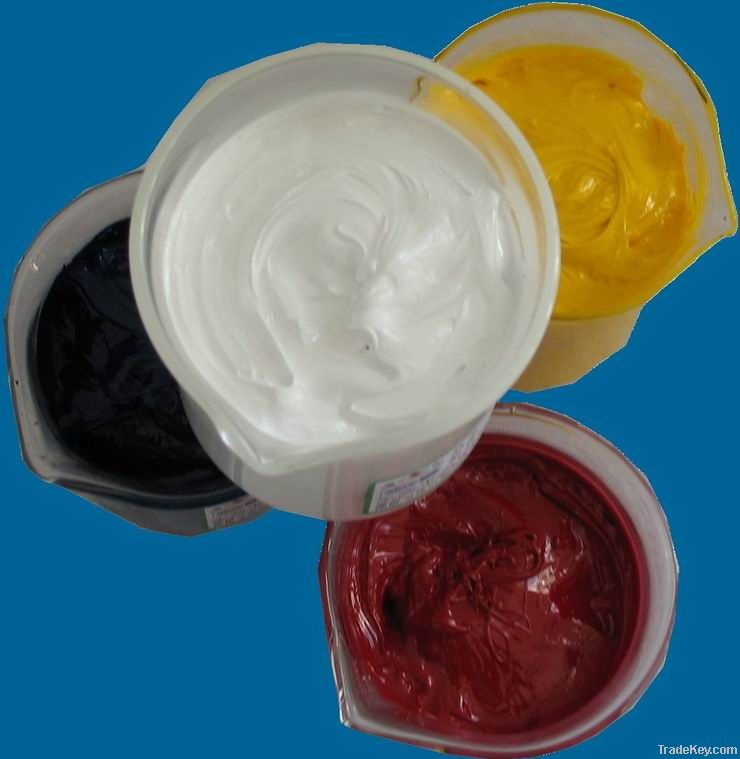
Printing paste ready to use.

This quality is called “flow”.  The choice of an agent to create this flow (called a thickening agent) is a critical component. In addition, each printing method we talked about last week (flat bed, screen or rotary), as well as the nature and sequence of fixation and aftertreatment steps  requires a specific kind of printing ink or paste.

For direct printing, a printing paste is prepared by dissolving the dyes in hot water to which is added urea and a solvent (ethylene glycol, thioethylene glycol, sometimes glycerine or a similar substance – and sometimes water).   This solution is stirred into a thickener that is easily removed by washing.  Small amounts of oxidizing agents are added.[1]

After making the printing paste, it is essential to strain or sieve all colours in order to free them from lumps, fine sand, and other foreign objects, which would inevitably damage the highly polished surface of the engraved rollers and result in bad printing. Every scratch on the surface of a roller prints a fine line in the cloth, and too much care, therefore, cannot be taken to remove, as far as possible, all grit and other hard particles from every color.

The straining is usually done by squeezing the paste through filter cloths as artisanal fine cotton, silk or industrial woven nylon. Fine sieves can also be employed for pastes that are used hot or are very strongly alkaline or acid.

All the necessary ingredients for the paste are metered (dosed) and mixed together in a mixing station. Since between 5 and 10 different printing pastes are usually necessary to print a single pattern (in some cases up to 20 different pastes are applied), in order to reduce losses, due to incorrect measurement, the preparation of the pastes is done in automatic stations. In modern plants, with the help of special devices, the exact amount of printing paste required is determined and prepared in continuous mode for each printing position, thus reducing leftovers at the end of the run.

There are two main types of paste used:

  1. Pigmented emulsions: Pigmented emulsions are suitable for all fiber types,  they are able to dry by evaporation at room temperature and are able to be cured at 320 degrees F for 2 – 3 minutes, which achieves washing and drycleaning fastness.  A typical formulation of a pigment emulsion printing paste is:

COMPONENTS

RATIO

Water

10%

Emulsifier

1%

Thickener

4%

White spirit

62%

Catalyst solution

3%

Binder

15%

Pigment dispersion

5%

Pastes which are entirely water-based are obtained by replacing the white spirit  with  water.

  1. Plastisol printing pastes :  based on a vinyl resin dispersed in plasticizer; characterized by virtually 100% non-volatility (no solvent is present); used frequently for printing on dark or dark-colored fabrics.  Components of plastisol printing pastes consist of
    1. PVC homopolymer (i.e., a vinyl resin) dispersed in phthalate plasticizer;
    2.  liquid plasticizer (i.e., dialkyl phthalate or di-iso-octyl phthalate);
    3. heat and light stabilisers (i.e., liquid barium/cadmium/zinc combined with epoxy plasticizer);
    4.  high proportion of extender to improve wet-on-wet properties.

Printing pastes are made up of four main components:

  1. The coloring matter used (dyes or pigments)
  2. The binding agent
  3. The solvent
  4. The auxiliaries.

The coloring matter used can be either dyestuffs or pigments.   Dyes are in solution and become chemically or physically incorporated into the individual fibers.   The dyes used for printing mostly include vat, reactive, naphthol and disperse colours which have good fastness properties.    Pigments are largely insoluable, so often organic solvents are used (such as benzene or toluene).   The pigmented printing paste must physically bind with the fabric, so must contain a resin, which holds the pigment in place on top of the fabric.

The binder is decisively responsible for the fastness of the pigment prints during use. The most important fastnesses are wash fastness, chemical cleaning fastness and friction fastness. The handle and the brilliance of the colours are also influenced by the choice of binder.
Binders are in general “self-crosslinking polymers” based mainly on acrylates and less commonly on butadiene and vinyl acetate, with solid contents of approx.. 40 – 50%. (2)   Binders made of natural wood resin, wax stand linseed or safflower oils and chitosan were tested in order to obtain biodegradable printing paste.  Promising results were reported when using chitosan as a binder, and no solvent was necessary.

Solvents are usually added in the formulation of the thickeners.  The type of paste (emulsion vs. plastisol) and thickening agent determines the type of solvent needed.  White spirit is a commonly used organic solvent, as is water.  The organic solvent concentration in print pastes may vary from 0% to 60% by weight, with no consistent ratio of organic solvent to water.  Water based solvents may still emit VOC’s from small amounts of solvent and other additives blended into the paste. The liquid waste material of water based pastes may also be considered hazardous waste.

The most important auxiliaries are the thickening agents.  Printing paste normally contains 40 – 70% thickener solution. [3] The printing thickeners used depend on the printing technique and fabric and dyestuff used. Typical thickening agents are starch derivatives, flour, gum Senegal and gum arabic (both very old thickenings, and very expensive today) and albumen. A starch paste is made from wheat starch, cold water, and olive oil, and boiled for thickening.  Starch used to be the most preferred of all the thickenings, but nowadays gums or alginates derived from seaweed is preferred as they allow better penetration of color and are easier to wash out.

Hot water soluble thickening agents as native starch are made into pastes by boiling; the colorants and solvents were added during this step then cooled, after which the various fixing agents would be added.  Colors are reduced in shade by simply adding more stock printing paste.  For example, a dark blue containing 4 oz. of methylene blue per gallon may readily be made into a pale shade by adding to it thirty times its bulk of starch paste or gum, as the case may be. Mechanical agitators are also fitted in these pans to mix the various ingredients together, and to destroy lumps and prevent the formation of lumps, keeping the contents thoroughly stirred up during the whole time they are being boiled and cooled to make a smooth paste. Most thickening agents used today are cold soluble and require less stirring.

Almost exclusively synthetic, acrylate-based thickening agents are used in pigment printing – or none at all, since the mix of resins, solvents and water produces thickening anyway.

Generally, the auxiliaries used for printing are the same as those used in dyeing with a dye bath.  These types of auxiliaries include:

  • Oxidizing  agents (e.g. m-nitrobenzenesulphonate, sodium chlorate, hydrogen peroxide)
  • Reducing  agents (e.g. sodium dithionite, formaldehyde sulphoxylates, thiourea      dioxide, tin(II) chloride)
  • Wetting  agents (nonionic, cationic, anionic)
  • Discharging  agents for discharge printing (e.g. anthraquinone)
  • Humectants   (urea, glycerine, glycols)
  • Carriers:  (cresotinic acid methyl ester,  trichlorobenzene, n-butylphthalimide in combination with other      phthalimides, methylnaphthalene)
  • Retarders  (derivatives of quaternary amines, leveling agents)
  • Resist agents  (zinc oxide, alkalis, amines, complexing agents)
  • Metal  complexes (copper or nickel salts of sarcosine or hydroxyethylsarcosine)
  • Softeners
  • Defoamers,  (e.g. silicon compounds, organic and inorganic esters, aliphatic esters,      etc.)
  • Resins[4]

[1] Ullman’s Fibers, page 766

(2)  Lacasse, K., and Baumann, W., Textile Chemicals: Enviornmental Data and Facts, Springer, 2004; p. 234

[3] Fritz Ullmann, editor,  Ullmann’s Fibers: Textile and dyeing technologies, vol 2; Wiley-VCH Verlag GmbH & Co, KGaA, weinheim, 2008, p. 759

[4] Ulmman, p. 743

Printing – part 1

O Ecotextiles (and Two Sisters Ecotextiles)

It is well known that the “finishing” of a fabric is where a great deal of the environmental impact occurs –  it uses the most water, chemicals and energy.

“Finishing” includes not only the application of treatments to make fabric perform in a certain way (i.e., to be free of something, such as static, wrinkles, or odor, or perhaps be waterproofed or flameproofed).  It also includes the decoration of the fabric.  This decoration can be simply dyeing the fabric a vibrant color.   But glorious designs on fabrics have always been popular.  Applying colored patterns and designs to decorate a finished fabric is called ‘printing’ – and we sure do love them!   Humans have been printing designs onto fabric for centuries.  It has been found on cloth in Egyptian tombs dating to about 5000 B.C. and India exported block prints to the Mediterranean region in the 5th cent. B.C., demonstrating that the Indus Valley civilization knew well the art of dyeing and use of mordents 5,000 years ago.

Printing on fabric is still very much in use today – we could even say it’s wildly popular –  and there’s a lot of talk about the sort of printing inks and dyestuffs used to print fabrics.   So I thought we’d take a look at textile printing and try to find out what the consequences of printing may be to us and the planet.  Printing is one of the most complex of all textile operations, because of the number of variables and the need for a high degree of precision, particularly since there is no way to correct a bad print.  So we’ll be looking at this topic over several weeks.

Technically, printing on textile can be defined as the reproduction of a decoration by application of one tool loaded with coloring material on a textile support. Early forms of textile printing are stencil work, highly developed by Japanese artists, and block printing. In the latter method a block of wood, copper, or other material bearing a design in intaglio (or relief)  with the dye paste applied to the surface is pressed on the fabric and struck with a mallet. A separate block is used for each color, and pitch pins at the corners guide the placing of the blocks to assure accurate repeating of the pattern.

Another style of fabric printing documented in Nuremberg, Germany, was the application of gold or silver dust on still wet fabric. This was an inexpensive way for lesser monasteries and churches to copy the expensive brocades from the Near and Far East, which arrived in Europe via the silk routes. These silk routes most often started in Italy, Venice in particular, and travelled over both land and sea. To economize further in the copying process, color was often filled in areas with a brush, reducing the number of blocks needed.  Velvet  effects were also added sometimes, this was accomplished by spreading powered wool on the gummed ink pattern. The document found in Nuremberg gave specific directions for duplicating the flowers and animals from the brocades.  These procedures could only be used on tapestries, church vestments and table furnishings because the colors weren’t fast. Because they couldn’t be washed these ornate fabrics were not used for clothing.

There are 5 basic steps in printing a fabric:

  1. Preparation of the print paste.
  2. Printing the fabric.
  3. Drying the printed fabric.
  4. Fixation of the printed dye or pigment.
  5. Afterwashing.

We’ll begin with taking a look at  step #2, printing the fabric:  today, a decorative pattern or design is usually applied to constructed fabric by roller, flat screen, or rotary screen methods.

Cylinder or roller printing was developed around 1785.  In the roller printing process, print paste is applied to an engraved roller, and the fabric is guided between it and a central cylinder. The pressure of the roller and central cylinder forces the print paste into the fabric. Because of the high quality it can achieve, roller printing is the most appealing method for printing designer and fashion apparel fabrics.

Screen printing is by far the most popular technology in use today. Screen printing consists of three elements: the screen which is the image carrier; the squeegee; and ink. The screen printing process uses a porous mesh stretched tightly over a frame made of wood or metal. Proper tension is essential for accurate color registration. The mesh is made of porous fabric or stainless steel. A stencil is produced on the screen either manually or photochemically. The stencil defines the image to be printed in other printing technologies this would be referred to as the image plate.

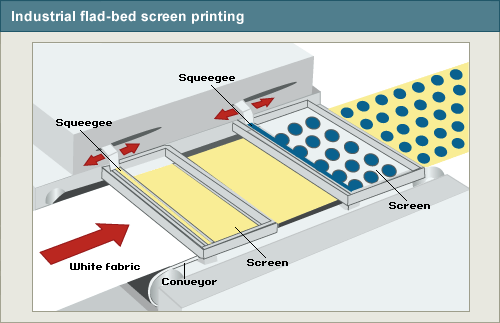
In flat bed screen printing, this process is an automated version of the older hand operated silk screen printing. For each color in the print design, a separate screen must be constructed or engraved.

From BBC, Bitesize, Design & Technology, Printing

If the design has four colors, then four separate screens must be engraved. The modern flat-bed screen-printing machine consists of an in-feed device, a glue trough, a rotating continuous flat rubber blanket, flat-bed print table harnesses to lift and lower the flat screens, and a double-blade squeegee trough. The in-feed device allows for precise straight feeding of the textile fabric onto the rubber blanket. As the cloth is fed to the machine, it is lightly glued to the blanket to prevent any shifting of fabric or distortion during the printing process. The blanket carries the fabric under the screens, which are in the raised position. Once under the screens, the fabric stops, the screens are lowered, and an automatic squeegee trough moves across each screen, pushing print paste through the design or open areas of the screens. Remember, there is one screen for each color in the pattern. The screens are raised, the blanket precisely moves the fabric to the next color, and the process is repeated. Once each color has been applied, the fabric is removed from the blanket and then processed through the required fixation process. The rubber blanket is continuously washed, dried, and rotated back to the fabric in-feed area. The flat-bed screen process is a semi-continuous, start-stop operation. Flat screen machines are used today mostly in printing terry towels.

Many factors such as composition, size and form, angle, pressure, and speed of the blade (squeegee) determine the quality of the impression made by the squeegee. At one time most blades were made from rubber which, however, is prone to wear and edge nicks and has a tendency to warp and distort. While blades continue to be made from rubbers such as neoprene, most are now made from polyurethane which can produce as many as 25,000 impressions without significant degradation of the image.

From a productivity standpoint, the process is slow with production speeds in the range of 15-25 yards per minute. Additionally, the method has obvious design limits. The design repeat size is limited to the width and length dimensions of the flat screen. Also, no continuous patterns such as linear stripes are possible with this method. However, this method offers a number of advantages. Very wide machines can be constructed to accommodate fabrics such as sheets, blankets, bedspreads, carpets, or upholstery. Also, this technique allows for multiple passes or strokes of the squeegee so that large amounts of print paste can be applied to penetrate pile fabrics such as blankets or towels. Currently, approximately 15-18% of printed fabric production worldwide is done on flat-bed screen machines.

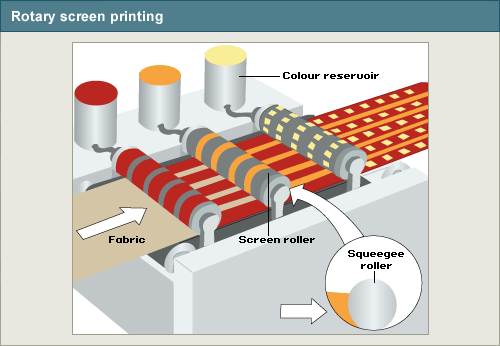
Rotary screen printing is so named because it uses a cylindrical screen that rotates in a fixed position rather than a flat screen that is raised and lowered over the same print location. Rotary presses place the squeegee within the screen. These machines are designed for roll-to-roll  printing on fabric ranging from narrow  to wide-format  textiles.

From BBC Bitesize, Design & Technology, Printing

In rotary printing, the fabric travels at a consistent speed between the screen and a steel or rubber impression roller immediately below the screen. (The impression roller serves the same function as the press bed on a flatbed press.) As the fabric passes through the rotary unit, the screen spins at a rate that identically matches the speed of substrate movement.

The squeegee on a rotary press is in a fixed position with its edge making contact with the inside surface of the screen precisely at the point where the screen, substrate, and impression roller come together . Ink is automatically fed into the center of the screen and collects in a wedge-shaped “well” formed by the leading side of the squeegee and the screen’s interior surface. The motion of the screen causes this bead of ink to roll, which forces ink into stencil openings, essentially flooding the screen without requiring a floodbar. The squeegee then shears the ink as the stencil and substrate come into contact, allowing the ink to transfer cleanly to the material.

By converting the screen-printing process from semi-continuous to continuous, higher production speeds are obtained than in flat bed printing. Typical speeds are from 50-120 yards per minute  for rotary screen printing depending upon design complexity and fabric construction.  Rotary screen machines are more compact than flat screen machines for the same number of colors in the pattern. Therefore, they use less plant floor space.

Also with rotary screens, the size of the design repeat is dependent upon the circumference of the screens. This was initially seen as a disadvantage, because the first rotary screens were small in diameter. However, with today’s equipment, screens are available in a range of sizes and are no longer considered design limited. Today’s rotary screen machines are highly productive, allow for the quick changeover of patterns, have few design limitations, and can be used for both continuous and discontinuous patterns.

Estimates indicate that this technique controls approximately 65% of the printed fabric market worldwide. The principle disadvantage of rotary screen printing is the high fixed cost of the equipment. The machines are generally not profitable for short yardages of widely varying patterns, because of the clean-up and machine down time when changing patterns. Flat screen printing is much more suitable for high pile fabrics, because only one squeegee pass is available with rotary screen. However, rotary machines are used for carpet and other types of pile fabrics.  Most knit fabric is printed by the rotary screen method, because it does not stress (pull or stretch) the fabric during the process.

The rotary garment screen printing machine, developed in the 1960s,  is the most popular device for screen printing in the industry. Screen printing on garments currently accounts for over half of the screen printing activity in the United States. [i]


If you’ve bought baby bottles or water bottles recently, I’m sure you’ve seen a prominent “BPA Free” sign on the container.

BPA stands for Bisphenol A, a chemical often used to make clear, polycarbonate plastics (like water and baby bottles and also eyeglass lenses, medical devices, CDs and DVDs, cell phones and computers).  And though it has been formally declared a hazard to human health in Canada and banned in baby bottles in both Canada as well as the EU,  U.S. watchdog agencies have wildly differing views of BPA:  The National Toxicology Program (NTP) reported “some concern” that BPA harms the brain and reproductive system, especially in babies and fetuses.  The Food and Drug Administration declared that “at current levels of exposure” BPA is safe.

But consider this:  Of  the more than 100 independently funded experiments on BPA, about 90% have found evidence of adverse health effects at levels similar to human exposure. On the other hand, every single industry-funded study ever conducted — 14 in all — has found no such effects.  David Case made the argument in the February 1, 2009 issue of Fast Company that this is a story about protecting a multibillion-dollar market from deregulation.  But that’s beside the point  which is:    nobody disputes the fact that people are constantly exposed to BPAs and babies are most at risk.  It’s also undisputed that BPA mimics the female sex hormone estrogen, and that some synthetic estrogens can cause infertility and cancer.  If you’d like to read more about this click here.

Bisphenol A is now deeply imbedded in the products of modern consumer society.  This is important because it’s used in so many modern products (making it pretty much ubiquitous), and because it is extremely potent in disrupting fetal development. BPA contamination is also widespread in the environment. For example, BPA can be measured in rivers and estuaries at concentrations that range from under 5 to over 1900 nanograms/liter.(1)

What this all means is that most of  us live our lives in close proximity to bisphenol A.

Because it’s used to make plastic hard, I never thought it would have a place in the textile industry.  So it was with some concern that I came across articles which explain the use of bisphenol A in the manufacturing of synthetic fibers.

Producing synthetic fibers and yarns is almost impossible without applying a processing aid to the fibers during the extrusion and spinning processes.   The fibers and yarns are frequently in contact with hot surfaces, or they pass through hot ovens.  In order to withstand these extreme conditions, the yarns and fibers have processing aids or finishes applied.    This applied processing aid or ‘finish’, in addition to helping the yarns withstand extreme temperatures, also  reduces static electricity, fiber-fiber and metal-fiber friction, provides integrity to the filaments,  and altogether eases the manufacturing processes.

But because modern manufacturing equipment runs at higher speeds and subsequently at higher temperatures, the finish degrades in the high temperatures – yielding lower quality fibers –  and generates unwanted decomposition products.  These byproducts can be in the form of:

  1. Toxic and nontoxic gases which have environmental and safety issues;
  2. Liquids, which leave a sticky residue on the yarns,
  3. Or they may form a solid varnish on hot surfaces that is very difficult to remove; the presence of the varnish interferes with continuous, efficient production leading to economic losses due to equipment shutdown and product failure.

To overcome the problems caused by the degradation of finishes, several additives are introduced to prevent or delay the reactions of oxidation and degradation.  Several classes of antioxidants are typically used as these additives in these finishes.

In a study sponsored by the National Textile Center, a research consortium of eight universities, three North Carolina State University professors investigated the thermal stability of textiles, specifically with respect to the antioxidants used in the finishes.  They investigated four different antioxidants – one of which is based on Bisphenol A. (2)

So I got interested, and began a bit of poking around for other mentions of Bisphenol A in the textile industry. I found two scientific references to use of bisphenol A in the production of  polyester fabrics.  Both reported similar use of Bisphenol A as this quote,  which states:  “ a woven polyester fabric was … finished with an aqueous compound  containing 5% polyethylene glycol bisphenol A ether diacrylate for 30 min at 60° to give a hygroscopic, antistatic fabric with good washfastness.” (3)

I found that Bisphenol A is used  in the production of flame retardants, and as an intermediate in the manufacture of polymers, fungicides, antioxidants (mentioned above), and dyes.   Because it is often used as an intermediate it’s hard to pin down, and manufacturers keep their ingredients trade secrets so we often will not know – unless somebody funds a study which is published.

I have not seen any studies which report finding Bisphenol A in a finished fabric, so this may be a tempest in a teacup.  But isn’t it worth noting that this chemical, which has been found in the blood of 95% of all Americans, and which some say may be the “new lead”, can exist in products in which we previously never would have thought to look?

(1)  http://www.ourstolenfuture.org/newscience/oncompounds/bisphenola/bpauses.htm

(2) Grant, Christine; Hauser, Peter; Oxenham, William, “Improving the Thermal Stability of Textile Processing Aids”,  www.ntcresearch.org/pdf-rpts/AnRp04/C01-NS08-A4.pdf

(3)  http://www.lookchem.com/cas-644/64401-02-1.html?countryid=0

Enzymes and GOTS

O Ecotextiles (and Two Sisters Ecotextiles)

Last week we reviewed the ways enzymes are helping to give textile processes a lighter footprint while at the same time producing better finished goods – at a lower cost.  Seems to be a win/win situation, until you begin to unpeel the onion:

It begins with the production of the enzyme:  Enzymes have always been obtained from three primary sources, i.e., animal tissue, plants or microbes.  By starting with the primary source and “feeding” it properly (known as fermentation), we ended up with our target product – like beer, for example.

But these naturally occurring enzymes are often not readily available in sufficient quantities for  industrial use. The production of enzymes – including microorganisms used to produce enzymes –  is a pursuit central to the modern biotechnology industry.  Until recently, the availability of enzymes  have been limited to the quantities that could be produced in the host organism in which they were naturally derived.

Today, the starting point is a vial of a selected strain of microorganisms – microbial hosts which have been selectively bred by industry. They will be nurtured and fed until they multiply many thousand times.  Once fermentation is complete, the microorganisms are destroyed, the desired enzymes are recovered from the fermentation broth and sold as a standardized product.

Modern biotechnology has improved enzyme production and enzyme quality in several ways:

1)     Increased efficiency of enzyme production resulting in higheryields;

2)     Increased enzyme purity through reduction or elimination of side activities;

3)     Enhancing the function of specific enzyme proteins, e.g., by increasing the temperature range over which an enzyme is active.

The results, as we discussed last week,  are better products, produced more efficiently, often at lower cost and with less environmental impact.

It wasn’t until genetic engineering came about that these biological methods became economically viable. Targeted genetic manipulation has not only enhanced the productivity of these methods, it also has resulted in the production of substances that were previously impossible. To date, up to 60% of all technical enzymes are produced with genetically modified organisms (GMO) – and this number is sure to increase given that GMO-based enzyme production requires 40-50% less energy and raw materials than traditional enzyme production.[1]  And therein lies the rub.

Cheese, eggs and milk, for example, may not be genetically modified themselves but may contain ingredients and additives that were produced from genetically modified microorganisms.

Take cheese for example: Traditionally, this enzyme preparation, sometimes known as rennin, was extracted from calf stomachs. The active ingredient is chymosin, an enzyme produced in the stomach of suckling calves needed for breaking down cow’s milk.

It is now possible to produce chymosin in genetically modified fungi. These modified microorganisms contain the gene derived from the stomach of calves that is responsible for producing chymosin. When grown in a bioreactor, they release chymosin into the culture medium. Afterwards, the enzyme is extracted and purified yielding a product that is 80 to 90 percent pure. Natural rennin contains only 4 to 8 percent active enzyme.[2]

Even the nutritive medium used to grow bacteria and fungi is often made from GMOs.

Again, what are the arguments against GMO?

Briefly, because I want to get to how this pertains to the textile industry, here are the most common concerns :

1)     What happens when these GMOs interact with other organisms?  Already there is concern that GMO crops resistant to weed killers will themselves become uncontrolled weeds in other fields – the GMO plant may cross pollinate with a related species that is a weed which then becomes resistant to weed killers.  This is already happening according to many published reports.  And it can happen in really subtle ways:

  1. Since 1986, Novo Nordisk, one of the world’s largest producers of industrial enzymes,  has processed the residuals of fermentation processes generated by GMOs into “biomass” or “sludge” called NovoGro. The sludge is dehydrated and freely distributed among farmers. NovoGro is virtually the company’s only possibility to dispose of its massive enzyme production waste. In 1996, 2.2 million cubic meters of NovoGro were produced. Daily about 150 truckloads of NovoGro are spread over 70 hectares of land in Denmark .  Total costs are about US$ 13 million per year, all carried by Novo Nordisk. A Danish farmers’ organization protested against the distribution of NovoGro because it suspected pollution by GMOs. There are concerns that risks associated with the use of GMO products is not worth the benefits as long as the environmental impacts are not monitored by third parties.[3]

2)     The argument rages about the human health risks of genetically engineered foods – specifically with regard to the rise in food allergies. The British Medical Association (BMA)  in a study done in 2003, concluded that the risks to human health associated with GMO foods is negligible, while calling for further research and surveillance.[4]

3)     Ethical concern of the “slippery slope”: because it appears to provide costless benefits, so companies and governments may rush into production one or more products of the new technologies that will turn out to be harmful, either to the environment or to humans directly.

The manufacturers and scientists tell us that there are no traces of these GMO microorganisms in the final product, and no microbial DNA is detectable.

Additives (such as enzymes) that are produced with the help of genetically modified microorganisms do not require labeling because GMOs are not directly associated with the final product.  In the textile industry, they are known as auxiliaries or processing aids.

In textiles, the Global Organic Textile Standard (GOTS) has stated that the use of genetically modified organisms – including their enzymes – is incompatible with the production of textiles labelled as ‘organic’ or ‘made with organic’ under GOTS.  According to the GOTS website:  “While the IWG Technical Committee acknowledges that there are applications including, and based on GM technologies, that result in a reduction of energy and water use and replace chemicals compared to some conventional textile processes this is only one side of the coin.”  They go on to say that it is important to give consumers a choice to actively decide for themselves if they want to purchase a textile product made without using any GMO derived inputs.

As a company which is trying to do the right thing, I don’t know where I stand on this issue.    What do you think?


[3] Pistorius, Robin, “Novo Nordisk’s Environmental Accountability”, Biotechnoloty and Development Monitor, December 1997

Enzymes in textile processing

O Ecotextiles (and Two Sisters Ecotextiles)

Humankind has used enzymes for thousands of years to carry out important chemical reactions for making products such as cheese, beer, and wine. Bread and yogurt also owe their flavor and texture to a range of enzyme producing organisms that were domesticated many years ago.

In the textile industry, one of the first areas which enzyme research opened up was the field of desizing of textiles.  A size is a substance that coats and strengthens the fibers to prevent damage during the weaving process. Size is usually applied to the warp yarn, since this is particularly prone to mechanical strain during weaving.   The size must be removed before a fabric can be bleached and dyed, since it affects the uniformity of wet processing. Previously, in order to remove the size, textiles were treated with acid, alkali or oxidising agents, or soaked in water for several days so that naturally occurring microorganisms could break down the starch. However, both of these methods were difficult to control and sometimes damaged or discoloured the material. But by using enzymes, which are specific for starch, the size can be removed without damaging the fibers.

Enzymes used in textile processing - photo from Novozymes

It represented great progress, therefore, when crude enzyme extracts in the form of malt extract, or later, in the form of pancreas extract, were first used to carry out desizing.  Bacterial amylase derived from Bacillus subtilis  was used for desizing  as early as 1917. Amylase is a hydrolytic enzyme which catalyses the breakdown of dietary starch to short chain sugars, dextrose  and maltose.

Enzymes have been used increasingly in the textile industry since the late 1980s. Many of the enzymes developed in the last 20 years are able to replace chemicals used by mills. The first major breakthrough was when enzymes were introduced for stonewashing jeans in 1987 – because more than one billion pairs of denim jeans require some sort of pre-wash treatment every year. Within a few years, the majority of denim finishing laundries had switched from pumice stones to enzymes.

Today, enzymes are used to  treat and modify fibers, particularly during textile processing and in caring for textiles afterwards.  They are used to enhance the preparation of cotton for weaving, reduce impurities, minimize “pulls” in fabric, or as pre-treatment before dying to reduce rinsing time and improve color quality.  New processing applications have been developed for:

  • Scouring (the process of removing natural waxes, pectins, fats and other impurities from the surface of fibers), which gives a fabric a high and even wet ability so that it can be bleached and dyed successfully. Today, highly alkaline chemicals (such as caustic soda) are used for scouring. These chemicals not only remove the non-cellulosic impurities from the cotton, but also attack the cellulose leading to heavy strength loss and weight loss in the fabric. Furthermore, using these hazardous chemicals result in high COD (chemical oxygen demand) and BOD (biological oxygen demand)  in the waste water. Recently a new enzymatic scouring process known as ‘Bio-Scouring’ is being used in textile wet-processing with which all non-cellulosic components from native cotton are completely or partially removed. After this Bio-Scouring process, the cotton has an intact cellulose structure, with lower weight loss and strength loss. The fabric gives better wetting and penetration properties, making the subsequent bleach process easy and  giving much better dye uptake.
    • One of the newest products, PrimaGreen® EcoScour from Genencor, offers sustainability advantages for eco-scouring in cotton pretreatment, including 30 percent water savings and 60 percent energy savings compared to standard processing. In addition, the mild processing conditions result in improved fabric quality and enhanced color brightness after dyeing.
  • Bleaching – When bleaching cotton, a lot of chemicals, energy and water are part of the process. The company Huntsman has developed a wetter/stabilizer that maximizes the wetting and detergency of the bleaching process and a one-bath caustic neutralizer and peroxide remover in order to shorten the bleaching cycle, reduce energy and water required and deliver more consistent bleaching results. They have developed surfactants that are environmentally friendly (in that they do not contain Alkylphenol ethoxylates), and the system is both Oeko-Tex and GOTS approved.  After fabric or yarn bleaching, residues of hydrogen peroxide are left in the bath, and need to be completely removed prior to the dyeingprocess, using a step called bleach cleanup.  The traditional method is to neutralize the bleach with a reducing agent, but the dose has to be controlled precisely. Incomplete peroxide removal results in poor dyeing with distinct change of color shade and intensity, as well as patchy, inconsistent dye distribution. Enzymes used for bleach clean-up ensure that residual hydrogen peroxide from the bleaching process is removed efficiently – a small dose of catalase breaks hydrogen peroxide into water and oxygen.  This results in cleaner waste water and reduced water consumption.
    • In 2010, a life-cycle assessment was completed comparing PrimaGreen enzymatic bleaching to conventional textile bleaching methods. According to this LCA, if the enzymatic system were to see wide scale global adoption, the potential savings in freshwater consumption could be up to 10 trillion liters of water annually, and greenhouse gas reductions could range from 10-30 million metric tons. (1)
  • Biofinishing or biopolishing (removing fiber fuzz and pills from fabric surface) –  enzymatic biofinishing yields a cleaner surface, softer handfeel, reduces pilling and increases luster;
  • Denim finishing – In the traditional stonewashing process, the blue denim was faded by the abrasive action of pumice stones on the garment surface. Nowadays, denim finishers are using a special cellulase.  Cellulase works by loosening the indigo dye on the denim in a process known as ‘Bio-Stonewashing’. A small dose of enzyme can replace several kilograms of pumice stones. The use of less pumice stones results in less damage to garment, machine and less pumice dust in the laundry environment; in addition, it’s possible to fade denim without risk of damaging the garment.
  • European scientists have just announced a new and environmentally friendly way to produce textile dyes using enzymes from fungi. (2)

Because of the properties of enzymes, they make the textile manufacturing process much more  environmentally benign. (3)   Generally, they:

  1. operate under milder conditions (temperature and pH) than conventional process chemicals – this results in lower energy costs ( up to 120 kg CO2 savings per ton of textile produced) (4) ;
  2. save water – reduction of water usage up to 19,000 liters per ton of textiles bleached;
  3. are an alternative for toxic chemicals, making wastewater easier and cheaper to treat.
  4.  are easy to control;  do not attack the fiber structure with resulting loss of weight, resulting in better quality of material;
  5. better and more uniform affinity for dyes;
  6. contribute to safer working conditions through elimination of chemical treatments during production processes;
  7. are fully biodegradable.

So why is there a ruckus about enzymes being used in textile processing by GOTS and other organic certifying agencies?

(1)   http://primagreen.genencor.com/sustainability/lca_results/

(2)   http://www.just-style.com/news/eco-friendly-textile-dyes-use-enzymes-from-fungi_id112195.aspx

(3)   http://www.textiletodaybd.com/index.php?pid=magazine&id=52

(4)  http://www.europabio.org/sites/default/files/pages/lutz-walter-benefits-from-white-biotechnology-applications-in-the-european-textile-and-clothing-industry.pdf

Thanksgiving

O Ecotextiles (and Two Sisters Ecotextiles)

I really love Thanksgiving – it’s hard to ruin this holiday. Thanksgiving     can be about nothing more than the name implies… expecting nothing, but giving profound thanks for our imperfect, nutty, busy, fractured, silly, wonderful lives. And since Thanksgiving asks us to slow down and think about all that we have to be thankful for, here are a few things I’ll be doing this weekend:

  • Practicing gratitute. I will, as Ram Dass said, try to “be here now”. I will be in the moment, really be in the moment, and notice what’s around me. And be thankful for all of it. Rosie Cash said, “Just ‘thank you’ is a mighty powerful prayer. Says it all.”
  • Choosing joy. John Milton  said so long ago in Paradise Lost:

The mind is its own place, and in itself

Can make a Heav’n of Hell, a Hell of Heav’n

I hope you have a wonderful holiday.

White biotechnology and enzymes

O Ecotextiles (and Two Sisters Ecotextiles)

For tens of thousands of years, humans relied on nature to provide them with everything they needed to make their lives more comfortable -cotton and wool for clothes, wood for furniture, clay and ceramic for storage containers, even plants for medicines. But this all changed during the first half of the twentieth century, when organic chemistry developed methods to create many of these products from oil.  Oil-derived synthetic polymers, colored with artificial dyes, soon replaced their precursors from the natural world.

But today, with growing concerns about the dependence on imported oil and the awareness that the world’s oil supplies are not limitless, coupled with stricter environmental regulations,  chemical and biotechnology industries are exploring nature’s richness in search of methods to replace petroleum-based synthetics.  As with other forms of biotechnology, industrial biotech involves engineering biological molecules and microbes with desirable new properties. What is different is how they are then used: to replace chemical processes with biological ones. Whether this is to produce chemicals for other processes or to create products such as biopolymers with new properties, there is a  huge effort to harness biology to accomplish what previously needed big, dirty chemical factories, but in cleaner and greener ways.

The public has for a long time perceived biotechnology to mean dangerous meddling with the genes in food and fiber crops.  But biotechnology is about much more than transgenic crops – it also uses microbes to make pharmaceuticals, for example.  Industrial biotechnology is known as “white” biotechnology, as distinct from “red” biotechnology, which is devoted to medical and pharmaceutical purposes, and “green” biotechnology, or the application of biotechnology in agriculture.

From: EuropaBio

Today, the application of biotechnology to industrial processes holds many promises for sustainable development.  One of the first goals on white biotechnology’s agenda has been the production of biodegradable plastics, and in textiles,  DuPont has invested much in the production of textile fibers from corn sugar (Sorona ®) while Cargill Dow has introduced NatureWorks ™, a polymer made from lactic acid which is used in textiles under the brand name Ingeo ®.  And these new processes have resulted in considerable environmental benefits:  In the case of Sorona ®, for example,  DuPont was able to replace the toxic elements of ethylene glycol and carbon monoxide in typical PET fibers with benign corn sugars.

But there are challenges pertaining to these new bioplastics, and the evidence that they’re actually better for the planet is hotly debated.  As Jim Thomas argues in the New Internationalist online magazine:

Strictly speaking a bioplastic is a polymer that has been produced from a plant instead of from petroleum. That is neither a new breakthrough nor a guarantee of ecological soundness. The earliest plastics such as celluloid were made from tree cellulose before petroleum proved itself a cheaper source. Today, with oil prices skyrocketing, it’s cheaper feedstock –  not green principles –  that is driving chemical companies back to bio-based plastics. Bioplastics may bring in the greenbacks for investors but are they actually green for the planet? The evidence is not convincing. For a start bioplastics may or may not be degradable or biodegradable – two terms that mean very different things. Many bio-based plastics – like DuPont’s Sorona – make no claims to break down in the environment. So much for disposal. But replacing fossil fuels with plants has to be a good idea, right? This is the premise on which the green claims of bioplastics mostly rest. Unfortunately, as advocates of biofuels have learned, switching from oil to biomass as the feedstock of our industrial economy carries its own set of problems. Like hunger.

There is nothing sustainable or organic about most industrial agriculture feedstocks. At present genetically modified corn grown using pesticides is probably the leading source of starch for bioplastics.  The link between genetic contamination and bioplastics is strong.

As concerns mount, the Sustainable Biomaterials Collaborative (SBC) – a network of 16 civil society groups and ethical businesses – is working to define a truly sustainable bioplastic. One of its founders, Tom Lent, explains that the SBC started because ‘the promise of bioplastics was not being realized’.

But biotechnology is not just about bioplastics – it’s actually mostly, these days,  about enzymes.  Biotechnology can provide an unlimited and pure source of enzymes as an alternative to the harsh chemicals traditionally used in industry for accelerating chemical reactions. Enzymes are found in naturally occurring microorganisms, such as bacteria, fungi, and yeast, all of which may or may not be genetically modified.  (We’ll come back to this important point later.)

But what are enzymes?

Enzymes are large protein molecules that  act as  catalysts – substances that start or accelerate chemical reactions without themselves being affected —  and help complex reactions occur everywhere in life.  By their mere presence, and without being consumed in the process, enzymes can speed up chemical processes – reactions occur about a million times faster than they would in the absence of an enzyme. In principle, these reactions could go on forever, but in practice most enzymes have a limited life.   There are many factors that can regulate enzyme activity, including temperature, activators, pH levels, and inhibitors.

Enzymes play a diversified role in many aspects of everyday life including aiding in digestion and the production of food as well as in industrial applications. Enzymes are nature’s catalysts. Humankind has used them for thousands of years to carry out important chemical reactions for making products such as cheese, beer, and wine. Bread and yogurt also owe their flavor and texture to a range of enzyme producing organisms that were domesticated many years ago.

Enzymes are categorized according to the compounds they act upon. Some of the most common include:

  •  proteases which break down proteins,
  •  cellulases which break down cellulose,
  •  lipases which split fats (lipids) into glycerol and fatty acids, and
  •  amylases which break down starch into simple sugars.  Human saliva, for example, contains amylase, an enzyme that helps break down starchy foods into sugars.

In textile treatment, the first enzyme applications, as early as 1857, was the use of barley for removal of starchy size from woven fabrics. The first microbial amylases were used in the 1950s for the same desizing process, which today is routinely used by the industry.

Enzymes are now widely used to prepare the fabrics that your clothing, furniture and other household items are made of.  Increasing demands to reduce pollution caused by the textile industry has fueled biotechnological advances that have replaced harsh chemicals with enzymes in many textile manufacturing processes.  The use of enzymes not only make the process less toxic (by substituting enzymatic treatments for harmful chemical treatments) and eco-friendly, they reduce costs associated with the production process, and consumption of natural resources (water, electricity, fuels), while also improving the quality of the final textile product.

But how do they work?

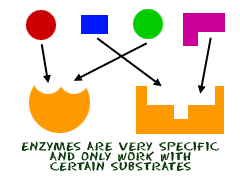
Rader’s Chem4Kids.com website  has a great explanation, which I’ve quoted below:

Think of enzymes as similar to keys which can open locks.  Just as when you need a key that is just the right shape to fit in a particular lock, enzymes complete very specific jobs and do nothing else.  

From: Chem4Kids

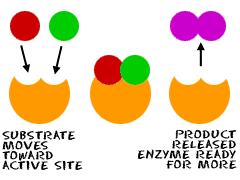
 They are very specific locks and the compounds they work with are the special keys. In the same way there are door keys, car keys, and bike-lock keys, there are enzymes for neural cells, intestinal cells, and your saliva.

Here’s the deal: there are four steps in the process of an enzyme working. 

  1.  An enzyme and a substrate are in the same area. The substrate is the biological molecule that the enzyme will attack. 
  2.  The enzyme grabs onto the substrate with a special area called the active site.  The active site is a specially shaped area of the enzyme that fits around the substrate. The active site is the keyhole of the lock. 
  3. A process called catalysis happens. Catalysis is when the substrate is changed. It could be broken down or combined with another molecule to make something new. 
  4.  Then the enzyme lets go.  When the enzyme lets go, it returns to normal, ready to do another reaction. But the substrate is no longer the same – the substrate is now called the product.

Next, well take a look at how enzymes are helping to make the textile industry’s environmental footprint a bit more benign.