OEcotextiles

Indulgent yet responsible fabrics

Listmania: LBC Red List and others

O Ecotextiles (and Two Sisters Ecotextiles)

I love lists – you know, all those “best of” lists – movies, books, toxic chemicals.

Having a list makes it easy for us to tick off those bad chemicals that nobody wants to live with.  And in the building industry there have been a proliferation of lists which identify chemicals of concern:  the Perkins & Will Precautionary List, the LEED Pilot 11 and the Living Building Challenge Red List, among others.  And make no mistake, we think it’s critical that we begin to develop these lists, because we all need a baseline.   As long as we need to eat and breathe, toxics should be an important consideration.  We just have a problem with  how these lists are used.

So let me explain.

First, lists for the most part are developed on the basis of science that usually occurred five or 10 years ago, so they can  (though not always) be lagging indicators of safety to humans and the environment.  (But that’s a minor point, just wanted us to remember to maintain those lists.)

When using lists, it’s important to remember the concept of reactive chemistry:  many of the chemicals, though possibly deemed to be benign themselves, will react with other chemicals to create a third substance which is toxic.   This reaction can occur during the production of inputs, during the manufacture of the final product, or at the end of life (burning at the landfill, decomposing or biodegrading).   So isn’t it important to know the manufacturing supply chain and the composition of all the products – even those which do not contain any chemicals of concern on the list you’re using – to make sure there are no, say … dioxins created during the burning of the product at the landfill, for example?

It’s also important to remember that  chemicals are synergistic  – toxins can make each other more toxic.  A small dose of mercury that kills 1 in 100 rats and a dose of aluminum that will kill 1 in 100 rats, when combined, have a striking effect: all the rats die.  So if the product you’re evaluating is to be used in a way that introduces a chemical which might react with those in your product, shouldn’t that be taken into consideration?

So, O.K., the two problems above would be extremely difficult to define  – I mean, wouldn’t you need a degree in chemistry, not to mention the time and money, to determine if these could occur .  The average consumer wouldn’t have a clue.  Just wanted you to know that these problems do exist and contribute to our precautionary admonition regarding lists.

Each list has a slightly different interpretation – and lists different chemicals.  The Healthy Building Network published this Venn diagram of several of the most prevalent lists used in building materials:

The real reason we don’t like the way lists are used is that people see the list, are convinced by a manufacturer that their product doesn’t contain any of the chemicals listed, so without any further ado the product is used.

What does that mean in the textile industry, for example?

By attempting to address all product types, most lists do not mention many of the toxic chemicals which ARE used in textile processing. In the Living Building Challenge Red List, no mention is made of polyester, the most popular fiber for interiors, which itself is made from two toxic ingredients (ethylene glycol and terephthalic acid – both carcinogens, neither of which are on the list).  That means  a fabric made of polyester – even recycled polyester – that has been processed using some pretty nasty chemicals – could be specified.   Chemicals which are commonly used in textile processing  and which are NOT included on the Living Building Challenge Red List, for example,  but which have been found to be harmful , include:

Chlorine   (sodium hypochlorite NaOCL); registered in the Toxic Substances Control Act   as hypochlorous acid ; sodium chlorite
Sodium cyanide;   potassium cyanide
sodium sulfate   (Na2SO4)
Sodium sulfide
 APEOs ( Alkylphenolethoxylates)
Chromium III   and VI (hexavalent chromium)
Zinc
Copper
pentachlorophenol   (PCP)
permethrin
Dichloromethane   (DCM, methylene chloride)
Tetrachloroethylene   (also known as perchloroethylene, perc and PCE)
Methyl ethyl   ketone
Toluene:   toluene diisocyanate and other aromatic amines
Methanol (wood   alcohol)
Chloroform;   methyl chloroform
Arsenic
Phosphates   (concentrated phosphoric acid)
Dioxin –   by-product of chlorine bleaching; also formed during synthesis of certain   textile chemicals
Benzenes and   benzidines; nitrobenzene; C3 alkyl benzenes; C4 alkyl benzenes
Sulfuric Acid
Optical   brighteners: includes several hundred substances, including triazinyl   flavonates; distyrylbiphenyl sulfonate
Acrylonitrile
ethylenediaminetetra   acetic acid [EDTA]
diethylenetriaminepenta   acetic acid [DTPA]
Perfluorooctane   sulfonates (PFOS)

In the case of arsenic (used in textile printing and in pesticides) and pentachlorophenol (used as a biocide in textile processing) – the Living Building Challenge Red List expressly forbids use in wood treatments only, so using it in a textile would qualify as O.K.

Perhaps we should manufacture with a “green list” in mind: substituting chemicals and materials that are inherently safer, ideally with a long history of use (so as to not introduce completely new hazards)?

But using any list of chemicals of concern ignores what we consider to be the most important aspect needing amelioration in textile processing – that of water treatment.  Because the chemicals used by the textile industry include many that are persistent and/or bioaccumulative which can interfere with hormone systems in people and animals and may be carcinogenic and reprotoxic, and because the industry often ignores water treatment even when it is required (chasing the lowest cost) the cost of dumping untreated effluent into our water is incalculable.

The textile industry uses a LOT of water – according to the World Bank, 20% of industrial freshwater pollution is from the textile industry; that’s another way of saying that it’s the #1 industrial polluter of water on the planet.  In India alone textile effluent averages around 425,000,000 gallons per day, largely untreated[1].   The chemically infused effluent – saturated with dyes, de-foamers, detergents, bleaches, optical brighteners, equalizers and many other chemicals –  is often released into the local river, where it enters the groundwater, drinking water, the habitat of flora and fauna, and our food chain.  The production of polychlorinated biphenyls (PCBs) were banned in USA more than 30 years ago (maybe that’s why they’re not listed on any of these lists?), but are still showing up in the environment as unintended byproducts of  the chlorination of wastes in sewage disposal plants that have a large input of biphenyls (used as a dye carrier) from textile effluent.[2]

Please click HERE to see the PDF by Greenpeace on their new campaign on textile effluent entitled  “Dirty Laundry”, which points the finger at compliant corporations which basically support what they call the “broken system”.  It asks corporations to become champions for a post toxic world, by putting in place policies to eliminate the use and release of all hazardous chemicals across a textile company’s entire supply chain based on a precautionary approach to chemicals management, to include the whole product lifecycle and releases from all pathways.

Another problem in the textile industry which is often overlooked is that of end of life disposal.  Textile waste in the UK, as reported by The Ecologist, has risen from 7% of all waste sent to landfills to 30% in 2010.[3]  The US EPA estimates that textile waste account for 5% of all landfill waste in the U.S.[4]  And that waste slowly seeps chemicals into our groundwater, producing environmental burdens for future generations.  Textile sludge is often composted, but if untreated,  that compost is toxic for plants.[5]

What about burning:    In the United States, over 40 million pounds of still bottom sludge from the production of ethylene glycol (one of the components of PET fibers) is generated each year. When incinerated, the sludge produces 800,000 lbs of fly ash containing antimony, arsenic and other metals.[6]

These considerations are often neglected in looking at environmental pollution by textile mills[7] – but is never a consideration on a list of chemicals of concern.

So yes, let’s recognize that there are chemicals which need to be identified as being bad, but let’s also look at each product and make some kind of attempt to address any other areas of concern which the manufacture of that product might raise.  Using a list doesn’t get us off the hook.


[1] CSE study on pollution of Bandi river by textile industries in Pali town, Centre for Science and Environment,New Delhi, May 2006 and “Socio-Economic, Environmental and Clean Technology Aspects of Textile Industries in Tiruppur,South India”, Prakash Nelliyat, Madras School of Economics.  See also:

Jacks Gunnar et al (1995), “The Environmental Cost of T-Shirts”, Sharing Common Water Resources, First Policy Advisory Committee Meeting, SIDA, Madras Institute of Development Studies, Chennai.

Also:  CSE: Down to Earth Supplement on Water use inIndia, “To use or to misuse”;  http://www.cseindia.org/dte-supplement/industry20040215/misuse.htm

[3] Ecologist, “’Primark effect’ sill clogging up UK landfills”, January 19, 2010,  http://www.newsinferno.com/legal-news/possible-link-between-formaldehyde-lou-gehrigs-disease-found/2926

[5] Scientia Agricola, vol. 62, no 3 May/June 2005

[6] Sustainable Textile Development at Victor,  http://www.victor-innovatex.com/doc/sustainability.pdf

[7] Assuming a beginning value of 375ppm of antimony in an undyed polyester fiber, as much as 175ppm of antimony can be leached from the fiber during the dyeing process. This seemingly insignificant amount translates into a burden on water treatment facilities and is still a hazardous waste when precipitated out during treatment. The U.S. EPA lists the allowable limit for antimony in drinking water to be 6 parts per billion (ppb). Countries that can afford technologies that precipitate the metals out of the water are left with a hazardous sludge that must then be disposed of in a properly managed landfill or incinerator operations. Countries who cannot, or who are unwilling to employ these end-of-pipe treatments, release antimony along with a host of other dangerous substances to open waters. Victor Defining Sustainability, http://www.victor-innovatex.com/doc/sustainability.pdf
Toxic Baby

O Ecotextiles (and Two Sisters Ecotextiles)

Since I’ve managed to figure out how to embed videos in the blog, I can’t seem to help showing you some of the most electrifying clips I’ve seen.  This is one of them – please watch it!

Filmmaker Penelope Jagessar Chaffer was curious about the chemicals she was exposed to while pregnant: Could they affect her unborn child?

Ms.  Chaffer won her first British Academy Award Nomination for her BBC4 debut, Me and My Dad, followed by Shakespeare’s Stories for the BBC, for which she received a BAFTA nomination.

It was her question about the effects of chemicals on her unborn child which led to her production of the  documentary/surrealist film Toxic Baby.   Today she works to bring to light the issue of  environmental chemical pollution and its effect on babies and children.

In working on the film, she worked with scientist Tyrone Hayes, an expert on amphibians at the University of California, Berkeley.  He is a critic of atrazine (a herbicide used on corn), which he has found to interfere with the development of frog endocrine systems.

Onstage together at TEDWomen, Hayes and Chaffer tell their story.  It’s stunningly disturbing.

Nylon 6 and Nylon 6,6

O Ecotextiles (and Two Sisters Ecotextiles)

Nylon is a synthetic polymer called a polyamide  because of the characteristic monomers of amides in the backbone chain.  Polyamides are also naturally occurring – proteins such as wool and silk are also polyamides.

We commonly see two basic types of nylon used in fabrics: nylon 6 and nylon 6,6:

  • Nylon 6,6:  Two different molecules (adipic acid and hexamethylene diamine)  are combined to create repeat units of 6 carbon atoms, thus the name nylon 6,6.
  • Nylon 6:  Only one type of molecule is used in the formation of nylon 6, which also has 6 carbon atoms.  The repeat unit for type 6 nylon is made from caprolactam (also called ε-caprolactam).

Remember polyester is also a polymer (as are lots of naturally occurring things).  And like polyester, the nylon polymers are theoretically unreactive and not particularly harmful, but that’s not true of the monomers:

  • A small % of the monomers escape during production (off gassing or into water), which have environmental consequences.
  • With production expected to be over  4.4 million pounds/year by 2020, burden on water treatment facilities is immense.
  • Monomers are precipitated out during treatment, so they are present in the sludge.

The manufacture of both nylon 6,6 and nylon 6 uses cyclohexane as a precursor [1] – and cyclohexane is made from benzene, “one of the most challenging processes in the chemical industry”.[2]  Benzene is listed as a human carcinogen by the US Department of Health and Human Services.  It is associated with acute myeloid leukemia (AML), aplastic anemia, myleodysplastic syndrome (MDS), acute lymphoblastic leukemia (ALL), and chronic myeloid leukemia (CML)[3]  The American Petroleum Institute (API) stated in 1948 that “it is generally considered that the only absolutely safe concentration for benzene is zero.” [[4]

But the real culprits are the generation of unwanted by-products of nylon manufacture:  ammonium sulfate [5] in the case of nylon 6 and nitrous oxide in the case of nylon 6,6.

For nylon 6, the conventional synthesis route to caprolactam uses toxic hydroxylamine (NH2OH) and, in the last two steps, concentrated sulfuric acid. Every metric ton of caprolactam produces up to 4.5 tons of ammonium sulfate as a by-product [6].  As with many chemicals now in use, there is no data to evaluate ammonium sulfate as to toxicity to humans, though it has been shown to affect development, growth and mortality in amphibians, crustaceans, fish, insects, mollusks, and other organisms.[7]

In addition, waste water generated during production of nylon-6 contains the unreacted monomer, caprolactam. Owing to the polluting and toxic nature of ε-caprolactam, “its removal from waste streams is necessary”[8]

In evaluating the chief components of nylon 6,6  (hexamethlylenediamine and adipic acid), we find a darker situation.   Hexamethlylenediamine is a  petroleum derivative,  with the usual consequences of petroleum processing. It is considered “mildly toxic”[9] (though in one study, ten administrations of 700 mg/kg to mice killed 3 of 20[10]).   But the production of the other monomer,  adipic acid,  requires the oxidation of cyclohexanol or cyclohexanone by nitric acid, a process which produces nitrous oxide (N2O) –  a greenhouse gas 300 times more potent than CO2.[11]  A study published in 1991 credits the production of nylon – and the concurrent by-product of nitrous oxide – as contributing as much as 10% to the increased observance of atmospheric N2O.[12]  And this is a great concern, so much so that there is increased talk of our “nitrogen footprint”.

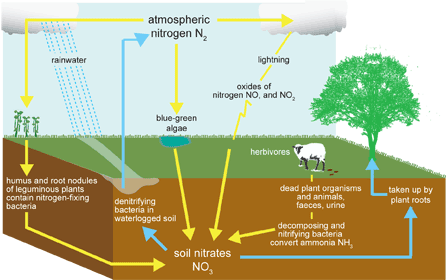
Nitrogen is one of the 5 elements (the others are carbon, hydrogen, oxygen, and phosphorus) that make life possible. It is essential for the creation of DNA, amino acids and proteins. 79% of the earth’s atmosphere is made up of nitrogen, but living things can’t use it in this form called dinitrogen (N2).  So in the nitrogen cycle, lightning  converts N2 into nitrate, which is carried to Earth by rain, where it enters the food chain.  When organisms die, bacteria recycles the nitrogen in them and it returns to the atmosphere.  Pretty elegant, isn’t it?

From: Nitrous Oxide Focus Group

But we have disrupted this nitrogen cycle.  A study by University of Virginia environmental scientist James Galloway and colleagues reported that from 1970 to 2008, world population increased by 78% and reactive nitrogen creation grew 120%.[13] The turning point, according to the International Nitrogen Initiative, came in 1909 when humans figured out how to combine hydrogen with N2 to create ammonia – which was used to produce fertilizer. Humans have introduced additional reactive nitrogen into the environment by expanding the production of soybeans, peanuts and alfalfa, (leguminous) crops which host nitrogen-fixing bacteria that convert N2 into reactive nitrogen. We use ammonia to manufacture nylon, plastics, resins, animal and fish feed supplements, and explosives. Fossil fuel burning industries and vehicles produce nitrogen emissions, and nitrogen is a component of the electronics, steel, drug, missile and refrigerant industries.

A single nitrogen molecule can cascade through the environment affecting air and water quality, human health and global warming in numerous ways(click here for a summary):

  • Runoff from agriculture—from fertilized crops fed to animals, from manure, and from biofuel and crops—enters rivers and streams and can contaminate groundwater. When nitrogen-loaded runoff makes its way to the ocean, it can result in eutrophication, where algae bloom, then die, depleting the oxygen and suffocating plants and animals. Runoff from urban areas, sewage treatment plants, and industrial wastewater also contribute to eutrophication.
  • Nitrogen is also a component of acid rain, which can acidify soils, lakes and streams. While some trees may utilize the extra nitrogen to grow, others experience foliage damage and have reduced tolerance for stress.
  • Our air quality is affected by nitrogen emissions from vehicles, fossil fuel burning industries (like coal), and the ammonia from agriculture, which cause ground-level ozone. High concentrations of ozone affect human respiratory and cardiovascular health and disrupt photosynthesis in plants.
  • Climate change is both influenced by and exacerbated by nitrogen. For example, nitrogen may stimulate plant growth, resulting in more carbon dioxide uptake in some forests.

Scientists have stressed the need to reduce fossil fuel emissions, improve wastewater treatment, restore natural nitrogen sinks in wetlands, and both reduce the use and increase the efficiency of nitrogen fertilizers. Galloway’s study also underscores the importance of better management of animal waste from the concentrated animal feeding operations that produce most of our meat today.

Another concern of using nylon is that all nylons break down in fire and form hazardous smoke.  Also smoke from burning nylon at a landfill emits the same chemicals,  typically containing  hydrogen cyanide, nitrous oxide (N2O) and dioxins[14].

Because nylon 6,6 is made from two different molecules, it is very difficult to recycle and/or repurpose.  Trying to separate and re-use them is like “trying to unbake a cake”.  However, nylon 6, because it is made from only one molecule, can easily be re-polymerized, and therin lies it’s claims to environmental superiority.  But  nylon production uses a lot of energy – about double that of polyester.  If recycling it uses about half the energy as is needed to produce virgin nylon, then recycled nylon and virgin polyester use about the same amount of energy.

Nylon 6 is becoming the new green darling of designers – but unless the recyling process captures all emissions, treats wastewater and sludge and also recaptures the energy used, the claim is tepid at best.  And nylon, unlike polyester, does degrade,  but slowly[15], giving it plenty of time to release its chemical load into our groundwater

I couldn’t find any data on the toxicity of nylon as fabric, but the government of Canada has evaluated nylon 6,6 because it is also used in cosmetics, and classified it as a “medium human health priority”; it is also on the Environment Canada Domestic Substance List.[16]  Another study found that some of the chemicals in nylon kitchen utensils migrated into food.[17]


[1] The remaining less than five percent of installed caprolactam capacity is via the cyclohexane photonitrozation process of Toray, which goes directly from cyclohexane to the oxime, or the SNIA Viscosa process, which utilizes toluene as feedstock and proceeds via oxidation-hydrogenation-nitrozation.  http://www.chemsystems.com/about/cs/news/items/PERP%200910_1_Caprolactam.cfm

[2] Villaluenga, J.P. Garcia, Tabe-Mohammadi, A., “A review on the separation of benzene/cyclohexane mixtures by pervaporation processes, Journal of Membrane Science, Vol 169, issue 2, pp. 159-174, May 2000.

[3] Smith, Martyn T. (2010). “Advances in understanding benzene health effects and susceptibility”. Ann Rev Pub Health 31: 133–48. DOI:10.1146/annurev.publhealth.012809.103646.

[4] American Petroleum Institute, API Toxicological Review, Benzene, September 1948, Agency for Toxic Substances and Disease Registry, Department of Health and Human Services

[6] Hoelderich, Wolfgang and Dahlhoff, Gerd, “The Greening of Nylon”, Chemical Innovation, February 2001, Vol 31, ppg. 29-40 and Weston, Charles et al, “Ammonium Compounds”, Encyclopedia of Chemical Technology, June 20, 2003, http://onlinelibrary.wiley.com/doi/10.1002/0471238961.0113131523051920.a01.pub2/abstract

[8] Kulkarni, Rahul and Kanekar, Pradnya, “Bioremediation of e-Caprolactum from Nylon 6 waste water…” MICROBIOLOGY, Vol 37, Number 3 1997

[10] “Handbook of Toxic Properties of Monomers and Additives”, Victor O. Sheffel, CRC Press, Inc., 1995

[11] 2007 IPCC Fourth Assessment Report (AR4) by Working Group 1 (WG1), Chapter 2 “Changes in Atmospheric Constituents and in Radiative Forcing” which contains information on global warming potential (GWP) of greenhouse gases

[12] Thiemens, Mark and Trogler, William, “Nylon Production: An unknown source of atmospheric nitrous oxide”, Science, February 1991, vol 251, pp 932-934

[13] Galloway, JN, and Gruber,  “An Earth-system perspective of the global nitrogen cycle.” Nature 451, 2008, 293-296.

[15] For nylon fabric, current estimates are 30 – 40 years.

With the increased interest in avoidance of certain chemicals and industrial products that are particularly harmful to our environment, it’s not surprising that manufacturers are becoming ingenious in pointing out attributes that play to this script.  So we now see claims for “chrome free” leather, or for “eco friendly” leather.

In last week’s post, I pointed out two kinds of leather tanning – chromium and vegetable. Although most leather is tanned using chromium (from 80 – 95% of all leather produced[1]) there is a third type of leather tanning, called aldehyde tanning, which like vegetable tanning does not use chromium.  Let’s revisit leather tanning for a minute:

  1. Sometimes leather manufacturers will tell you that they don’t use the toxic form of chromium in tanning – the toxic form is called chromium IV or hexavalent chromium.  And that is correct:  chromium tanned leathers use chromium III salts (also called trivalent chromium) in the form of chromium sulfate.  This form of chromium is found naturally in the environment and is a necessary nutrient for the human body.   However, the leather manufacturers fail to explain that  chromium III oxidizes into chromium IV in the presence of oxygen combined with other factors, such as extremes in pH.  This happens during the tanning process.  Chromium-tanned leather can contain between 4 and 5% of chromium [2] – often hexavalent chromium, which produces allergic reactions and easily moves across membranes such as skin.  End of life issues, recovery and reuse are a great concern – chromium (whether III or IV) is persistent (it cannot be destroyed) and will always be in the environment.   Incineration, composting and gasification will not eliminate chromium.
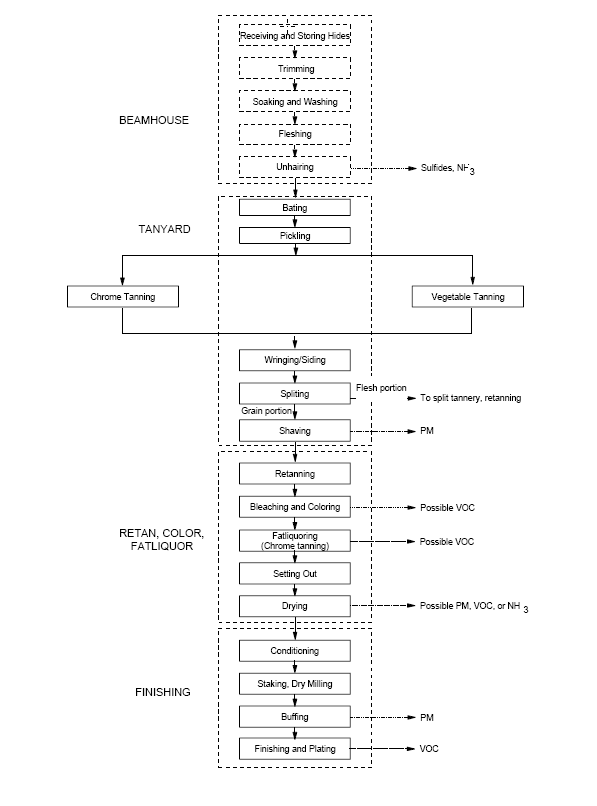
  2. Vegetable tanning is simply the replacement of the chromium for bark or plant tannins – all other steps remain the same.  And since there are about 250 chemicals used in tanning, the replacement of chromium for plant tannins, without addressing the other chemicals used, is a drop in the bucket.   Last week I mentioned some of the other 249 chemicals routinely used in tanning:  alcohol, coal tar , sodium sulfate, sulfuric acid, chlorinated phenols (e.g. 3,5-dichlorophenol), azo dyes, cadmium, cobalt, copper, antimony, cyanide, barium, lead, selenium, mercury, zinc, polychlorinated biphenyels (PCBs), nickel, formaldehyde and pesticide residues.[3]   Here are the steps to creating leather :
  3. Aldehyde tanning is the main type of leather referred to as “chrome-free”, and is often used in automobiles and baby’s shoes.  Aldehyde tanning is often referred to as “wet white” due to the pale cream color it imparts to the skins.  But aldehydes are a group of chemicals that contain one chemical which many people are familiar with: formaldehyde.  And we all know about formaldehyde: it is highly toxic to all animals; ingestion of as little as little as 30 mL (1 oz.) of a solution containing 37% formaldehyde has been reported to cause death in an adult human[4]  and the Department of Health and Human Services has said it may reasonably be anticipated to be a carcinogen.  Aldehyde tanning essentially uses formaldehyde, which reacts with proteins in the leather to prevent putrefication.  BLC Leather Technology Centre,  a leading independent leather testing center, states that leathers should contain no more than 200ppm of formaldehyde for articles in general use. If the item is in direct skin contact this should be 75ppm, and 20ppm for items used by babies (<36 months). Typically, with modern tanning techniques, leathers contain 400ppm or less.[5]   Yet that far exceeds levels set elsewhere – in New Zealand, for example, acceptable levels of formaldehyde in products is set at 100 ppm[6]  – the European Union Ecolabel restricts formaldehyde to 20 ppm for infant articles, 30 ppm for children and adults, while GOTS prohibits any detectable level.

BLC Leather Technology Centre Ltd.  commissioned a study by Ecobilan S.A (Reference BLC Report 002)  to do a life cycle analysis to evaluate the various tanning chemicals, to see if there was an environmentally preferable choice between chrome, vegetable and aldehyde based processes.  The result?  They found no significant differences between the three  – all have environmental impacts, just different ones.  These LCA’s demonstrate that tanning is just one of the impacts – other steps may have equal impacts.   Chrome was sited as having the disadvantage of being environmentally persistent. “Another consideration, in terms of end-of-life leather or management of chrome tanned leather waste, is the possibility of the valency state changing from the benign Cr III to the carcinogenic Cr VI.”[7]

So much for “chrome free” leather.  What about claims for “eco leather”?

In the strict sense of the definition, the term “eco leather” is meaningless. However, retailers want to imply improved environmental performance. So how can you evaluate their claims for “eco leathers”?

There are two main considerations in making leather:

  • How is it manufactured?
  • What inputs are used to produce it?

Research has shown that a significant part of the environmental impact of leather is in the manufacturing process.  In this respect it is the environmental stewardship practice of tanners coupled with chemical selection that should determine how eco friendly a leather is.  The following areas of leather manufacture have the most significant potential impact:

  • Management of restricted substances
  • Energy consumption
  • Air emissions
  • Waste management (hazardous and non hazardous)
  • Environmental management systems
  • Water consumption
  • Control of manufacturing processes
  • Effluent treatment
  • Chrome management
  • Traceability of material

In terms of the selection of inputs, we should consider the use of certain materials that could give an improved eco profile to leather. These include:

  • Biodegradable wetting agents for soaking
  • Reduced sulphide processing
  • Non synthetic or polymeric re-tannage systems
  • optimized dyestuffs
  • Vegetable oil based fatliquors
  • Optimised finishing systems to reduce waste such HVLP or roller coating
  • Biodegradable in 12 months or less

In summary, although there is no current definition, these are the key elements which should determine an “eco leather”:

  1. Control of leather manufacturing processes
  2. Clean technology chemical selection in the process
  3.  Effective management of restricted substances within the leather
  4. A measure of the end of life impact

As I mentioned in last week’s post, the production of leather can be a hellish life for the animal.  I have found only one company, Organic Leather, which looks beyond the production of the leather itself to the important questions of animal husbandry and land management practices which provide the skins, and incorporate these into a tanning process which “prevents further toxicity entering our environment and our bodies.”

The Leather Working Group (LWG)   is a multi-stakeholder group[8], whose purpose is  “to develop and maintain a protocol that assesses the compliance and environmental performance of tanners and promotes sustainable and appropriate environmental business practices within the footwear leather industry.”   The LWG, in conjunction with BLC Leather Technology Center Ltd., operates an eco rating system for leather. (This sort of mark is known as a first or second party certification, and lacks – I believe – the credibility of a true third party certification.)   Retailers, brands or tanners who are able to meet the requirements of this standard are eligible to use the EcoSure mark. To be eligible to use this mark tanneries must have achieved at least a Bronze award in the LWG Tannery Environment Auditing Protocol,  and the finished leather on which the mark is to be used must meet the requirements of the audit and testing regime. (to see the audit form, click here  ).

One issue which is a hot topic in leather production is that of deforestation and the sourcing of skins from Brazil – cattle ranching in Brazil accounted for 14% of global deforestation and ranches occupy approximately 80% of all deforested land in the Amazon.[9]  Greenpeace and the National Wildlife Federation (NWF) aims to stop all deforestation in the Amazon by encouraging the meat processors to insist that their suppliers register their farms and map and log their boundaries as a minimum requirement. They also encourage companies to cancel orders with suppliers that are not prepared to stop deforestation and adhere to these minimum requirements.  Many of the LWG member brands have  made commitments to a moratorium on hides sourced from farms involved in deforestation and LWG itself has a project to identify and engage with the key stakeholders in Brazil, investigate traceability solutions, conduct trials and implement third party auditing solutions.


[1] Richards, Matt, et al, “Leather for Life”, Future Fashion White Papers, Earth Pledge Foundation

[2] Gustavson, K.H. “The Chemistry of Tanning Processes” Academic Press Inc., New York, 1956.

[3] Barton, Cat, “Workers pay high price at Bangladesh tanneries”, AFP, Feb. 2011

[4] Agency for Toxic Substances & Disease Registry, “Medical management guidelines for formaldehyde”, http://www.atsdr.cdc.gov/mmg/mmg.asp?id=216&tid=39

[5] BLC Leather Technology Center Ltd, “Technology Restricted substances – Formaldehyde”, Leather International,  November 2008,  http://www.leathermag.com/news/fullstory.php/aid/13528/Technology_Restricted_substances-Formaldehyde.html

[6] “Evaluation of alleged unacceptable formaldehyde levels in Clothing”, Wellington, New Zealand: New Zealand Ministry of Consumer Affairs, October 17, 2007.

[8] Currently the consumer brands involved with the LWG are: Adidas-group, Clarks International, Ikea of Sweden, New Balance Athletic Shoe, Nike Inc, Pentland Group including (Berghaus, Boxfresh, Brasher, Ellesse, Franco Sarto, Gio-Goi, Hunter, KangaROOS, Mitre, Kickers (UK), Lacoste Chaussures, ONETrueSaxon, Radcliffe, Red or Dead, Speedo, Ted Baker Footwear), The North Face, The Timberland Company, Wolverine World Wide Inc including (CAT, Merrel, Hush Puppies, Patagonia, Wolverine, Track n Trail, Sebago, Chaco, Hytest, Bates, Cushe, Soft Style). New brands recently joined are Airwair International Ltd, K-Swiss International, Marks & Spencers and Nine West Group.

[9] “Broken Promises: how the cattle industry in the Amazon is still connected to deforestation…” Greenpeace, October 2011; http://www.leatherworkinggroup.com/images/documents/Broken%20promises%20-%20Oct11FINAL.pdf

People like to buy leather furniture because of leather’s durability (it’s advertised to last a lifetime) – even though it demands a bit of attention to keep it looking its best.   Manufacturers also like to portray leather (perhaps because of its high price) as conveying luxury and sophistication.

Leather has been used practically forever –  ancient peoples used materials that were available, like bark and plant tannins, alum, earth minerals, fish oils, animal brains, lime and smoke to preserve animal skins.  The natural tanning process takes a long time – from 1 to 12 months.  It often also relies on physical manipulation.

Today’s leather is a far cry from  early leathers because horribly toxic synthetic chemicals have replaced the older tanning chemicals (usually in the interest of time – chrome tanning takes only a fraction of the time as does “natural” tanning); modern leather tanneries are frighteningly toxic and the animal husbandry aspect is sad and sickening. There are a very few ethical tanneries, but so far I can count them on one hand.  [1]

Let’s take a look at what that leather on your sofa means to us today.

Many people think that leather is a by-product of the meat industry, and that buying leather does not increase the number of animals slaughtered.  But in the case of some animals, the meat is the by product – on ostrich farms, the leather account for 80% of the dead animal’s value.[2]  Some leather – made from more exotic animals like kangaroos, zebras, seals, snakes, lizards and even sharks – are either raised or hunted specifically for their skins. [3] Regardless of how you define it, the skin is not a “leftover” since processing it as leather accounts for about 10% of the slaughtered animal’s overall value,[4] generating significant profits for both factory farms and the leather trade itself.  In fact, without the lucrative sale of animal skins for leather, factory farms would not even be able to turn a profit by selling meat alone. Ultimately, buying leather products subsidizes factory farms while providing financial incentive for them to produce more leather.

Most leather comes from cattle who are slaughtered for meat, worn-out dairy cows who no longer produce enough milk to be profitable, and veal calves whose soft skin is particularly valuable.  These animals often suffer in many ways that are detailed on various websites (such as Liberation BC: Speaking out for Animals and PETA) – it is such a gut wrenching, gruesome story that I can’t even bring myself to talk specifics.

Let’s face it – leather is the skin of a dead animal.  It is, by nature, meant to decompose.  What do you think has to be done to that skin so it doesn’t decompose?

After 75 years at the bottom of the Atlantic, few items aboard the R.M.S. Titanic had survived the ravages of saltwater.  But leather items hadn’t rotted away because their chrome tanning prevented their decay.[5]

The global leather industry is composed of three sectors of activity: animal husbandry and slaughter, tanning, and product manufacturing. Tanning is the stage in which raw leather is processed and made more durable so that it doesn’t decompose in your living room. Tanning consists of two major processes:

  1. Wet blue production (so called because the semi-finished hide is given a chrome bath which imparts a blusih tint).  This process involves removing unwanted substances (salt, flesh, hair, and grease) from a rawhide (by soaking in a bath of lime and sodium sulfide to dissolve hair and flesh), trimming it, treating it to impart the desired grain and stretch, and finally soaking it in a chrome bath to prevent decomposition.  This step is far more polluting than finishing, generating 90% of the water pollution associated with leather tanning.[6]
  2. Finishing – Finishing involves splitting, shaving, re-tanning, and dying the wet blue.

Often leather is advertised as being “aniline dyed”.  That means the leather is dyed for color without any pigments applied.  These dyes enhance the subtle variations of each hide and the leather does not lose any structure or grain pattern.  It is often considered to be of a higher quality than other types of dyed leather because aniline dyed leathers develop a  distinctive patina over time. Only premium hides with the most pleasing color and texture are selected for this category, less than 5% of all upholstery hides in the world.

Semi-aniline, also referred to as “Aniline Plus”,  is also advertised.  These leathers are first dyed in the penetrating aniline dyes. Then a topcoat is applied to even out the color of the hide surface. The topcoat also serves to create fading- and soil-resistant pieces.  They retain a great amount of the softness of aniline dyed hides because the natural top grain is left intact. A much larger proportion of the worldwide hide supply is suitable for this class of leather and as a result they are more moderately priced than pure aniline dyed hides.

So now we come to the part about the problems with using leather – you knew it was coming.

According to the results of a three year study to address health impacts of pollution from the Blacksmith Institute, which works to solve pollution problems in the developing world,  the tanning of leather is in the top 10 of the world’s worst pollution threats,  at #5, directly affecting more than 1.8 milllion people.[7]

Blacksmith’s Bret Ericson, who managed the three-year project, says:  “These are not large-scale, multinational corporations that are responsible for this pollution. Typically, it’s low income, small-scale industries who have no emissions controls,” often because these outdated industries remain unregulated.

Because of the acknowledged hazards of leather production, the process is being discontinued in most European countries and the U.S., and operations are moving overseas.   Because of the relatively inexpensive cost of labor and materials, over half the world’s tanning activity occurs in low- and middle-income countries.  Leather tanneries are highly concentrated in Nepal, Bangladesh and India.  Bangladesh Tanners Association President M. Harun Chowdhury said, “Most of the European countries and USA are discontinuing leather processing, as [the] leather industry is an environmentally hazardous one.”[8]

Spurred by retailer demand in the West, leather buyers in Asia have been welcomed with open arms by governments all-too-eager for a slice of the global market, and happy to turn a blind eye to non-existent safety regulations in return. Regulations governing tannery pollution have been on the books for decades in countries such as Mexico. Among other things, they require tanneries to register with environmental authorities, install sedimentation tanks and water gauges, handle most solid wastes as hazardous materials, and— most important—pretreat wastewater so that daily concentrations of various pollutants do not exceed set standards. For the most part, however, these regulations are simply not enforced.[9]  One of the reasons mentioned for this, cited by Allen Blackman,  is that tanneries are often a mainstay of the local economy and therefore enjoy considerable political power.

So today Hazaribag, Dhaka, home to many leather tanneries,  the  once  pleasant, semi-rural district in the Bangladeshi capital, is now a wasteland of toxic swamps, garbage landfills and mountains of decomposing leather scraps, surrounded by slums where tannery workers live.  Piles of smouldering trash line the banks of the nearby Buriganga, which is classified as a “dead” river after it hits Hazaribag as pollution from the tanneries has made it impossible for any fish or plantlife to survive.

Every day, the tanneries collectively dump 22,000 cubic litres of toxic waste, including cancer-causing chromium, into the Buriganga — Dhaka’s main river and a key water supply — according to the ministry of environment.

More than 90 percent of the tannery workers suffer from some kind of disease — from asthma to cancer — due to chemical exposure, according to a 2008 survey by SEHD, a local charity, with local residents being almost as badly affected.[10]

This is The Ecologist Film Unit’s Jim Wickens take on what the situation is in Dhaka:

What chemicals are used to create such terrible pollution?

In all, around 250 chemicals are used in tanning. Skins are transferred from vat to vat, soaked and treated and dyed.   Chemicals include alcohol, coal tar , sodium sulfate, sulfuric acid, chlorinated phenols (e.g. 3,5-dichlorophenol), chromium (trivalent and hexavalent), azo dyes, cadmium, cobalt, copper, antimony, cyanide, barium, lead, selenium, mercury, zinc,  polychlorinated biphenyels (PCBs), nickel, formaldehyde and pesticide residues.[11]  At the same time, toxic gases like ammonia, hydrogen sulfide, and carcinogenic arylamines are emitted into the air. The smell of a tannery is the most horrifyingly putrid smell on earth.

Groundwater near tanneries has been found with highly elevated levels of a variety of toxic substances. The Regis Tanning Co., Inc., operated a tanning facility from the early 1950s until 1972 in New Hampshire. But more than 20 years after it closed down, groundwater samples collected in the area revealed that arsenic, chromium, lead, and zinc were all still present—likely because of wastes disposed of on the property—while samples taken from nearby Lamprey River and its wetlands indicated the presence of cyanide, chromium, and polychlorinated biphenyls (PCBs).[12]

The U.S. Centers for Disease Control and Prevention (CDC) found that the incidence of leukemia among residents near one tannery in Kentucky was five times the national average.[13]

Arsenic, a common tannery chemical, has long been associated with lung cancer in workers who are exposed to it on a regular basis. Several studies have established links between sinus and lung cancer and the chromium used in tanning. [14] Studies of leather-tannery workers in Sweden and Italy found cancer risks “between 20% and 50% above [those] expected.” [15]

And that aniline dye that is often advertised as non toxic:  not according to these sources:  Aniline is toxic by inhalation of the vapour.   [16] The International Agency for Research on Cancer(IARC) lists it in Group 3  (not classifiable as to its carcinogenicity to humans) due to the limited and contradictory data available.  It is linked to bladder cancer.[17]

What about vegetable-tanning, which is sometimes touted as an environmentally-friendly alternative to chrome-tanning? Vegetable-tanning is actually only different from chrome-based in one way: it uses vegetable dyes rather than, perhaps, aniline dyes, to give the leather a “more subtle, muted colour.”[18]The preparation of the skin for tanning is the same, and though vegetable-tanning eliminates the toxins produced during the process of chrome-tanning, it also has its limits: being stiffer and firmer than chrome-tanned leather, it can be used for saddles, belts,  and leather carving, but often not for shoes, coats, or anything that requires much flexibility. Additionally, when exposed to water and allowed to dry, it can discolour and shrink, becoming brittle.

As mentioned in the first footnote above, there are a few companies that are trying to transform the industry and to educate consumers about leather, such as Organic Leather in California.  They seek to “return reverence to the practice of working with leather…to pay homage to the tribal peoples of our world and to encourage respect for the quality of the animals’ lives, from the way they are raised to the way they die…(and) to make sure that no part of the animal already being harvested goes to waste.  Moreover, we are strongly concerned with the chemicals used in the tanning and dyeing process and their effects on the natural environment and the health of both workers and customers.”


[1] Organic Leather, in California,  is trying to create high-quality and stylish leather while working to transform the industry and educate consumers.  See their white paper: http://www.organicleather.com/organic_leather_white_paper.pdf

[2] Kate Carter, Don’t Hide from the Truth, Guardian.co.uk, 27 Aug. 2008

[3] Leather Made From different animals, Leather Supreme, May 13, 2008 AND “Animals Abused and Killed for their Skins”, PETA media center, 2010.

[5] Davis, John, “Method for safer leather tanning published by Texas Tech researchers”, Texas Tech Today, November 2007.

[6] Blackman, Allen, “Adoption of Clean Leather-Tanning Technologies in Mexico”, discussion paper, Resources for the Future, August 2005

[8] Jasim Uddin Khan, “Local Tanners Eye Bright Prospect as US, EU Quit Leather Processing,” The Daily Star 20 Dec 2007.

[9] Blackman, Allen, “Adoption of Clean Leather-Tanning Technologies in Mexico”, discussion paper, Resrouces for the Future, August 2005

[10] Barton, Cat, “Workers pay high price at Bangladesh tanneries”, AFP, Feb. 2011

[11] Ibid.

[12] U.S. Environmental Protection Agency, “Regis Tannery,” Waste Site Cleanup and Reuse in New England 9 Aug. 2006.

[13] Richard E. Sclove et al., Community-Based Research in the United States (Amherst: The Loka Institute, 1998) 52.

[14] Richard B. Hayes, “The Carcinogenicity of Metals in Humans,” Cancer Causes and Control 8 (1997): 371-85.

[15] France Labrèche, Occupations and Breast Cancer: Evaluation of Associations Between Breast Cancer and Workplace Exposures (Montréal: McGill University, 1997).

[16] Muir, GD (ed.) 1971, Hazards in the Chemical Laboratory, The Royal Institute of Chemistry, London.

[17] http://www.pathologyoutlines.com/topic/bladderurothelialinvasivegen.html  AND Carreon, Tania, et al, “Increased bladder cancer risk among workers exposed to o-toluidine and aniline: a reanalysis”, Occupational and Environmental Medicine, 2010; 67:348-350

[18] Elizabeth Olsen, Can Leather Be Eco-Friendly…Ever?, Ecouterre, 19 Oct. 2009


The new bioeconomy

O Ecotextiles (and Two Sisters Ecotextiles)

Last week we explored using biomass as fuel, and some of the implications in doing that.  Previously we looked at using biomass in the world of fabrics and furnishings,  which include the new biotech products polylactic acid (PLA) (DuPont’s Ingeo and Sorona fibers) and soy-based foam for upholstery  (click  here and here to see our posts).  The ideas being presented by new bio technologies are not new – in the 19th century Rumpelstiltskin spun straw into gold – and the idea has always held a fascination for humans.

There is a new report called “The New Biomassters – Synthetic Biology and The Next Assault on Biodiversity and Livelihoods” (click here to download the report) published by The ETC Group, which focuses on the social and economic impacts of new bio technologies.  This report paints an even more troubling picture than what I’ve been able to uncover to date, and the information contained in this post comes from that report:

“Under the pretext of addressing environmental degredation, climate change and the energy and food crisis, and using the rhetoric of the “new” bioeconomy  (“sustainability”, “green economy”, “clean tech”, “clean development”) industry is talking about  solving these problems by substituting fossil carbon for that of living matter.    The term “bioeconomy” is based on the notion that biological systems and resources can be harnessed to maintain current industrial systems of production, consumption and capital accumulation.” 

Sold as an ecological switch from a ‘black carbon’ (i.e. fossil) economy to a ‘green carbon’ (plant-based) – and therefore a “clean” form of development –  this emerging bioeconomy is in fact, according to ETC,  “a red-hot resource grab of the lands, livelihoods, knowledge and resources of peoples in the global South” (because 86% of that biomass is located in the tropics and subtropics).

What does a new bioeconomy look like?  According to the ETC:   “as the DNA found in living cells is decoded into genetic information for use in biotechnology applications, genetic sequences  acquire a new value as the building blocks of designed biological production systems. By hijacking the ‘genetic instructions’ of cells … to force them to produce industrial products, industry transforms synthetic organisms into bio-factories that can be deployed elsewhere on the globe – either in private vats or plantations.  Nature is altered to meet business interests.”

They go on to say that as ecosystems collapse and biodiversity declines, new markets in ecosystem “services” will enable the trading of ecological ‘credits.’   The declared aim is to “incentivize conservation” by creating a profit motive in order to justify interventions in large-scale natural systems such as hydrological cycles, the carbon cycle or the nitrogen cycle.[1] Like the ‘services’ of an industrial production system, these ‘ecosystem services,’ created to privatize natural processes, will become progressively more effective at serving the interests of business.

It seems to be all about profit.

The ETC report states that concerted attempts are already underway by many industrial players to shift industrial production feedstocks from fossil fuels to the 230 billion tons of ‘biomass’ (living stuff) that the Earth produces every year -not just for liquid fuels but also for production of power, chemicals, plastics and more.

The visible players involved in commodifying the 76% of terrestrial living material that is not yet incorporated in the global economy include BP, Shell, Total, Exxon, Cargill, DuPont, BASF, Syngenta and Weyerhaeuser.   Enabling this attempt is the adoption of synthetic biology techniques (extreme genetic engineering) by these well-funded companies.

“We have modest goals of replacing the whole petrochemical industry and becoming a major source of energy.”

– J. Craig Venter, founder Synthetic Genomics, Inc.[2]

There is lots more in the ETC report, here’s just a summary of some other issues:

  • The report examines the next generation biofuels, including algal biofuels and synthetic hydrocarbons, and establishes the case for why this generation may be as ecologically and socially dangerous as the first.  Even leading companies and scientists involved in synthetic biology agree that some oversight is necessary – currently it’s being mostly ignored and is not on the agenda for the Rio+20 summit to be held in Brazil in June.
  • Today’s synthetic biology is unpredictable, untested and poorly understood.  Could open a Pandora’s box of consequences.  See:  http://www.cbd.int/doc/emerging-issues/foe-synthetic-biology-for-biofuels-2011-013-en.pdf
  • The “green” credentials of current bio-based plastics and chemicals are called into question.  (See our posts on biopolymers – click here and here).
  • How much biomass is enough?  “Attempting to set an ‘acceptable level’ of biomass extraction is as inappropriate as forcing a blood donation from a hemorrhaging patient. Already struggling to maintain life support, the planet simply does not have any biomass to spare. Human beings already capture on-fourth of land based biomass for food, heat and shelter; attempts to define a limit beyond which ecosystems lose resilience and begin to break down reveal that we consumed past such limits 20 years ago.”
  • Biomass is considered a “renewable resource” – and it is true that while plants may be renewable in a short period of time, the soils and ecosystem that they depend on may not be.  Industrial agriculture and forest biomass extraction rob soils of nutrients, organic matter, water and structure, decreasing fertility and leaving ecosystems more vulnerable or even prone to collapse. Associated use of industrial chemicals and poor land management can make things worse. In practice, therefore, biomass is often only truly renewable when extracted in such small amounts that they are not of interest to industry.
  • The claim that biomass technology will be a stepping stone to a new mix of energy sources misses the whole point – that we are facing a crisis of overproduction and consumption.  Reducing our overall energy demands is critical, as it boosting support for decentralized peasant agriculture.

[1] See for example, The Economics of Ecosystems and Biodiversity:

Ecological and Economic Foundations. Edited By Pushpam Kumar. An

output of TEEB: The Economics of Ecosystems and Biodiversity,

Earthscan Oct. 2010

[2] Michael Graham Richard, “Geneticist Craig Venter Wants to Create Fuel from CO2,” Treehugger, 29 February 2008. Available online at: http://www.treehugger.com/files/2008/02/craig-venter-fuel-co2-tedconference.php

Is biomass carbon neutral?

O Ecotextiles (and Two Sisters Ecotextiles)

Global climate change is the major environmental issue of current times. Evidence for global climate change is accumulating and there is a growing consensus that the most important cause is humankind’s interference in the natural cycle of greenhouse gases. (Greenhouse gases get their name from their ability to trap the sun’s heat in the earth’s atmosphere – the so-called greenhouse effect.)

CO2 emissions are recognized as the most important contributor to this problem. Since the turn of the 20th century the atmospheric concentration of greenhouse gases has been increasing rapidly, and the two main causes have been identified as:

  1. burning of fossil fuels and
  2. land-use change, particularly deforestation.

And now the world has discovered plants.  People seem to think there is some magic in nature – that they can keep taking and things will grow back.  We can buy “carbon offsets” to mitigate our guilt – trees planted to “offset” our energy consumption for, maybe, a plane ride to Hawaii.

Because the carbon emitted when plants are burned is equal to that absorbed during growing, it seems self-evident that biomass is a zero carbon (or carbon neutral) fuel.[1]  The thinking goes like this:  Plants are busy converting CO2 to stored (“sequestered”) carbon in their branches, roots, stems and leaves – so when that plant is burned, the carbon which is released (as CO2) is replaced by another plant which is busy sequestering that carbon.

Why is burning fossil fuel – which  also releases CO2 when burned  – not considered to be carbon neutral?  As far as I can tell, it’s a matter of definition.  Today, the definition of carbon neutral means that the greenhouse gases released  by burning fuel is the same or less than the carbon that was stored in recent history (translation = plants, which grow and mature within 100 years or so, i.e., “recent history”). Releasing carbon that was stored in ancient history, such as  burning fossil fuels (which comes from plant material millions of years old)  introduces extra carbon to the environment. Because fossil fuels contain carbon that was in the environment in ancient times, by burning fossil fuels we release greenhouse gasses that wouldn’t naturally be there!

That concept took off.  Beginning with the Koyoto Protocol, which overlooked reduction targets for biomass, others embraced the concept of using biomass as a carbon neutral fuel:  the EU Emissions Trading Scheme counts biomass as “carbon neutral” as do UK Building Regulations, the World Business Council for Sustainable Development and the World Resources Institute –  despite the recognition that this definition is problematic.[2]  Biomass burning is being ramped up all around the world in the name of green energy.

The concept of biomass as being carbon neutral is so popular that the European Union’s energy objectives for 2020 include the requirement that 20% of the total be from renewable sources, made up from biomass such as wood, waste and agricultural crops and residues.[3]  And the biomass industry in the US asked for an exemption from the Environmental Protection Agency’s greenhouse gas regulations because, it claims, biomass is carbon neutral.  In January 2011, the EPA gave them a 3 year exemption.

This loophole gives oil companies, power plants and industries that face tighter pollution limits a cheap means to claim reductions in greenhouse gas emissions. According to a number of studies, applying this incentive globally could lead to the loss of most of the world’s natural forests as carbon caps tighten.  A very frightening scenario indeed, since deforestation is responsible for up to 20% of the world’s greenhouse gas emissions – more than all cars, trains, planes, boats and trains in the world combined. [4]

I found a great blog post on this subject by Jeff Gibbs on Huffington Post Green, and I’ve relied on it for much of this post.  Here are just two of the issues:

Issue 1:  “Trees not harvested will eventually die and be decomposed by insects, fungi, bacteria, and other microorganisms which will release all the carbon dioxide that burning would. This cycling process has been going on for half a billion years, long before humans had a hand in it, and will continue with or without us.”

Here’s what Jeff Gibbs has to say:

  • “Actually nature has plans for that dead tree. For one it’s food for the next generation of forest life. And it turns out trees are pretty good at transferring their CO2 to the soil rather than the atmosphere when they fall over dead. Underground roots of mushrooms called mycorrhiza digest the wood and keeps the carbon the trees had sucked from the air in the forest soil.   The proof? It’s called coal.  Millions of generations of plants and trees have taken in carbon from the air and deposited it as mountains of coal. It’s what trees and plants do. Because trees and plants took the CO2 out of the atmosphere we have the nice comfortable climate we enjoy today. It’s not their fault we’re releasing everything they worked so hard to lock away, and if we cut then down they are going to have that much more difficult of a time soaking the carbon back up.”

Issue 2:  “Carbon dioxide –  released by burning biomass – is carbon dioxide that was taken from the air as the trees grew, and the trees that replace the harvested biomass will grow by taking in carbon dioxide again.”

This is so fraught with different issues that we have to break it down into manageable segments to understand why this is not as simple as it seems:

  1.   When you cut down a fully mature, multi-ton tree, how long do you think it will be before the one-ounce sapling that replaces it will be able to replicate the carbon uptake of the multi-ton tree?  Some trees take 100 years or more to mature.  When burned for energy, a mature tree (80-100 years old) takes minutes to release its full load of carbon into the atmosphere, but its replacement, if grown, takes a full century to re-sequester that carbon. For those 100 years, the CO2 is still aloft in the atmosphere helping push the climate toward the point of dangerous change, and yet carbon accounting rules treat it as non-existent.  After the initial release of carbon sequestered in a standing forest, a well-managed forest will start re-growing and at some point in time will achieve approximately the same concentration of carbon sequestration as the original forest.  But during that time, the atmospheric concentration of heat trapping gasses has been higher than it would otherwise have been, increasing associated environmental damages, and we have foregone the sequestration that would have happened in the original forest![5]
  2.  Chopping down forests to burn for ethanol production — even if replanted as tree plantations — is like biting the hand that feeds you. “Natural forests, with their complex ecosystems, cannot be regrown like a crop of beans or lettuce,” reports the nonprofit Natural Resources Defense Council (NRDC), a leading environmental group. “And tree plantations will never provide the clean water, storm buffers, wildlife habitat and other ecosystem services that natural forests do.”[6]
  3.  Recent studies show that there is more biomass contained IN the soil than in what grows ON the soil above ground.   This soil carbon can be disturbed and released by harvesting and reforestation activities.[7]
  4.  In a study published by the Manomet Center for Conservation Sciences, it was found that burning  trees emits about 30% more carbon pollution than coal, which the report calls the “carbon debt” of biomass. [8]   According to the study,  under normal forest management   it takes over 21 years just to re-absorb the extra pollution that is released in the first year of burning the wood.    Also, the energy content of biomass is about 40% lower than that of regular fossil fuels, so you need to burn more of it to get the same power, which means more CO2. (to read more about this, click here.)
  5.  It is simply not possible to plant sufficient numbers of trees to deal with the increased carbon dioxide emissions that are expected over the next half century.  According to Harpers Index, the number of years the United States could meet its energy needs by burning all its trees is … 1.
  6.  Recent evidence suggests that global warming itself is stressing ecosystems and turning forests and forest soils into failing forests and, in the long run, into net sources of CO2. Thus, if we don’t curb our use of fossil fuels, it won’t matter how many trees we plant because these forests will be overcome and die as the climate continues to warm.[9]
  7.  Old-growth forests are often replaced by tree-farm plantations that are heavily managed (including with chemicals and fossil fuel-intensive machinery) and do not offer the same biodiversity benefits as natural forests.
  8.  Investment in forestry offsets does not contribute to reducing society’s dependence on fossil fuels, something that is ultimately needed to address climate change. Responding to climate change means fundamentally changing the way we produce and use energy.
  9.  All biomass is not created equal.  According to Jeff Gibbs, some biomass plants burn old tires; others shovel in old houses and creosote soaked railroad ties. I don’t know what’s “bio” about all this but the energy you get is considered carbon neutral and renewable.

Here are Jeff Gibb’s seven truths that the Lorax would have us remember:

  1. Saving our forests (and that doesn’t mean more tree plantations) is the best way to stop global warming and save humanity.
  2. Deforestation is just as likely to result in the end of humanity as climate change and it’s right on track to do so.
  3. Burning things is the most insane way to stop global warming since doctors drilled holes in skulls to let the demons out and gave you a bill for it.
  4. There is no extra in nature and there is not enough “bio” on the planet to be burned, turned to ethanol, biodiesel or jet fuel, or bio-charcoal.
  5. Woody biomass falsely deemed renewable energy increases the CO2 in the atmosphere, destroys forests, and prevents renewables from being fully explored.
  6. Geo-engineering the forests, atmosphere or oceans to stop global warming isn’t going to work. We can’t even figure out how to stop carp from taking over a river or bugs from eating a forest.
  7. There is a possibility that the only way to heal the planet is to get control of our own numbers and consumption while letting nature do the work she has done for three billion years: run the planet.

[2] Johnson, Eric, “Goodbye to carbon neutral:  Getting Biomass footprints right”, Atlantic Consulting, Gattikon, Switzerland, November 2008.

[3] Neslan, Arthur, Guardian Environment Network, April 2, 2012. http://www.guardian.co.uk/environment/2012/apr/02/eu-renewable-energy-target-biomass

[4] Greenpeace, “Solutions to Deforestation”;  http://www.greenpeace.org/usa/en/campaigns/forests/solutions-to-deforestation/

[5] Natural Resrouces Defense Council comments with respect to draft Policy DAR-12, June 17, 2010.

[8] “Biomass Sustainability and Carbon Policy Study”, Manomet Center for Conservation Sciences, June 2010

[9] David Suzuki Foundation, Ibid.

Global Recycle Standard update

O Ecotextiles (and Two Sisters Ecotextiles)

Textile Exchange, which administers the new Global Recycle Standard, has introduced what it says is a “minor but important” change in GRS version 2.1, according to the April/May 2012 issue of Ecotextile News.  (If you’re wondering what the Global Recycle Standard is all about, please see our blog post on the subject:  click here .)

The new change removes the allowance for the use of pre-industrial waste.  The Version 2.1 will only recognize pre-consumer and post-consumer waste.  This change was made because the Textile Exchange has determined that pre-industrial waste does not meet the Federal Trade Commission requirement for recycled input – which is that in order to be considered a recycled input, it must have been diverted from the waste stream.  An example of such pre-industrial waste that does not meet the criteria for being diverted from the waste stream is that of short cotton fibers which fall out of cotton during the spinning process;  the fibers are scooped up and re-introduced into the spinning process.  In terms of polyester, an example would be that of a manufacturer collecting plastic pellets that have spilled onto the manufacturing floor, washing them and then feeding them directly back into the same manufacturing process without reprocessing.

Both of these examples are considered an efficient manufacturing procedure and standard industry practice, not recycling.

Interpreting these pre-consumer recycled content claims can get very specific and technical.  Underwriters Laboratory has published a handy White Paper entitled  “Interpreting Pre-Consumer Recycled Content Claims: Philosophy and Guidance on Environmental Claims for Pre-Consumer Recycled Materials”.(1)

The new GRS standard becomes effective June 1, 2012.  All companies being newly certified to the GRS will be required to use the new GRS v.2.1, while companies with existing GRS v2 certification will be able to maintain their current status until the end of the validity date of their certification.

Textile Exchange is currently working on Version 3 of the GRS, and they say it will be more stringent than the current version, with further refining of definitions for inputs that can be claimed as recycled input and additional requirements for chemical inputs.

(1)  http://greenerul.com/pdf/ULE_whitepaper_July2010.pdf

Climate change and extreme weather

O Ecotextiles (and Two Sisters Ecotextiles)

I just saw this powerful video based on a recent editorial by Bill McKibben  in the Washington Post on May 23, 2011.   Narritation is  by Stephen Thomson of Plomomedia.com, who accompanies the piece with striking footage of the events Bill wrote about.

Bioplastics – are they the answer?

O Ecotextiles (and Two Sisters Ecotextiles)

From Peak Energy blog; August 27, 2008

From last week’s blog post, we discussed how bio based plastics do indeed save energy during the production of the polymers, and produce fewer greenhouse gasses during the process.  Yet right off the bat, it could be argued that carbon footprints may be an irrelevant measurement,  because it has been established that plants grow more quickly and are more drought and heat resistant in a CO2 enriched atmosphere!   Many studies have shown that worldwide food production has risen, possibly by as much as 40%, due to the increase in atmospheric CO2 levels.[1] Therefore, it is both ironic and a significant potential problem for biopolymer production if the increased CO2 emissions from human activity were rolled back, causing worldwide plant growth to decline. This in turn would greatly increase the competition for biological sources of food and fuel – with biopolymers coming in last place.[2]  But that’s probably really stretching the point.

The development of bioplastics holds the potential of renewability, biodegradation, and a path away from harmful additives. They are not, however, an automatic panacea.  Although plant-based plastics appeal to green-minded consumers thanks to their renewable origins,  their production carries environmental costs that make them less green than they may seem.  It’s important to remember that bioplastics, just like regular plastics, are synthetic polymers; it’s just that plants are being used instead of oil to obtain the carbon and hydrogen needed for polymerization.

It’s good marketing, but bad honesty, as they say, because there are so many types of plastics and bioplastics that you don’t know what you’re getting in to;  bioplastics are much more complicated than biofuels.  There are about two dozen different ways to create a bioplastic, and each one has different properties and capabilities.

Actually the term “bioplastic” is pretty meaningless, because some bioplastics are actually made from oil – they’re called “bioplastics” because they are biodegradeable.  That causes much confusion because plastics made from oil can be biodegradeable whereas some plant-based  bioplastics are not. So the term bioplastics can refer either to the raw material (biomass) or, in the case of oil-based plastic, to its biodegradability.  The problem with biodegradability and compostability is that there is no agreement as to what that actually means either,  and under what circumstances

You might also see the term “oxo-degradable”.   Oxo-degradables look like plastic, but they are not. It is true that the material falls apart, but that is because it contains metal salts which cause it to disintegrate rapidly into tiny particles. Then you cannot see it anymore, but it is still there, in the ocean too. Just as with conventional plastics, these oxo-degradables release harmful substances when they are broken down.

Let’s re-visit  some of the reasons bioplastics are supposed to be an environmental benefit:

  • Because it’s made from plants, which are organic, they’re good for the planet.  Polymer bonds can be created from oil, gas or plant materials. The use of plant materials does not imply that the resulting polymer will be organic or more environmentally friendly. You could make non-biodegradable, toxic plastic out of organic corn!
  • Bioplastics are biodegradable. Although made from materials that can biodegrade, the way that material is turned into plastic  makes it difficult (if not impossible) for the materials to naturally break down.  There are bioplastics made from vegetable matter (maize or grass, for example) which are no more biodegradable than any other plastics, says Christiaan Bolck of Food & Biobased Research.[3]  Bioplastics do not universally biodegrade in normal conditions  –  some require special, rare conditions to decompose, such as high heat composting facilities, while others may simply take decades or longer to break down again, mitigating the supposed benefits of using so-called compostable plastics material. There are no independent standards for what even constitutes “biodegradable plastic.”  Sorona makes no claim to break down in the environment; Ingeo is called “compostable” (though it can only be done in industrial high heat composters). Close studies of so-called degradable plastics have shown that some only break down to plastic particles which are so small they can’t be seen  (“out of sight, out of mind”), which are more easily ingested by animals. Indeed, small plastic fragments of this type may also be better able to attract and concentrate pollutants such as DDT and PCB.[4]
  • Bioplastics are recyclable. Because bioplastics come in dozens of varieties, there’s no way to make sure you’re getting the right chemicals in the recycling vat – so although some bioplastics are recyclable, the recycling facilities won’t separate them out.  Cargill Natureworks insists that PLA  can in theory be recycled, but in reality it is likely to be confused with polyethylene terephthalate (PET).  In October 2004, a group of recyclers and recycling advocates issued a joint call for Natureworks to stop selling PLA for bottle applications until the recycling questions were addressed.[5]  But the company claims that levels of PLA in the recycling stream are too low to be considered a contaminant.  The process of recycling bioplastics is cumbersome and expensive – they present a real problem for recyclers because they cannot be handled using conventional processes. Special equipment and facilities are often needed. Moreover, if bioplastics commingle with traditional plastics, they contaminate all of the other plastics, which forces waste management companies to reject batches of otherwise recyclable materials.
  • Bioplastics are non-toxicBecause they’re not made from toxic inputs (as are oil based plastics), bioplastics have the reputation for being non toxic.  But we’re beginning to see the same old toxic chemicals produced from a different (plant-based) source of carbon. Example:  Solvay’s bio-based PVC uses phthalates,  requires chlorine during production, and produces dioxins during manufacture, recycling and disposal. As one research group commissioned by the European Bioplastics Association was forced to admit, with regard to PVC,  “The use of bio-based ethylene is …  unlikely to reduce the environmental impact of PVC with respect to its toxicity potential.[6]

The arguments against supporting bioplastics include the fact that they are corporate owned, they compete with food, they bolster industrial agriculture and lead us deeper into genetic engineering, synthetic biology and nanotechnology.  I am not with those who think we shouldn’t go there, because we sorely need scientific inquiry  and eventually we might even get it right.  But, for example, today’s industrial agriculture is not, in my opinion, sustainable, and the genetic engineering we’re doing is market driven with no altruistic motive. 

If properly designed, biodegradable plastics have the potential to become a much-preferred alternative to conventional plastics. The Sustainable Biomaterials Collaborative (SBC)[7] is a coalition of organizations that advances the introduction and use of biobased products. They seek to replace dependence on materials made from harmful fossil fuels with a new generation of materials made from plants – but the shift they propose is more than simply a change of materials.  They promote (according to their website): sustainability standards, practical tools, and effective policies to drive and shape the emerging markets for these products.  They also refer to “sustainable bioplastics” rather than simply “bioplastics”.  In order to be a better choice, these sustainable bioplastics must be:

  • Derived from non-food, non-GMO source materials – like algae rather than GMO corn, or from sustainably grown and harvested cropland or forests;
  • Safe for the environment during use;
  • Truly compostable and biodegradable;
  • Free of toxic chemicals during the manufacturing and recycling process;
  • Manufactured without hazardous inputs and impacts (water, land and chemical use are considerations);
  • Recyclable in a cradle-to-cradle cycle.

Currently, manufacturers are not responsible for the end-life of their products. Once an item leaves their factories, it’s no longer the company’s problem. Therefore, we don’t have a system by which adopters of these new bioplastics would be responsible for recovering, composting, recycling, or doing whatever needs to be done with them after use. Regarding toxicity, the same broken and ineffective regulatory system is in charge of approving bioplastics for food use, and there is no reason to assume that these won’t raise just as many health concerns as conventional plastics have. Yet again, it will be an uphill battle to ban those that turn out to be dangerous.

A study published in Environmental Science & Technology traces the full impact of plastic production all the way back to its source for several types of plastics.[8]   Study author Amy Landis of the University of Pittsburgh says, “The main concern for us is that these plant-derived products have a green stamp on them just because they’re derived from biomass.  It’s not true that they should be considered sustainable. Just because they’re plants doesn’t mean they’re green.”

The researchers found that while making bioplastics requires less fossil fuel and has a lower impact on global warming, they have higher impacts for eutrophication, eco-toxicity and production of human carcinogens.  These impacts came largely from fertilizer use, pesticide use and conversion of lands to agricultural fields, along with processing the bio-feedstocks into plastics, the authors reported.

According to the study, polypropylene topped the team’s list as having the least life-cycle impact, while PVC and PET (polyethylene terephthalate) were ranked as having the highest life-cycle impact.

But as the Plastic Pollution Coalition tells us, it’s not so much changing the material itself that needs changing – it’s our uses of the stuff itself.  We are the problem:   If we continue to buy single-use disposable objects such as plastic bottles and plastic bags, with almost 7 billion people on the planet, our throwaway culture will continue to harm the environment, no matter what it’s made of.

The Surfrider Foundation

The Surfrider Foundation has a list of ten easy things you can do to keep plastics out of our environment:

  1. Choose to reuse when it comes to  shopping bags and bottled water.  Cloth bags and metal or glass reusable  bottles are available locally at great prices.
  2. Refuse single-serving packaging, excess  packaging, straws and other ‘disposable’ plastics.  Carry reusable utensils in your purse, backpack or car to use at bbq’s, potlucks or take-out  restaurants.
  3. Reduce everyday plastics such as sandwich bags and juice cartons by replacing them with a reusable lunch bag/box that includes a thermos.
  4. Bring your to-go mug with you to the coffee shop, smoothie shop or restaurants that let you use them. A great  way to reduce lids, plastic cups and/or plastic-lined cups.
  5. Go digital! No need for plastic cds,  dvds and jewel cases when you can buy your music and videos online.
  6. Seek out alternatives to the plastic  items that you rely on.
  7. Recycle. If you must use plastic, try to choose #1 (PETE) or #2 (HDPE), which are the most commonly recycled      plastics. Avoid plastic bags and polystyrene foam as both typically have very low recycling rates.
  8. Volunteer at a beach cleanup. Surfrider Foundation Chapters often hold cleanups monthly or more frequently.
  9. Support plastic bag bans, polystyrene  foam bans and bottle recycling bills.
  10. Spread the word. Talk to your family and friends about why it is important to Rise Above Plastics!

[1] See for example: Idso, Craig, “Estimates of Global Food Production in the year 2050”, Center for the Study of Carbon dioxide and Global Change, 2011  AND  Wittwer, Sylvan, “Rising Carbon Dioxide is Great for Plants”, Policy Review, 1992  AND  http://www.ciesin.org/docs/004-038/004-038a.html

[2] D. B. Lobell and C. B. Field, Global scale climate-crop yield relationships and the impacts of recent warming, Env. Res. Letters 2, pp. 1–7, 2007 AND L. H. Ziska and J. A. Bunce, Predicting the impact of changing CO2 on crop yields: some thoughts on food, New Phytologist 175, pp. 607–618, 2007.

[3] Sikkema, Albert, “What we Don’t Know About Bioplastics”, Resource, December 2011; http://resource.wur.nl/en/wetenschap/detail/what_we_dont_know_about_bioplastics

[4] Chandler Slavin, “Bio-based resin report!” Recyclable Packaging Blog May 19, 2010 online at http://recyclablepackaging.wordpress.com/2010/05/19/bio-based-resin-report

[6] L. Shen, “Product Overview and Market Projection of Emerging Bio- Based Plastics,” PRO-BIP 2009, Final Report, June 2009