Wishing you all a wonderful, peaceful Thanksgiving.
As we express our gratitude, we must never forget that the highest appreciation is not to utter words, but to live by them.
John Fitzgerald Kennedy

In 2011 Greenpeace published two reports: one investigating the discharge of hazardous substances from textiles manufacturing in China linked to major clothing and sportswear companies (Dirty Laundry), and another detailing the presence of NPEs in clothing and footwear of 15 leading brands (Dirty Laundry 2: Hung Out to Dry). With the publication of these reports Greenpeace challenged global brands to eliminate all releases of hazardous chemicals from their supply chains and products by 2020.
The Detox Campaign, as it is now known, is especially targeting Chinese manufacturers. With nearly 50,000 textile factories, the “factory of the world” is in fact the first victim of textile water pollution, prompting even the government to face up to the problem. “China is moving toward legislation where each company is responsible for its wastewater,” said Ulrike Kallee. “Awareness is now very high.”
The man-made chemical by-products of the textile industry are shown to have long-term effects on the environment and potentially devastating impacts on human and animal life. Furthermore, when testing clothing from 15 corporate brands, Greenpeace found that the chemicals used in the textile production process continue to be released when contaminated clothing is purchased and washed by consumers across the world. These tests demonstrate the truly global danger posed by these toxic chemicals as they are released into rivers and water sources from the point of production to the consumer.
I don’t know why there is not an outcry about the clothing which is continuing to contaminate washwater – doesn’t it occur to people that clothing contains chemicals which are being absorbed by our skin and causing us harm? For that matter, think about the fabrics we subject ourselves to intimately every day, like sheets and towels. Where is the disconnect here?
Greenpeace’s Detox Campaign is helping create a greener economy by challenging major global brands to rid their textile production processes of hazardous chemicals. The Detox Campaign has already successfully demonstrated the power of grassroots activism and social media in pressuring corporations to clean up their production practices. Only months into the Detox Campaign, major retailers H&M, Puma, Adidas and Nike committed to eliminating discharges of hazardous chemicals across their supply chains by 202; most recently Marks & Spencer joined the group. In addition to pressuring corporations to adopt greener production practices, Greenpeace is pursuing legislative changes within the textile industries in several Asian countries and the European Union in order to protect rivers and the communities and ecosystems they support.

Last week we explored the arguments being used against sustainable agricultural practices being able to feel the world – and that only more of the “green revolution” concepts will do. The biggest players in the food industry—from pesticide pushers to fertilizer makers to food processors and manufacturers—spend billions of dollars every year not selling food, but selling the idea that we need their products to feed the world. Food MythBusters is dedicated to leading the fight against the corporate control of our food system and showing a way to a world where we all have just good food – they want to change the common preconceptions we have about food.
Founder Anna Lappé is a national bestselling author, educator, and a founding principal of the Small Planet Institute and Small Planet Fund. Named one of TIME magazine’s “Eco” Who’s Who, Anna’s most recent book is Diet for a Hot Planet: The Climate Crisis at the End of Your Fork and What You Can Do About It.
Food MythBusters first film is designed to address the common belief that sustainable agriculture cannot feel the world.
Did you know that July 11, 1987 was the very first “World Population Day”? [1] World Population Day was designed “to track world population and bring light to population growth trends and issues related to it”. That year, the world’s population was 5 billion – a result of about 200,000 years of population growth – and 24 years later, we had added 2 billion more. Now 150 babies are being born every minute and the United Nations forecasts world population to reach 9 billion people by 2050.
I think you can easily google all the nightmare scenarios that this crushing population burden can have on our lives. One question which continues to be very controversial is how we’re going to feed 9 billion people, when today nearly 1 billion people don’t have enough food to eat. The United Nations warns that food production needs to increase by 70% in order to feed the world in 2050. [2] But with agricultural land dwindling while more than 1 billion people go to bed hungry, how could we possible feed the whole world population in 2050?
Since the 1950’s, we’ve been able to increase food production significantly through the “magic” of the “Green Revolution”, which increased yields through the use of synthetic fertilizers and pesticides, expansion of irrigation, and genetic engineering. The Green Revolution is a known quantity, and big chemical companies have lots at stake in ensuring that it continues down the same ol’ path of more agrochemicals and genetically modified crops, even though the world is different now. Farmers continue to use a lot of chemicals, because there is no coast assigned to environmental externalities, and the profitability of doing things with lots of chemical input isn’t questioned, according to Matt Liebman, an agronomy professor at Iowa State Univeristy. [3]
But in the world of the 21st Century, growth in food production is flattening, human population continues to increase, demand outstrips production and food prices soar. As Dale Allen Pfeiffer maintains in Eating Fossil Fuels, modern intensive agriculture – as developed through the Green Revolution – is unsustainable and has not been the panacea some hoped it would be. Technologically-enhanced agriculture has augmented soil erosion, polluted and overdrawn groundwater and surface water, and even (largely due to increased pesticide use) caused serious public health and environmental problems. Soil erosion, overtaxed cropland and water resource overdraft in turn lead to even greater use of fossil fuels and hydrocarbon products:
The data on yields, fertilizer and pesticide use (not to mention human health problems) supports these allegations. A study by the Union of Concerned Scientists called “Failure to Yield” sums it up nicely. (click here).
This food crisis has produced contradictory accounts of the problem and different ways of solving it. One group is concerned mainly about feeding the world’s growing population. It argues that high and volatile prices will make the job harder and that more needs to be done to boost supplies through the spread of modern farming, plant research and food processing in poor countries. For this group, the Green Revolution was a stunning success and needs to be followed by a second one now.
The other group argues that modern agriculture produces food that is tasteless, nutritionally inadequate and environmentally disastrous. It thinks the Green Revolution has been a failure, or at least that it has done more environmental damage and brought fewer benefits than anyone expected. An influential book espousing this view, Michael Pollan’s The Omnivore’s Dilemma, starts by asking: “What should we have for dinner?” By contrast, those worried about food supplies wonder: “Will there be anything for dinner?” The second group often proposes the tenants of organic agriculture as a way out of this crisis.
There is much skepticism and sometimes even outright opposition to sustainable agriculture. The popular belief is that switching to organic agriculture will almost certainly result in lower production, which couldn’t possibly be a way to feed 9 billion people. Mark Rosegrant, of the International Food Policy Research Institute, sums up this view nicely by saying that going organic would require more land, and though not bad, per se, it is not an important part of the overall process to feed 9 billion people.[4] And The Economist, in a special report on “feeding the World”, said “Traditional and organic farming could feed Europeans and Americans well. It cannot feed the world.”[5]
Why am I obsessing about agriculture? Agriculture and food production are the base of life and the economy and have multiple functions in creating healthy societies. It is at the center of addressing challenges like hunger and poverty, climate change and environment, women’s wellbeing and community health, income and employment. We certainly need to look beyond black/white, either/or options and find creative solutions to this crisis.
Agroecology is one of many terms people use to describe one approach to farming – others being sustainable agriculture, ecological agriculture, low-external input agriculture or people-centered agriculture. Agroecology is: farming that “centers on food production that makes the best use of nature’s goods and services while not damaging these resources.” It applies ecology to the design of farming systems; uses a whole-systems approach to farming and food systems; and links ecology, culture, economics and society to create healthy environments, food production and communities.[6] And agroecology works (please see reports in the footnotes section below)[7]:
In March, 2011, the United Nations Special Rapporteur on the Right to Food , Olivier de Schutter, presented a new report, “Agro-ecology and the right to food”, which was based on an extensive review of recent scientific literature. The report demonstrates that agroecology, if sufficiently supported, can double food production in entire regions within 10 years while mitigating climate change and alleviating rural poverty. “Today’s scientific evidence demonstrates that agroecological methods outperform the use of chemical fertilizers in boosting food production where the hungry live — especially in unfavorable environments. …To date, agroecological projects have shown an average crop yield increase of 80% in 57 developing countries, with an average increase of 116% for all African projects,” De Schutter says.
Now Mark Bittman, writing in the New York Times, states that “it’s becoming clear that we can grow all the food we need, profitably, with far fewer chemicals. …Conventional agriculture can shed much of its chemical use – if it wants to”.[8] He cites a study published by Iowa State University, in which researchers set up three plots: one replicated the typical Midwestern cycle of planting corn one year and then soybeans the next, along with its routine mix of chemicals. On another, they planted a three-year cycle that included oats; the third plot added a four-year cycle and alfalfa. The longer rotations also integrated the raising of livestock, whose manure was used as fertilizer. The longer rotations produced no downside at all – yields of corn and soy were better, nitrogen fertilizers and herbicides were reduced by up to 88%, and toxins in groundwater was reduced 200-fold – while profits didn’t decline by a single cent. There was an increase in labor costs (but remember profits were stable), so “it’s a matter of paying people for their knowledge and smart work instead of paying chemical companies for poisons.”[9]
Mr. Bittman goes on to say :
No one expects Iowa corn and soybean farmers to turn this thing around tomorrow, but one might at least hope that the U.S.D.A.would trumpet the outcome. The agency declined to comment when I asked about it. One can guess that perhaps no one at the higher levels even knows about it, or that they’re afraid to tell Monsantoabout agency-supported research that demonstrates a decreased need for chemicals. (A conspiracy theorist might note that the journals Science and Proceedings of the National Academy of Sciences both turned down the study. It was finally published in PLOS One; I first read about it on the Union of Concerned Scientists Web site.)
I think this study is a good example of agroecology principles. Mr. Bittman goes on to say:
When I asked Adam Davis, an author of the study who works for the U.S.D.A., to summarize the findings, he said, “These were simple changes patterned after those used by North American farmers for generations. What we found was that if you don’t hold the natural forces back they are going to work for you.”
THIS means that not only is weed suppression a direct result of systematic and increased crop rotation along with mulching, cultivation and other nonchemical techniques, but that by not poisoning the fields, we make it possible for insects, rodents and other critters to do their part and eat weeds and their seeds. In addition, by growing forage crops for cattle or other ruminants you can raise healthy animals that not only contribute to the health of the fields but provide fertilizer. (The same manure that’s a benefit in a system like this is a pollutant in large-scale, confined animal-rearing operations, where thousands of animals make manure disposal an extreme challenge.)
Perhaps most difficult to quantify is that this kind of farming — more thoughtful and less reflexive — requires more walking of the fields, more observations, more applications of fertilizer and chemicals if, when and where they’re needed, rather than on an all-inclusive schedule. “You substitute producer knowledge for blindly using inputs,” Davis says.
So: combine crop rotation, the re-integration of animals into crop production and intelligent farming, and you can use chemicals (to paraphrase the report’s abstract) to fine-tune rather than drive the system, with no loss in performance and in fact the gain of animal products.
Can you argue that less synthetic chemical use would not be a good thing? This is big business, and naturally the food system will need big investors to effect any changes. But some are waking up. One investor who sees the need for change is Jeremy Grantham, chief investment strategist for Grantham, Mayo, Van Otterloo & Co, LLC, who says: “The U.S.D.A., the big ag schools, colleges, land grants, universities — they’re all behind standard farming, which is: sterilize the soil. Kill it dead, [then] put on fertilizer, fertilizer, fertilizer and water, and then beat the bugs back again with massive doses of insecticide and pesticide.” (At one point in the conversation, he said that most supporters of industrial agriculture, who tell “deliberate lies over and over again,” could have been taught everything they know by Goebbels.) “I think a portfolio of farms that are doing state-of-the-art farming over a 20-, 30-year horizon will be the best investment money can buy.”[10]
[1] Adwell, Mandy, “World Population Day…2011”, The 9 Billion, http://www.the9billion.com/2011/07/12/world-population-day-well-reach-7-billion-by-october-2011/
[2] Vidal, John, “Food Shortages could force world into vegetarianism, warns scientists”, The Guardian, August 26, 2012.
[3] Bittman, Mark, “A simple fix for farming”, The New York Times, October 21, 2012
[8] Bittman, Mark, “A simple fix for farming”, The New York Times, October 21, 2012
[9] Ibid.
[10] Bittman, Mark, “A Banker Bets on Organic Farming”, New York Times, August 28, 2012
A current theme in the blogosphere is that organic sofas are expensive, so let’s see what that could mean.
We often hear that organic stuff costs more than conventional stuff, and that only the rich can take advantage of the benefits of organic products. That is true of food prices – organic food typically costs from 20% to 100% more than conventionally produced equivalents. [1] And I won’t go into what we seem to be getting in return for buying the cheaper, conventionally produced foods, but let’s just say it’s akin to a Faustian bargain.
But look at the food companies which in the 1950s routinely produced laughably inaccurate adverts trumpeting the health benefits associated with their products. 
Those old school adverts, ridiculous as they look now, displayed an awareness that healthy food resonated with modern consumers, and heralded the start of a 60 year long transformation that has seen nutrition become the issue that arguably defines the way the food industry operates. It is entirely conceivable that the raft of new green marketing campaigns that have emerged in recent years mark the beginning of a similar journey with other product categories.
So enough about food – this is a blog about textile subjects. And like food, organic fibers are also more expensive than non-organic. There is no way to get around the fact that organic cotton items are anywhere from 10 to 45 percent more expensive than conventional cotton products. But conventional cotton prices don’t take into account the impact that production has on the planet and the many people involved in its manufacture, including sweatshops and global poverty. With organic cotton, you are paying more initially, but that cost is passed not only to the retailer, but to the weavers, seamstresses, pickers and growers who made that item’s production possible. In turn, you are also investing in your own health with a garment that will not off-gas (yup, just like toxic paints) chemicals or dyes that can impact all of your body’s basic systems.
Those prices – or costs, depending on what we choose to call them – are compounded and go up exponentially in an organic vs. conventional sofa because each input in an organic sofa is more expensive than its conventional counterpart:
It just so happens that the web site Remodelista published a post on September 26 entitled “10 Easy Pieces: The Perfect White Sofa” by Julie.[3] (Click HERE to see that post.) And it gives us the pricing! Prices range from $399 for an IKEA sofa to $9500, and 10 sofas are priced (one in British Pound Sterling, which I converted into US dollars at 1.61 to the dollar). The average price of the sofas listed is $4626 and of the 10 sofas with pricing, the median is $3612. None of them mentions anything about being organic. That means you’ll be paying good money for a sofa that most probably uses:
As to price: let’s take a look at one sofa manufacturer with whom we work closely, Ekla Home (full disclosure: who uses our fabric exclusively) – the average price of Ekla Home’s sofa collection (assuming the most expensive fabric category) is $3290. That’s $1,336 LESS than the average of the sofas in the Remodelista post, none of which are organic.
Admittedly, one of the sofas that you can buy costs $399 from IKEA. Putting aside all the myriad health implications involved in this piece of furniture, there is still the issue of quality. Carl Richards, a certified financial planner in Park City, Utah, and the director of investor education at BAM Advisor Services, had a piece in the New York Times recently, about frugality and what it really means. Here is how he put it:
“It’s tempting to tell ourselves this little story about being frugal as we buy garbage from WalMart instead of the quality stuff that we want. Stuff that lasts. Stuff that we can own for a long time.
Here is the issue: when we settle for stuff that we don’t really want, and instead buy stuff that will be fine for a while, it often costs more in the long run.”

New York Times, Carl Richard
So I’m a bit flummoxed as to why people complain that organic sofas are expensive. Expensive compared to what? If I was paranoid, I’d think there was some kind of subtle campaign being waged by Big Industry to plant that idea into our heads.
[1] The Fox News website (http://www.foxnews.com/leisure/2012/03/11/10-reasons-organic-food-is-so-expensive/ ) had some interesting reasons as to why that’s true, some of which are listed below:
Many say that if Americans who profess to want to buy organic food would stop going to fast-food restaurants, convenience stores, and buying processed, packaged and pre-made foods, they could easily afford organic foods.
So for the past two weeks we’ve discussed the differences between synthetic and natural fibers. But there’s more to consider than just the fiber content of the fabric you buy. There is the question of whether a natural fiber is organically grown, and what kind of processing is used to create the fabric.
First, by substituting organic natural fibers for conventionally grown fibers you are supporting organic agriculture, which has myriad environmental, social and health benefits. Not only does organic farming take far less energy than conventional farming (largely because it does not use oil based fertilizers)[1], which helps to mitigate climate change, but it also:
Organic production has a strong social element and includes many Fair Trade and ethical production principles. As such it can be seen as more than a set of agricultural practices, but also as a tool for social change [2] . For example, one of the original goals of the organic movement was to create specialty products for small farmers who could receive a premium for their products and thus be able to compete with large commercial farms.
Organic agriculture is an undervalued and underestimated climate change tool that could be one of the most powerful strategies in the fight against global warming, according to Paul Hepperly, Rodale Institute Research Manager. The Rodale Institute Farming Systems Trial (FST) soil carbon data (which covers 30 years) shows conclusively that improved global terrestrial stewardship–specifically including regenerative organic agricultural practices–can be the most effective currently available strategy for mitigating CO2 emissions. [3]
But if you start with organic natural fibers (a great choice!) but process those fibers conventionally, then you end up with a fabric that is far from safe. Think about making applesauce: if you start with organic apples, then add Red Dye #2, preservatives, emulsifiers, stablizers and who knows what else – do you end up with organic applesauce? The US Department of Agriculture would not let you sell that mixture as organic applesauce, but there is no protection for consumers when buying fabric. And the same issues apply, because over 2000 chemicals are used routinely in textile processing.[4] Many of the chemicals used in textile processing have unknown toxicity, and many others are known to be harmful to humans (such as formaldehyde, lead, mercury, bisphenol A and other phthalates, benzenes and others). In fact, one yard of fabric made with organic cotton fiber is about 25% by weight synthetic chemicals – many of which are proven toxic to humans. [5]
I know you’re saying that you don’t eat those fabrics, so what’s the danger? Actually, your body is busy ingesting the chemicals, which are evaporating (so we breathe them in), or through skin absorption (after all, the skin is the largest organ of the body). Add to that the fact that each time you brush against the fabric, microscopic pieces of the fabric abrade and fly into the air – so we can breathe them in. Or they fall into the dust in our homes, where pets and crawling babies breathe them in.
Should that be a concern? Well, there is hardly any evidence of the effects of textiles themselves on individuals, but in the US, OSHA does care about workers, so most of the studies have been done on workers in the textile industry:
And consider this:
Are these rates of disease and the corresponding rise in the use of industrial chemicals a coincidence? Are our increased rates of disease due to better diagnosis? Some argue that we’re less prepared because we’re confronting fewer natural pathogens. All plausible. But it’s also true that we’re encountering an endless barrage of artificial pathogens that are taxing our systems to the maximum. And our children are the pawns in this great experiment. And if you think artifical pathogens are not main culprits, your opinion is not shared by a goodly number of scientists, who believe that this endless barrage of artificial pathogens that is taxing our systems to the maximum has replaced bacteria and viruses as the major cause of human illness. We don’t have to debate which source is primary; especially because, with the rise of super bugs, it’s a silly debate. The point remains that industrial pollution is a cause of human illness – and it is a cause we can take concrete actions to stem.
Textiles are the elephant in the room – the industry is global, relatively low tech, and decentralized – certainly not the darling of venture capatalists who look for the next big thing. So not many research dollars are going into new ways of producing fabrics. Most of the time people are looking for the lowest price fabric for their projects or products – so the industry is on a race to cut costs in any way possible: in 2007, the Wall Street Journal’s Jane Spencer detailed the pollution caused by Chinese textile industries who were being pushing by their multinational clients to cut costs, resulting in untreated effluent discharge [13].
[1] Aubert, C. et al., (2009) Organic farming and climate change: major conclusions of the Clermont-Ferrand seminar (2008) [Agriculture biologique et changement climatique : principales conclusions du colloque de Clermont-Ferrand (2008)]. Carrefours de l’Innovation Agronomique 4. Online at <http://www.inra.fr/ciag/revue_innovations_agronomiques/volume_4_janvier_2009>
A study done by Dr. David Pimentel of Cornell University found that organic farming systems used just 63% of the energy required by conventional farming systems, largely because of the massive amounts of energy requirements needed to synthesize nitrogen fertilizers.
[2] Fletcher, Kate, Sustainable Fashion and Textiles, p. 19
[3] http://www.rodaleinstitute.org/files/Rodale_Research_Paper-07_30_08.pdf Also see: Muller, Adrian, “Benefits of Organic Agriculture as a Climate change Adaptation and Mitigation Strategy for Developing Countries’, Environement for Development, April 2009
[4] See the American Association of Textile Chemists and Colorists’ (AATCC) Buyers Guide, http://www.aatcc.org/
[5] Lacasse and Baumann, Textile Chemicals: Environmental Data and Facts, Springer, New York, 2004, page 609
[6] Nakazawa, Donna Jackson, “Diseases Like Mine are a Growing Hazard”, Washington Post, March 16, 2008
[7] Pinkerton, LE, Hein, MJ and Stayner, LT, “Mortality among a cohort of garment workers exposed to formaldehyde: an update”, Occupational Environmental Medicine, 2004 March, 61(3): 193-200.
[8] Occupational and Environmental Medicine 2010, 67:263-269 doi:
10.1136/oem.2009.049817 SEE ALSO: http://www.breastcancer.org/risk/new_research/20100401b.jsp AND http://www.medpagetoday.com/Oncology/BreastCancer/19321
[9] Haguenour, J.M., “Occupational risk factors for upper respiratory tract and upper digestive tract cancers” , Occupational and Environmental Medicine, Vol 47, issue 6 (Br J Ind Med1990;47:380-383 doi:10.1136/oem.47.6.380).
[10] http://www.fibre2fashion.com/industry-article/3/297/safety-and-health-issues-in-the-textile-industry2.asp
[11] http://www.mountsinai.org/patient-care/service-areas/children/areas-of-care/childrens-environmental-health-center/cehc-in-the-news/news/mount-sinai-childrens-environmental-health-center-publishes-a-list-of-the-top-ten-toxic-chemicals-suspected-to-cause-autism-and-learning-disabilities
[12] “Textile Inkmaker Tackles Phthalates Ban”, Esther D’Amico, Chemical Week, September 22, 2008 SEE ALSO: Toxic Textiles by Disney, http://archive.greenpeace.org/docs/disney.pdf
[13] Spencer, Jane, “China Pays Steep Price as Textile Exports Boom”, Wall Street Journal, August 22, 2007.
Since the 1960s, the use of synthetic fibers has increased dramatically, causing the natural fiber industry to lose much of its market share. In December 2006, the United Nations General Assembly declared 2009 the International Year of Natural Fibres (IYNF); a year-long initiative focused on raising global awareness about natural fibers with specific focus on increasing market demand to help ensure the long-term sustainability for farmers who rely heavily on their production.

Natural fibers have a history of being considered the fibers that are easiest to live with, valued for their comfort, soft hand and versatility. They also carry a certain cachet: cashmere, silk taffeta and 100% pure Sea Island cotton convey different images than does 100% rayon, pure polyester or even Ultrasuede, don’t they? And natural fibers, being a bit of an artisan product, are highly prized especially in light of campaigns by various trade associations to brand fiber: “the fabric of our lives” from Cotton, Inc. and merino wool with the pure wool label are two examples. 

Preferences for natural fibers seem to be correlated with income; in one study, people with higher incomes preferred natural fibers by a greater percentage than did those in lower income brackets. Cotton Incorporated funded a study that demonstrated that 66% of all women with household incomes over $75,000 prefer natural fibers to synthetic.
What are the reasons, according to the United Nations, that make natural fibers so important? The UN website, Discover Natural Fibers lists the following reasons why natural fibers are a good choice. Please remember that this list does not include organic natural fibers, which provide even more benefits (but that’s another post):
 Released in July 2008, the Lotus Eco Elise (pictured above) features body panels made with hemp, along with sisal carpets and seats upholstered with hemp fabric. Japan’s carmakers, too, are “going green”. In Indonesia, Toyota manufactures door trims made from kenaf and polypropylene, and Mazda is using a bioplastic made with kenaf for car interiors.
So from last week’s post, you know that you want a durable, colorfast fabric that will be lovely to look at and wonderful to live with. What’s the best choice? I’m so glad you asked.
You have basically two choices in fibers: natural (cotton, linen, wool, hemp, silk) or synthetic (polyester, acrylic, nylon, etc.). Many fabrics today are made from blends of natural and synthetic fibers – it has been said that most sheet sets sold in the U.S. are cotton/poly blends.
Natural fibres breathe, wicking moisture from the skin, providing even warmth and body temperature; they are renewable, and decay at end of life. On the other hand, synthetics do not breathe, trapping body heat and perspiration; they are based on crude oil, definitely a non-renewable resource and they do not decompose at end of life, but rather remain in our landfills, leaching their toxic monomers into our groundwater. They are, however, cheap and durable.
I like to think that even without the health issues involved I’d choose to live with natural fibers, since they work so well with humans! The fibers themselves present no health issues and they’re comfortable. But they simply don’t last as long as synthetics. But I have begun to see the durability of synthetics as their Dorian Grey aspect, in other words they last so long that they’ve become a huge problem. By not decomposing, they just break into smaller and smaller particles which leach their toxic monomers into our groundwater.
The impact on health (ours the the planet’s) is an issue that’s often overlooked when discussing the merits of natural vs. synthetic. And it’s a complex issue, so this week we’ll explore synthetic fibers, and next week we’ll look at natural fibers.
The most popular synthetic fiber in use today is polyester.
At this point, I think it would be good to have a basic primer on polyester production, and I’ve unabashedly lifted a great discussion from Marc Pehkonen and Lori Taylor, writing in their website diaperpin.com:
Basic polymer chemistry isn’t too complicated, but for most people the manufacture of the plastics that surround us is a mystery, which no doubt suits the chemical producers very well. A working knowledge of the principles involved here will make us more informed users.
Polyester is only one compound in a class of petroleum-derived substances known as polymers. Thus, polyester (in common with most polymers) begins its life in our time as crude oil. Crude oil is a cocktail of components that can be separated by industrial distillation. Gasoline is one of these components, and the precursors of polymers such as polyethylene are also present.
Polymers are made by chemically reacting a lot of little molecules together to make one long molecule, like a string of beads. The little molecules are called monomers and the long molecules are called polymers.
Like this:
O + O + O + . . . makes OOOOOOOOOOOOOOOO
Depending on which polymer is required, different monomers are chosen. Ethylene, the monomer for polyethylene, is obtained directly from the distillation of crude oil; other monomers have to be synthesized from more complex petroleum derivatives, and the path to these monomers can be several steps long. The path for polyester, which is made by reacting ethylene glycol and terephthalic acid, is shown below. Key properties of the intermediate materials are also shown.

The polymers themselves are theoretically quite unreactive and therefore not particularly harmful, but this is most certainly not true of the monomers. Chemical companies usually make a big deal of how stable and unreactive the polymers are, but that’s not what we should be interested in. We need to ask, what about the monomers? How unreactive are they?
We need to ask these questions because a small proportion of the monomer will never be converted into polymer. It just gets trapped in between the polymer chains, like peas in spaghetti. Over time this unreacted monomer can escape, either by off-gassing into the atmosphere if the initial monomers were volatile, or by dissolving into water if the monomers were soluble. Because these monomers are so toxic, it takes very small quantities to be harmful to humans, so it is important to know about the monomers before you put the polymers next to your skin or in your home. Since your skin is usually moist, any water-borne monomers will find an easy route into your body.
Polyester is the terminal product in a chain of very reactive and toxic precursors. Most are carcinogens; all are poisonous. And even if none of these chemicals remain entrapped in the final polyester structure (which they most likely do), the manufacturing process requires workers and our environment to be exposed to some or all of the chemicals shown in the flowchart above. There is no doubt that the manufacture of polyester is an environmental and public health burden that we would be better off without.
What does all of that mean in terms of our health? Just by looking at one type of cancer, we can see how our lives are being changed by plastic use:
These studies support claims that plastics are simply not good for us – prior to 1940, breast cancer was relatively rare; today it affects 1 in 11 women. We’re not saying that plastics alone are responsible for this increase, but to think that they don’t contribute to it is, we think, willful denial. After all, gravity existed before Newton’s father planted the apple tree and the world was just as round before Columbus was born.
Polyester fabric is soft, smooth, supple – yet still a plastic. It contributes to our body burden in ways that we are just beginning to understand. And because polyester is highly flammable, it is often treated with a flame retardant, increasing the toxic load. So if you think that you’ve lived this long being exposed to these chemicals and haven’t had a problem, remember that the human body can only withstand so much toxic load – and that the endocrine disrupting chemicals which don’t seem to bother you may be affecting generations to come.
And then there is acrylic. The key ingredient of acrylic fiber is acrylonitrile, (also called vinyl cyanide). It is a carcinogen (brain, lung and bowel cancers) and a mutagen, targeting the central nervous system. According to the Centers for Disease Control and Prevention, acrylonitrile enters our bodies through skin absorption, as well as inhalation and ingestion. So could the acrylic fibers in our acrylic fabrics be a contributing factor to these results?
Acrylic fibers are just not terrific to live with anyway. Acrylic manufacturing involves highly toxic substances which require careful storage, handling, and disposal. The polymerization process can result in an explosion if not monitored properly. It also produces toxic fumes. Recent legislation requires that the polymerization process be carried out in a closed environment and that the fumes be cleaned, captured, or otherwise neutralized before discharge to the atmosphere.(4)
Acrylic is not easily recycled nor is it readily biodegradable. Some acrylic plastics are highly flammable and must be protected from sources of combustion.
Just in case you missed the recent report which was published in Occupational and Environmental Medicine [5], a Canadian study found that women who work with some common synthetic materials could treble their risk of developing breast cancer after menopause. The data included women working in textile factories which produce acrylic fabrics – those women have seven times the risk of developing breast cancer than the normal population, while those working with nylon fibers had double the risk.
What about nylon? Well, in a nutshell, the production of nylon includes the precursors benzene (a known human carcinogen) and hydrogen cyanide gas (extremely poisonous); the manufacturing process releases VOCs, nitrogen oxides and ammonia. And finally there is the addition of those organophosphate flame retardants and dyes.
[1] http://www.bu-eh.org/uploads/Main/Soto%20EDs%20as%20Carcinogens.pdf
[2] http://ehp03.niehs.nih.gov/article/fetchArticle.action?articleURI=info:doi/10.1289/ehp.95103608
[3] Sax, Leonard, “Polyethylene Terephthalate may Yield Endocrine Disruptors”,
Environmental Health Perspectives, April 2010, 118 (4): 445-448
(4) ) http://www.madehow.com/Volume-2/Acrylic-Plastic.html
(5) Occupational and Environmental Medicine 2010, 67:263-269 doi: 10.1136/oem.2009.049817 (abstract: http://oem.bmj.com/content/67/4/263.abstract) SEE ALSO: http://www.breastcancer.org/risk/new_research/20100401b.jsp AND http://www.medpagetoday.com/Oncology/BreastCancer/19321
This week we’ll begin to talk about the fabric used in your sofa – which we (of course) think is a very complicated and important topic! One thing to remember is that there is much more fabric used in constructing an upholstered piece of furniture than just the decorative fabric that you see covering the piece – a typical “quality” sofa also uses about 20 yards of decorative fabric, plus 20 yds of lining fabric, 15 yds of burlap and 10 yds of muslin, for a total of 65 yards of fabric!
So what do people look for in an upholstery fabric?
After color, fabric durability is probably top of everybody’s list. Durability translates into most people’s minds as “heft” – in other words, a lightweight cotton doesn’t usually come to mind. But more important in evaluating durability than the weight of the fabric is the length of the fibers. Cotton as a fiber is much softer and of shorter lengths than either hemp or linen, averaging 0.79 -1.30 inches in length. Hemp’s average length is 8 inches, but can range up to 180 inches in length. In a study done by Tallant et. al. of the Southern Regional Research Laboratory, “results indicate that increases in shortfibers are detrimental to virtually all yarn and fabric properties and require increased roving twist for efficient drafting during spinning. A 1% increase in fibers shorter than 3/8 in. causes a strength loss in yarns of somewhat more than 1%.”[1] In fact, the US textile industry has advocated obtaining the Short Fiber Content (SFC) for cotton classification. SFC is defined as the percentage of fibers shorter than ½ inch. So a lower cost sofa upholstered in cotton fabric, even one identified as an upholstery fabric, could have been woven of short fiber cotton, a cheaper alternative to longer fiber cotton and one which is inherently less durable.
Patagonia, the California manufacturer of outdoor apparel, has conducted tests on both hemp and other natural fibers, with the results showing that hemp has eight times the tensile strength and four times the durability of other natural fibers. Ecolution had a hemp twill fabric tested for tensile and tear strength, and compared the results with a 12-oz cotton denim. Hemp beat cotton every time: Overall, the 100% hemp fabric had 62% greater tear strength and 102% greater tensile strength. [2] And polyester trumps them both – but that’s a whole different ballgame, and we’ll get to that eventually.
There is a high correlation between fiber strength and yarn strength. People have used silk as an upholstery fabric for hundreds of years, and often the silk fabric is quite lightweight; but silk is a very strong fiber.
In addition to the fiber used, yarns are given a twist to add strength. This is called Twist Per Inch or Meter (TPI or TPM) – a tighter twist (or more turns per inch) generally gives more strength. These yarns are generally smooth and dense.
So that brings us to weave structure. Weave structures get very complicated, and we can refer you to lots of references for those so inclined to do more research (see references listed at the end of the post).
But knowing the fibers, yarn and weave construction still doesn’t answer people’s questions – they want some kind of objective measurement. So in order to objectively compare fabrics, tests to determine wear were developed (called abrasion tests), and many people today refer to these test results as a way to measure fabric durability.
Abrasion test results are supposed to forecast how well a fabric will stand up to wear and tear in upholstery applications. There are two tests generally used: Martindale and Wyzenbeek (WZ). Martindale is the preferred test in Europe; Wyzenbeek is preferred in the United States. There is no correlation between the two tests, so it’s not possible to estimate the number of cycles that would be achieved on one test if the other were known:
The Association for Contract Textiles performance guidelines lists the following test results as being suitable for commercial fabrics:
| Wyzenbeek | Martindale | |
| General contract | 15,000 | 20,000 |
| Heavy duty contract | 30,000 | 40,000 |
According to the Association for Contract Textiles, end use examples of “heavy duty contract” where 30,000 WZ results should be appropriate are single shift corporate offices, hotel rooms, conference rooms and dining areas. Areas which would require higher than 30,000 WZ are: 24 hour facilities (like transportation terminals, healthcare emergency rooms, casino gambling areas, and telemarketing offices) and theatres, stadiums, lecture halls and fast food restaurants.
Sina Pearson, the textile designer, has been quoted in the Philadelphia Inquirer as saying that 6,000 rubs (Wyzenbeek) may be “just fine” for residential use”[3] The web site for Vivavi furniture gives these ratings for residential use:
| Wyzenbeek | ||
| from | to | |
| Light use | 6,000 | 9,000 |
| Medium use | 9,000 | 15,000 |
| Heavy use | 15,000 | 30,000 |
| Maximum use | >30,000 | |
Theoretically, the higher the rating (from either test) the more durable the fabric is purported to be. It’s not unusual for designers today to ask for 100,000 WZ results. Is this because we think more is always better? Does a test of 1,000,000 WZ guarantee that your fabric will survive years longer than one rated only 100,000 WZ? Maripaul Yates, in her guidebook for interior designers, says that “test results are so unreliable and the margin of error is so great that its competency as a predictor of actual wear is questionable.”[4] The Association for Contract Textiles website states that “double rubs exceeding 100,000 are not meaningful in providing additional value in use. Higher abrasion resistance does not necessarily indicate a significant extension of the service life of the fabric.”
And of course, any company can skew results in their favor. This is an image I found on Google images, with abrasion test results from a company selling leather motorcycle clothing. They did say that “leather will sometimes score up to 100,000 cycles or so on the Wyzenbeek test, but testing to destruction (over 50k cycles) doesn’t always prove much.” No comment on these results !

There are, apparently, many ways to tweak test results. We’ve been told if we don’t like the test results from one lab, we can try Lab X, where the results tend to be better. The reasons that these tests produce inconsistent results are:
In the final analysis, if you have doubts about the durability of a fabric, will any number of test results convince you otherwise? Also, if your heart is set on a silk jacquard, for example, I bet it would take a lot of data to sway you from your heart’s desire. Some variables just trump the raw data.
REFERENCES FOR WEAVE STRUCTURE:
1. Peirce, F.T., The Geometry of Cloth Structure, “The Journal of the Textile Institute”, 1937: pp. 45 – 196
2. Brierley, S. Cloth Settings Reconsidered The Textile Manufacturer 79 1952: pp. 349 – 351.
3. Milašius, V. An Integrated Structure Factor for Woven Fabrics, Part I: Estimation of the Weave The Journal of the Textile Institute 91 Part 1 No. 2 2000: pp. 268 – 276.
4. Kumpikaitė, E., Sviderskytė, A. The Influence of Woven Fabric Structure on the Woven Fabric Strength Materials Science (Medžiagotyra) 12 (2) 2006: pp. 162 – 166.
5. Frydrych, I., Dziworska, G., Matusiak, M. Influence of Yarn Properties on the Strength Properties of Plain Fabric Fibres and Textile in Eastern Europe 4 2000: pp. 42 – 45.
6. ISO 13934-1, Textiles – Tensile properties of fabrics – Part 1: Determination of Maximum Force and Elongation at Maximum Force using the Strip Method, 1999, pp. 16.
[1] Tallant, John, Fiori, Louis and Lagendre, Dorothy, “The Effect of the Short Fibers in a Cotton on its Processing Efficiency and Product Quality”, Textile Research Journal, Vol 29, No. 9, 687-695 (1959)
[3] ‘How will Performance Fabrics Behave”, Home & Design, The Philadelphia Inquirer, April 11, 2008.
[4] Yates, Maripaul, “Fabrics: A Guide for Interior Designers and Architects”, WW. Norton and Company.
In my last post I explained that polyurethane foam (polyfoam) has a plethora of problems associated with it:
When untreated foam (aka, “solid gasoline”) is ignited, it burns extremely fast. Ignited polyurethane foam sofas can reach temperatures over 1400 degrees Fahrenheit within minutes. Making it even more deadly is the toxic gas produced by burning polyurethane foam – hydrogen cyanide gas. Hydrogen cyanide itself is so toxic that it was used by the Aum Shinrikyo terrorists who attacked Tokyo’s subway system in 1995, and in Nazi death camps during World War II. The gas was also implicated in the 2003 Rhode Island nightclub fire that killed 100 people, including Great White guitarist Ty Longley, and injured more than 200 others. Tellingly, a witness to that fire, television news cameraman Brian Butler, told interviewers that “It had to be two minutes, tops, before the whole place was black smoke.” Just one breath of superheated toxic gas can incapacitate a person, preventing escape from a burning structure.
Polyfoam is so flammable – burning so hot and emitting such toxic fumes while burning – that even the National Association of State Fire Marshals (NASFM) recommends that it be placed in Class 9 (an unusual but clearly hazardous material) because they are concerned about the safety of firemen and other first responders.
According to the federal government’s National Institute of Standards and Technology, polyurethane foam in furniture is responsible for 30 percent of U.S. deaths from fires each year.
Polyurethane foam was introduced as a cushion component in furniture in 1957 – only a bit more than 50 years ago – and quickly replaced latex, excelsior, cotton batting, horsehair and wool because it was CHEAP! Imagine – polyfoam cushions at $2 vs. natural latex at $7 or $8. Price made all the difference.
But today – not long after jumping on the bandwagon – we have concerns about polyurethane: in addition to all the problems mentioned above there is concern about its carbon footprint.  So now we see ads for a new miracle product: a bio based foam made from soybeans, which is highly touted as “A leap forward in foam technology, conserving increasingly scarce oil resources while substituting more sustainable options,” as one product brochure describes it. Companies and media releases claim that using soy in polyurethane foam production results in fewer greenhouse gas emissions, requires less energy, and could significantly reduce reliance on petroleum. Many companies are jumping on the bandwagon, advertising their green program of using foam cushions with “20% bio based foam” (everybody knows we have to start somewhere and that’s a start, right?). As Len Laycock, CEO of Upholstery Arts, says – who wouldn’t sleep sounder with such promising news? I have again leaned heavily on Mr. Laycock’s articles on poly and soy foam, “Killing You Softly”, for this post.
As with so many over hyped ‘green’ claims, it’s the things they don’t say that matter most. While these claims contain grains of truth, they are a far cry from the whole truth. So-called ‘soy foam’ is hardly the dreamy green product that manufacturers and suppliers want people to believe.
To begin, let’s look at why they claim soy foam is green:
Are these viable claims?
It’s made from soybeans, a renewable resource: This claim is undeniably true. But what they don’t tell you is that this product, marketed as soy or bio-based, contains very little soy. In fact, it is more accurate to call it ‘polyurethane based foam with a touch of soy added for marketing purposes’. For example, a product marketed as “20% soy based” may sound impressive, but what this typically means is that only 20 % of the polyol portion of the foam is derived from soy. Given that polyurethane foam is made by combining two main ingredients—a polyol and an isocyanate—in approximately equal parts, “20% soy based” translates to a mere 10% of the foam’s total volume. In this example the product remains 90% polyurethane foam and by any reasonable measure cannot legitimately be described as ‘based’ on soy. As Len Laycock asks, if you go to Starbucks and buy a 20 oz coffee and add 2-3 soy milk/creamers to it, does it become “soy-based” coffee?
It reduces our dependence on fossil fuels: According to Cargill, a multi-national producer of agricultural and industrial products, including BiOH polyol (the “soy” portion of “soy foam”), the soy based portion of so called ‘soy foam’ ranges from 5% up to a theoretical 40% of polyurethane foam formulations (theoretical because 40% soy has not resulted in useable foams). This means that while suppliers may claim that ‘bio foams’ are based on renewable materials such as soy, in reality a whopping 90 to 95%, and sometimes more of the product consists of the same old petro-chemical based brew of toxic chemicals. This is no ‘leap forward in foam technology’ as claimed.
It is true that the energy needed to produce soy-based foam is, according to Cargill, who manufactures the soy polyol, less that that needed to produce the polyurethane foam. But the way they report the difference is certainly difficult to decipher: soy based polyols use 23% less energy to produce than petroleum based polyols, according to Cargill’s LCA. But the formula for the foam uses only 20% soy based polyols, so by my crude calculations (20% of 50%…) the energy savings of 20% soy based foam would require only 4.6% less energy than that used to make the petroleum based foam. But hey, that’s still a savings and every little bit helps get us closer to a self sustaining economy and is friendlier to the planet.
But the real problem with advertising soy based foam as a new, miracle green product is that the foam, whether soy based or not, remains a “greenhouse gas spewing pretroleum product and a witches brew of carcinogenic and neurotoxic chemicals”, according to Len Laycock.
My concern with the use of soy is not its carbon footprint but rather the introduction of a whole new universe of concerns such as pesticide use, genetically modifed crops, appropriation of food stocks and deforestation. Most soy crops are now GMO: according to the USDA, over 91% of all soy crops in the US are now GMO; in 2007, 58.6% of all soybeans worldwide were GMO. If you don’t think that’s a big deal, please read our posts on these issues (9.23.09 and 9.29.09). The debate still rages today. Greenpeace did an expose (“Eating Up The Amazon”) on what they consider to be a driving force behind Amazon rainforest destruction – Cargill’s race to establish soy plantations in Brazil. You can read the Greenpeace report here, and Cargill’s rejoinder here.
An interesting aside: There is an article featured on CNNMoney.com about the rise of what they call Soylandia – the enormous swath of soy producing lands in Brazil (almost unknown to Americans) which dominates the global soy trade. Sure opened my eyes to some associated soy issues.
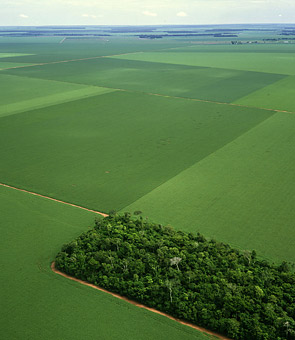
In “Killing You Softly“, Len Laycock presents another sinister side of soy based foam marketing:
“Pretending to offer a ‘soy based’ foam allows these corporations to cloak themselves in a green blanket and masquerade as environmentally responsible corporations when in practice they are not. By highlighting small petroleum savings, they conveniently distract the public from the fact that this product’s manufacture and use continues to threaten human health and poses serious disposal problems. Aside from replacing a small portion of petroleum polyols, the production of polyurethane based foams with soy added continues to rely heavily on ‘the workhorse of the polyurethane foam industry’, cancer causing toluene diisocyanate (TDI). So it remains ‘business as usual ‘ for polyurethane manufacturers.
Despite what polyurethane foam and furniture companies imply , soy foam is not biodegradable either. Buried in the footnotes on their website, Cargill quietly acknowledges that, “foams made with BiOH polyols are not more biodegradable than traditional petroleum-based cushioning”. Those ever so carefully phrased words are an admission that all polyurethane foams, with or without soy added, simply cannot biodegrade. And so they will languish in our garbage dumps, leach into our water, and find their way into the soft tissue of young children, contaminating and compromising life long after their intended use.
The current marketing of polyurethane foam and furniture made with ‘soy foam’ is merely a page out the tobacco industry’s current ‘greenwashing’ play book. Like a subliminal message, the polyurethane foam and furniture industries are using the soothing words and images of the environmental movement to distract people from the known negative health and environmental impacts of polyurethane foam manufacture, use and disposal.
Cigarettes that are organic (pesticide-free), completely biodegradable, and manufactured using renewable tobacco, still cause cancer and countless deaths. Polyurethane foam made with small amounts of soy derived materials still exposes human beings to toxic, carcinogenic materials, still relies on oil production, and still poisons life.
While bio-based technologies may offer promise for creating greener, cradle-to-cradle materials, tonight the only people sitting pretty or sleeping well on polyurethane foam that contains soy are the senior executives and shareholders of the companies benefiting from its sale. As for the rest of humankind and all the living things over which we have stewardship, we’ve been soy scammed!”
 OEcotextiles